


Yes, golden retrievers are smart. They rank fourth out of more than 130 breeds for working and obedience intelligence, trailing only Border Collies, Poodles, and German Shepherds. That ranking comes from how fast they learn commands and how reliably they follow them.
But intelligence isn’t just obedience—it’s also instinct, problem-solving, and social awareness. This article breaks down what dog intelligence really measures, how golden retrievers compare to other top breeds, and what you can do to keep your dog’s mind engaged.
How Experts Actually Measure Dog Intelligence
Dog intelligence isn’t measured the way human IQ is measured. There’s no test with multiple-choice questions or a score out of 100. Instead, researchers look at how quickly a dog learns new behaviors and how reliably it repeats them.
The most widely cited framework comes from psychologist Stanley Coren, whose research ranked breeds based on working and obedience intelligence—essentially, how fast a dog learns a new command and how often it obeys on the first try. Golden retrievers typically learn a new command in fewer than five repetitions and obey a known command over 95% of the time, according to Coren’s data.
It’s worth noting this method has limits. It measures trainability more than raw problem-solving ability, and it doesn’t fully capture creativity, memory, or emotional intelligence. A dog that struggles with obedience drills isn’t necessarily “dumb”—it might just be less motivated by the reward system used in testing.
Researchers also study cognition more directly, using tasks like hiding food behind barriers and timing how long it takes a dog to retrieve it. These studies consistently show that intelligence varies not just between breeds, but between individual dogs within the same breed—genetics, environment, and training all play a role.
The Three Types of Intelligence Golden Retrievers Show
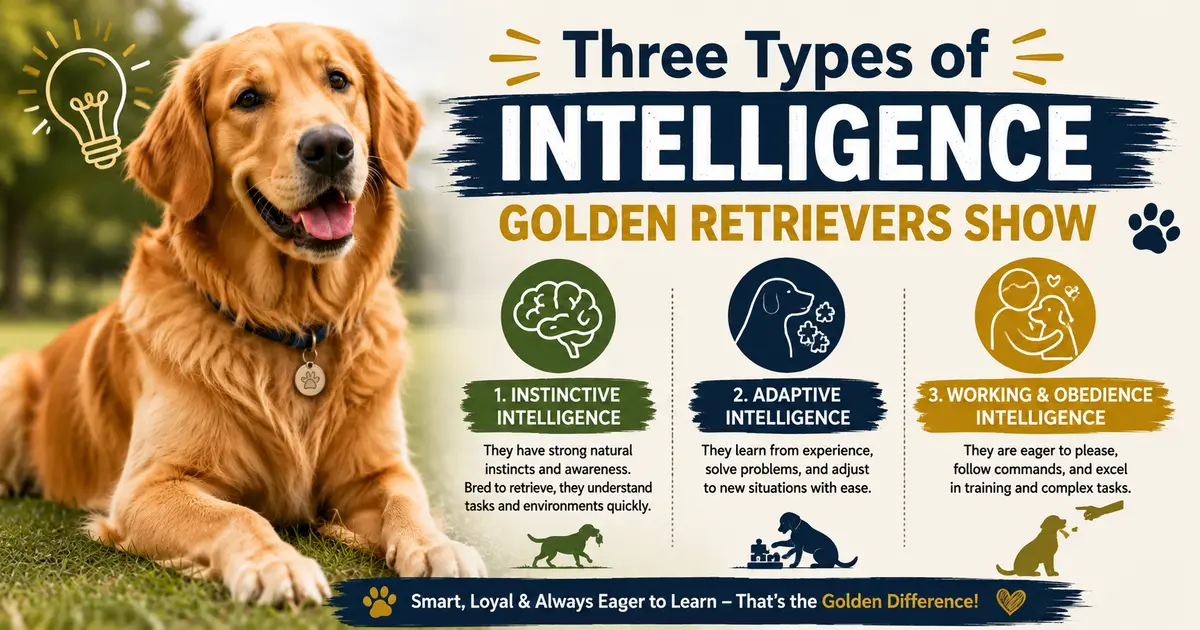
Coren’s research identifies three separate categories of canine intelligence. A golden retriever doesn’t score the same in all three, and understanding the difference helps explain why your dog might excel at some tasks and struggle with others.
Instinctive Intelligence
This is the intelligence a dog is born with—the abilities bred into it for a specific purpose. Golden retrievers were originally bred as gundogs to retrieve waterfowl for hunters, so tracking scents, carrying objects gently in their mouth, and swimming come naturally to them. You’ll see this instinct show up even in goldens that have never been near a hunting field, like a dog that instantly knows how to carry a stick or a toy without damaging it.
Adaptive Intelligence
This covers a dog’s ability to solve problems and learn from experience on its own, without direct instruction. It’s the kind of intelligence that lets a golden figure out how to open a door left slightly ajar or remember which cabinet holds the treats. Adaptive intelligence tends to vary more between individual dogs than the other two categories.
Working (and Obedience) Intelligence
This is what Coren’s breed rankings are based on—how quickly a dog learns commands from a person and how consistently it performs them. Golden retrievers score especially high here, which is a major reason they’re used so often in obedience training, service work, and competitive events.
How Golden Retrievers Compare to Other Smart Dog Breeds
Golden retrievers are smart, but they’re not the smartest breed by Coren’s ranking. Here’s how they stack up against other commonly compared breeds:
| Breed | Working/Obedience Rank | Known For |
| Border Collie | 1 | Fastest learners, high problem-solving drive |
| Poodle | 2 | Quick learner, strong adaptive intelligence |
| German Shepherd | 3 | High trainability, strong working drive |
| Golden Retriever | 4 | High obedience, eager learner, people-focused |
| Labrador Retriever | 7 | Similar temperament, slightly slower obedience learning |
So are golden retrievers as smart as German Shepherds? They’re close, but German Shepherds edge them out slightly in Coren’s working intelligence rankings. In practical terms, the difference is small—both breeds learn new commands in just a handful of repetitions.
Compared to Labradors, their closest relative in temperament, goldens generally rank a bit higher for obedience learning speed, though both breeds are considered highly trainable family dogs.
It’s worth remembering that breed rankings reflect averages. An individual, well-bred, well-socialized Labrador can easily out-learn an under-stimulated golden retriever. Genetics set the potential; training and environment determine how much of that potential gets used.
Smart or Just Eager to Please? The Truth About Trainability
This is where a lot of golden retriever content gets it wrong. People often assume goldens are easy to train because they’re highly intelligent. In reality, their trainability comes from two separate traits working together: genuine intelligence and an unusually strong desire to please their owner.
A golden retriever’s eagerness to please means it’s highly motivated to figure out what earns praise or a reward—and that motivation speeds up learning, even on tasks that aren’t especially complex. This is different from a breed like a Border Collie, which often learns fast out of pure problem-solving drive, with or without a person cheering it on.
In practice, this distinction rarely matters for everyday obedience training. But it does explain why goldens can struggle with independent problem-solving tasks that don’t involve pleasing a person, such as figuring out a food puzzle with no one watching. Their motivation is partly social, not purely intellectual.
This also means goldens generally respond best to positive reinforcement—reward-based training methods that reinforce good behavior instead of punishing mistakes. Harsh correction-based methods tend to work against their people-pleasing nature rather than with it.
Real-World Jobs That Show Golden Retriever Intelligence
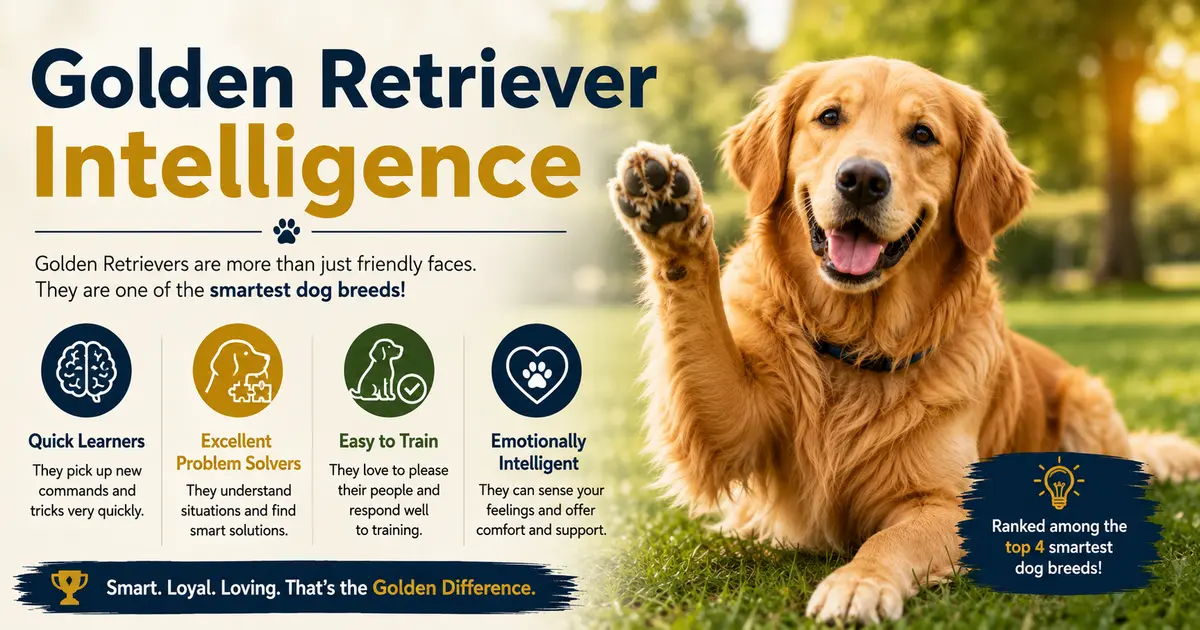
Golden retriever intelligence isn’t just theoretical—it shows up clearly in the jobs the breed has performed for over a century.
Retrieving and hunting. Goldens were bred in 19th-century Scotland to retrieve shot waterfowl from water and thick brush without damaging the bird. This job requires a soft mouth, strong scent-tracking ability, and the judgment to navigate difficult terrain while staying focused on the task—all signs of applied instinctive and working intelligence.
Guide work. Golden retrievers are commonly trained as guide dogs for people who are visually impaired. This role demands more than obedience; the dog has to assess real-time risks, like judging whether it’s safe to cross a street, while ignoring its own instincts to sniff around or greet strangers.
Search and rescue. Goldens are frequently used in search and rescue work because of their strong scenting ability and stamina. Staying locked onto a single scent trail across miles of unpredictable terrain takes sustained focus, not just a good nose.
Detection work. Some golden retrievers are trained to detect explosives or narcotics in security settings. This requires the dog to filter out irrelevant smells and reliably signal only the specific scent it’s trained to find—a task that depends heavily on working intelligence and consistency.
Learned tricks. On a lighter note, goldens are quick to pick up tricks like shaking paws, rolling over, or fetching specific named objects. These tricks demonstrate trainability more than raw problem-solving, but they’re still a visible, everyday sign of a fast learner.
Simple At-Home Tests to Gauge Your Golden’s Intelligence
You don’t need formal training to get a sense of how your golden retriever thinks. These simple, low-pressure exercises can give you a rough idea of your dog’s problem-solving and learning ability at home.
- The towel test. Drape a light towel over your dog’s head and time how long it takes to shake or paw it off. Quicker removal generally points to good adaptive problem-solving.
- The hidden treat test. Place a treat under one of three cups while your dog watches, then shuffle the cups. See if your dog remembers and checks the correct cup first.
- The new command test. Try teaching a simple, unfamiliar cue—like “spin” or “touch”—and count how many repetitions it takes before your dog responds correctly on its own.
- The barrier test. Place a favorite toy behind a low barrier, like a couch cushion, where your dog can see it but not reach it directly. Watch whether your dog looks for an alternate route instead of just pawing at the obstacle.
These aren’t scientific evaluations, and results can vary based on your dog’s mood, age, and how comfortable it is in the moment. Think of them as a fun way to observe your golden’s thinking style, not a formal measurement.
How to Keep Your Golden Retriever Mentally Sharp
Intelligence isn’t fixed—it needs regular use, especially in a breed built for active, purposeful work. Goldens that don’t get enough mental stimulation often channel that energy into unwanted behavior, like chewing, digging, or excessive barking.
Use positive reinforcement consistently. Reward-based training techniques—treats, praise, and play—tend to work better with goldens than correction-based methods, since they respond strongly to approval from their owner.
Rotate training and enrichment activities. Puzzle feeders, scent-based games, and short daily training sessions keep a golden’s mind engaged without requiring hours of effort. Even 10–15 minutes a day makes a noticeable difference.
Give their retrieving instinct an outlet. Structured fetch, dock diving, or scent work taps directly into a golden’s natural retrieving skills and instinctive intelligence, which helps prevent boredom-driven behavior.
Keep training sessions short and positive. Goldens learn best in short bursts—5 to 10 minutes—ending on a success rather than pushing until the dog loses focus.
Socialize early and often. Exposure to new people, environments, and situations as a puppy strengthens adaptive intelligence and builds a more confident, quicker-thinking adult dog.
If you’re working on foundational obedience, our guide to golden retriever training basics walks through age-appropriate commands and common training mistakes to avoid. And if you’re deciding between a working-line or show-line puppy, our comparison of field vs. show golden retrievers covers how trainability and energy levels can differ between the two.
FAQs About Golden Retriever Intelligence
Do golden retrievers get smarter with age?
Not exactly. Cognitive ability generally peaks in early adulthood and gradually declines in senior years, similar to humans. What improves with age is experience—older dogs often seem “smarter” because they’ve learned more cues and routines over time.
Are male or female golden retrievers smarter?
There’s no strong evidence that sex affects intelligence in golden retrievers. Differences in trainability between individual dogs are influenced far more by genetics, early socialization, and consistent training than by whether a dog is male or female.
Are golden retrievers hard to train despite being smart?
Not usually. Their combination of intelligence and eagerness to please makes them one of the more forgiving breeds for new dog owners, though their high energy can be a bigger training challenge than their learning ability.
Is a golden retriever smarter than a Labrador?
They’re close. Golden retrievers rank slightly higher in Coren’s obedience intelligence data, but the practical difference between the two breeds is minor, and individual variation matters more than breed averages.
Key Takeaway
Golden retrievers earn their reputation as a smart breed through a real combination of trainability, instinct, and a strong desire to work with people rather than against them. That intelligence isn’t automatic, though—it needs regular mental exercise through training, play, and enrichment to stay sharp. If you want to see it in action, start with a few short training sessions this week and build from there.
For more science-backed information on canine behavior and cognition, the American Veterinary Medical Association is a reliable resource for pet owners.

Hi, I’m Jack Austin, founder of Cool Goldens. I share practical, research-backed advice on training, nutrition, and daily care to help you give your Golden Retriever the happiest, healthiest life possible.