

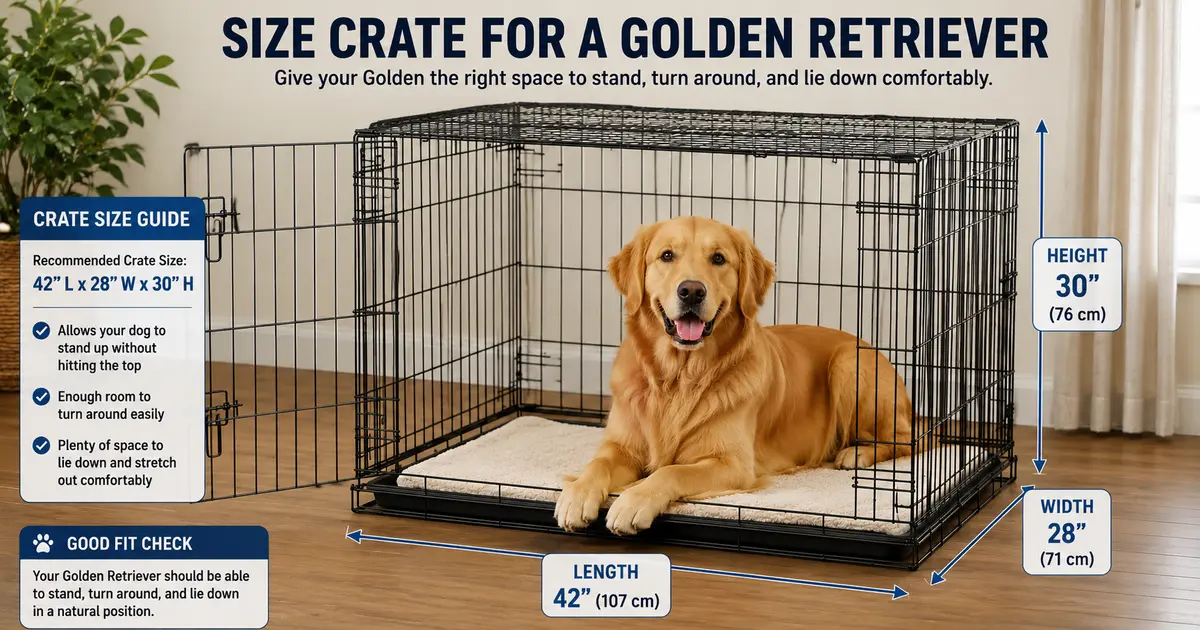
Most adult Golden Retrievers need a 42-inch crate. That’s the number most owners are searching for, and it holds true for a large share of the breed, though sex, build, and age all shift the exact fit.
This guide gives you the full size breakdown by age and weight, shows you how to measure your dog correctly in under five minutes, and covers the sizing mistakes that trip up even experienced owners. No guesswork, no generic ranges. Just the numbers you need to buy the right crate the first time.
What Size Crate for a Golden Retriever? (Quick Answer)
Adult Golden Retrievers typically need a 42-inch crate. This gives most dogs enough room to stand fully upright, turn around without bumping the walls, and lie down stretched out.
Smaller or leaner females sometimes do fine in a 36-inch crate, while larger males may need the extra depth a 42-inch model provides. Puppies need a much smaller space at first, sized up gradually as they grow.
The exact fit always comes down to your individual dog’s measurements, not just their breed. A quick measurement, covered in the next few sections, gives you a far more reliable answer than a general rule.
Golden Retriever Crate Size Chart by Age and Weight
Golden Retrievers grow fast in the first year, so their crate needs change more than owners expect. This chart gives a general starting point based on typical growth patterns for the breed.
| Age | Approximate Weight | Approximate Height | Recommended Crate Size |
| 8–12 weeks | 10–20 lbs | 10–13 inches | 24-inch (with divider) |
| 3–4 months | 20–35 lbs | 13–17 inches | 30-inch (with divider) |
| 5–6 months | 35–50 lbs | 17–20 inches | 36-inch (with divider) |
| 7–12 months | 50–65 lbs | 20–23 inches | 36 to 42-inch |
| Adult | 55–75 lbs | 21.5–24 inches | 42-inch (most dogs) |
These numbers are general guidelines, not exact rules. Golden Retrievers vary in size more than people realize, especially between the field-bred and show-bred lines, so always confirm the fit against your own dog’s measurements.
Also read Golden Retrievers Weigh
How to Read and Use This Chart
Match your dog’s current weight and age to the closest row, then check the crate size against your own measurements from the next section. If your dog is between two rows, size up rather than down.
For puppies, the “with divider” note matters most. A divider panel lets you buy one larger crate and adjust the usable space as your dog grows, instead of buying a new crate every few months.
How to Measure Your Golden Retriever for a Crate
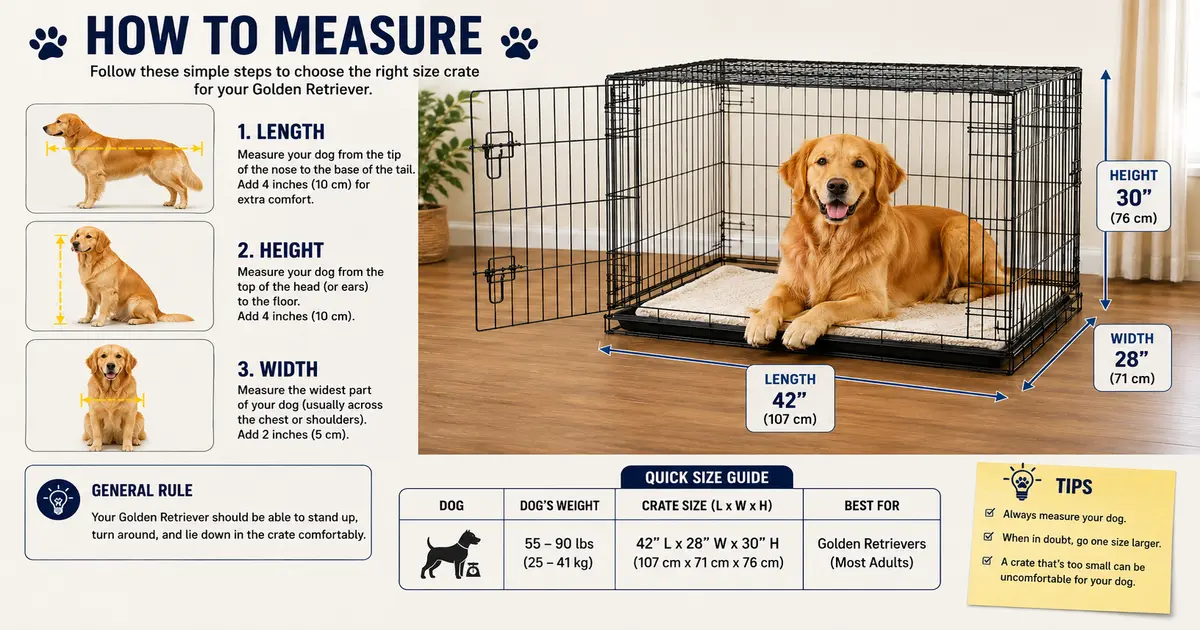
A weight chart gets you close, but a direct measurement gives you a size you can trust. This takes about five minutes and three simple steps.
Height: Have your dog stand naturally on all four legs. Measure from the floor to the top of their head or ears (whichever is taller), then add 4 inches for headroom.
Length: Measure from the tip of their nose to the base of their tail while they stand still. Add 4 inches so they can lie down fully stretched out without their nose or tail touching the crate walls.
Width: This one matters less for crate shopping since most crates come in standard width-to-length ratios, but check your dog can turn around without their shoulders brushing both sides.
A few measuring mistakes throw off the whole process. Measuring a puppy that’s still growing gives you a size that’s outdated within weeks. Measuring while the dog sits or lies down also underestimates their true standing height, which is the number that actually matters for crate comfort.
What Size Crate for a Golden Retriever Male vs. Female
Golden Retrievers have a noticeable size gap between males and females, and most crate size guides ignore it completely. According to the American Kennel Club breed standard, adult males typically stand 23 to 24 inches tall and weigh 65 to 75 pounds, while females run smaller at 21.5 to 22.5 inches and 55 to 65 pounds.
That gap is often enough to change which crate size fits best. A compact adult female may sit comfortably in a 36-inch crate with room to spare, while a large adult male usually needs the full 42 inches to stand and turn without restriction.
Sex is a useful starting point, but it’s not the final word. A tall, lean female can need more room than a short, stocky male. Always check the actual measurement against the chart rather than assuming sex alone decides the answer.
Also read Male vs Female Golden Retriever
Crate Size for a Growing Puppy: Divider or Multiple Crates?
Golden Retriever puppies grow so quickly that owners face a real choice: buy a series of smaller crates as the puppy grows, or buy one adult-size crate with a divider panel from the start.
Buying one crate with a divider usually costs less over time and means less hassle with returns or storage. You slide the divider panel back every few weeks as your puppy grows, keeping the usable space appropriately snug at each stage.
Buying multiple crates as your puppy grows can work better if you want a lighter, more portable crate for the early months, since a full 42-inch crate is heavy and awkward to move around a puppy-proofed space.
For most owners, the divider approach is the more practical and budget-friendly option. It also means one crate can follow your dog through their entire life, from an 8-week-old puppy to a fully grown adult.
Common Crate Sizing Mistakes and Misconceptions
A few sizing myths show up again and again in Golden Retriever forums and product reviews, and they lead owners to buy the wrong crate.
“Bigger is always more comfortable.” This isn’t true, especially for house training. A crate that’s too large gives a puppy enough space to potty in one corner and sleep in another, which slows down or completely undermines potty training.
“All crates labeled the same size are the same size.” Crate type affects usable interior space even when the label says otherwise. Soft-sided crates often run slightly smaller inside than a wire crate of the same labeled dimension, since the fabric walls flex inward. Wire crates tend to be the most size-consistent option across brands.
“A snug crate means the dog is uncomfortable.” A properly sized crate should feel snug, not spacious. Dogs are naturally drawn to den-like spaces, and a crate that’s just big enough to stand, turn, and stretch out in tends to feel more secure to them, not less.
Signs Your Crate Is the Wrong Size
A few quick checks tell you if your current crate fits:
- Your dog has to duck their head or crouch to stand up (too small)
- Your dog can’t turn around fully without hitting the walls (too small)
- Your dog consistently uses one end as a bathroom spot (likely too big)
- Your dog seems anxious or resistant to entering (could be either, but check size first)
Choosing the Right Crate Size for Travel and Flying
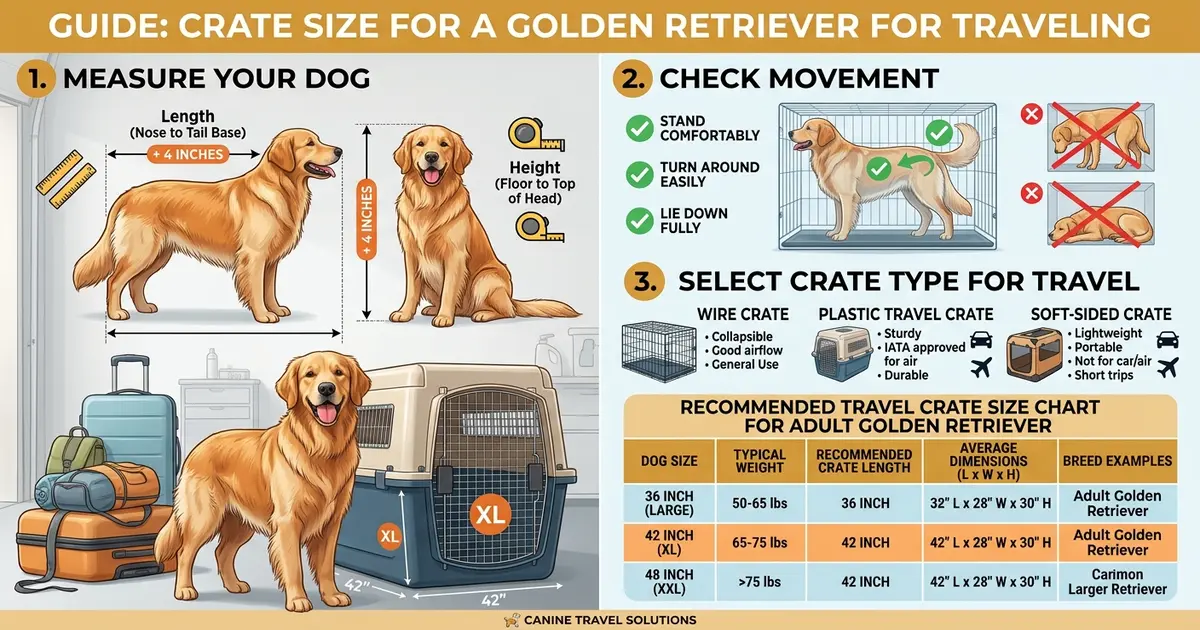
Travel crates follow different rules than the crate you use at home, especially if you’re flying with your Golden Retriever. Airlines that accept pets in cargo generally require an airline-approved hard-sided or plastic crate, not the wire crate used for everyday training.
The general rule for airline travel is that your dog must be able to stand up, turn around, and lie down naturally inside the crate, similar to the standard for home crates. Most adult Golden Retrievers need a large or extra-large hard-sided travel crate to meet this requirement.
Airline size and weight rules vary by carrier and can change, so it’s worth confirming directly with your airline before booking travel with your dog. The U.S. Department of Transportation and individual airline pet policies are the most reliable sources for current requirements.
Frequently Asked Questions
Do Golden Retrievers need a bigger crate than other breeds their size?
Not necessarily. Crate size depends on your individual dog’s measurements, not their breed name. A Golden Retriever and any other breed of similar height and weight need roughly the same size crate.
What size crate for a Golden Retriever mix?
It depends entirely on the mix and the individual dog’s adult size. Measure your dog directly rather than relying on breed averages, since mixed breeds can vary widely even within the same litter.
Can two Golden Retrievers share one crate?
This isn’t recommended for regular use. Crates work best as an individual, secure space for one dog, and sharing can create stress, resource guarding, or reduce the training benefits for both dogs.
Is a 48-inch crate too big for a Golden Retriever?
It can be, especially for potty training a puppy. A 48-inch crate suits very large adult males in some cases, but most Golden Retrievers are comfortable in a 42-inch crate with room to spare.
Conclusion
Most adult Golden Retrievers do best in a 42-inch crate, though your dog’s actual measurements, sex, and age matter more than any general rule. Measure your dog directly, check that measurement against the size chart, and size up gradually if you’re starting with a puppy.
If you haven’t measured your dog yet, do that first before buying anything. It takes five minutes and saves you from returning a crate that turns out to be the wrong fit.

Hi, I’m Jack Austin, founder of Cool Goldens. I share practical, research-backed advice on training, nutrition, and daily care to help you give your Golden Retriever the happiest, healthiest life possible.