


Adult male Golden Retrievers weigh 65 to 75 pounds. Adult females weigh 55 to 65 pounds. That’s the short answer, based on the American Kennel Club’s official breed standard.
But weight isn’t static, and it isn’t the same for every dog. Puppies gain rapidly in the first six months, growth rates shift by sex and breeding line, and the number on the scale only tells part of the health story. This guide covers the full weight range by age and sex, what actually drives those numbers, and how to check if your dog’s weight is genuinely healthy — not just close to average.
“Golden Retriever weight calculator”, “check if your puppy is a healthy weight”
How Much Do Golden Retrievers Weigh?
A healthy adult Golden Retriever weighs between 55 and 75 pounds, depending on sex and build. Males generally sit at the higher end of that range, while females tend to be lighter and more compact.
These figures reflect the AKC breed standard, which is based on decades of observation across the breed. Think of them as a guide, not a strict rule. A dog a few pounds outside this range isn’t automatically unhealthy — body condition matters more than the number itself, a point we’ll cover in detail later in this guide.
Adult Golden Retriever Weight: Male vs. Female
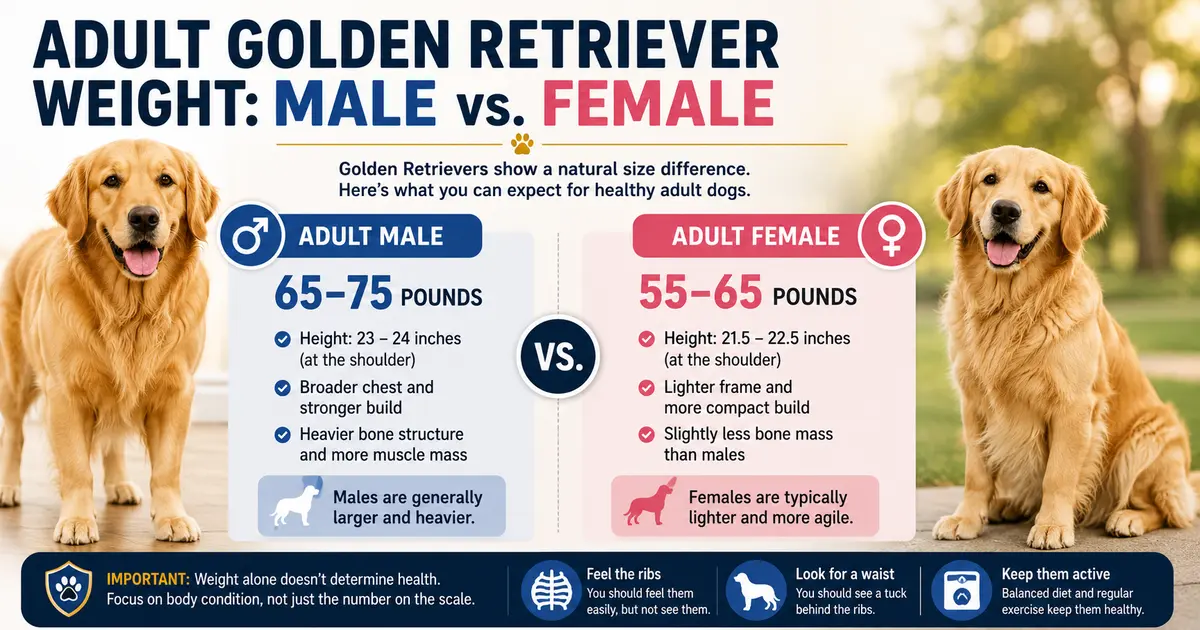
Golden Retrievers show a clear size difference between males and females, similar to many medium and large dog breeds. Males are built heavier through the chest and shoulders, which adds several pounds compared to females of the same height.
Average Weight for Male Golden Retrievers
Adult males typically weigh 65 to 75 pounds and stand 23 to 24 inches tall at the shoulder. Their frame is broader, with a deeper chest that supports the breed’s original job of carrying waterfowl through cold water.
Average Weight for Female Golden Retrievers
Adult females usually weigh 55 to 65 pounds and stand 21.5 to 22.5 inches tall. They’re proportionally similar to males but lighter overall, with a leaner build through the shoulders and hindquarters.
Neither weight is “better” than the other — the difference simply reflects normal sexual dimorphism in the breed. A well-proportioned 58-pound female is just as healthy as a well-proportioned 70-pound male.
Golden Retriever Puppy Weight Chart by Age (8 Weeks to 12 Months)
Puppy growth happens fast, especially in the first six months. The table below shows typical weight ranges by age. Remember these are averages — some puppies grow a little faster or slower without any cause for concern.
| Age | Male Weight | Female Weight |
| 8 weeks | 6–10 lb. | 5–9 lb. |
| 3 months | 20–25 lb. | 15–20 lb. |
| 4 months | 25–30 lb. | 20–25 lb. |
| 5 months | 35–40 lb. | 25–30 lb. |
| 6 months | 35–45 lb. | 30–35 lb. |
| 8 months | 45–55 lb. | 35–45 lb. |
| 10 months | 55–65 lb. | 45–55 lb. |
| 12 months | 60–70 lb. | 50–60 lb. |
A few things stand out in this chart. Growth speeds up sharply between 3 and 6 months, then slows down as the puppy approaches its first birthday. By 12 months, most Golden Retrievers are close to their adult weight, even though they still have some filling out to do.
If your puppy’s weight is consistently far outside these ranges — not just once, but over several weigh-ins — it’s worth a conversation with your veterinarian. Growth patterns can vary, but big, sustained gaps are worth checking.
When Do Golden Retrievers Stop Growing?
Most Golden Retrievers reach their adult height by around 12 to 18 months old. Weight is a different story — many dogs continue to gain muscle and fill out their chest until they’re close to 2 years old.
This is a detail a lot of owners miss. A 1-year-old Golden Retriever might already look full grown, but they’re often still 5 to 10 pounds away from their final adult weight. The chest and shoulders are usually the last areas to finish developing.
Smaller, lighter-boned dogs sometimes finish growing a bit earlier than larger, heavier-boned ones. If you’re unsure whether your dog has reached full maturity, your vet can often tell by checking growth plates on an X-ray, though this isn’t something most owners need to do routinely.
What Affects a Golden Retriever’s Adult Weight
Genetics plays the biggest role in determining how big your dog will get. Puppies tend to land somewhere between the size of their two parents, which is why reputable breeders can usually give you a realistic estimate based on the litter’s parents.
Diet during puppyhood matters too. Large-breed puppy food is formulated to control growth rate, not just speed it up. Feeding an adult formula or overfeeding a puppy can cause them to grow too fast, which puts extra strain on developing joints and raises the risk of hip dysplasia later in life.
Spaying or neutering timing has a measurable effect as well. Dogs fixed before growth plates close sometimes end up slightly taller or leaner than they would have otherwise, because the hormones involved in bone growth are removed earlier. This effect is well documented in veterinary research, though it varies by individual dog.
Activity level and overall health round out the list. A Golden Retriever that gets regular exercise and eats a balanced diet is more likely to reach a healthy adult weight than one that’s inactive or overfed.
Field-Bred vs. Show-Bred Golden Retrievers: Weight Differences

Not all Golden Retrievers are built the same way, and the difference often comes down to breeding line. Show-bred Goldens, the type most people picture, tend to have a heavier, more solid build with more coat.
Field-bred Golden Retrievers, sometimes called “working line,” are usually leaner and lighter, built for stamina rather than bulk. A field-bred male might weigh closer to 55 to 65 pounds, noticeably lighter than a show-line male at 65 to 75 pounds, even at the same height.
If you’re comparing your dog’s weight to a chart and it seems off, checking which line they come from can explain a lot. For a full breakdown of how these two types differ in build, temperament, and exercise needs, see our guide on field vs. show Golden Retrievers.
How to Tell If Your Golden Retriever Is at a Healthy Weight
A number on a scale only tells part of the story. Body condition — how your dog actually looks and feels — is the better indicator of whether they’re at a healthy weight.
Here’s a simple check you can do at home:
- Rib check: Run your hands along your dog’s sides. You should be able to feel the ribs easily, without heavy pressure, but they shouldn’t be visibly sticking out.
- Waist check: Looking down from above, your dog should have a visible waist behind the ribs, not a straight or bulging line.
- Side profile check: From the side, the belly should tuck up slightly behind the ribcage, rather than hanging level with the chest.
If you can’t feel the ribs at all, or there’s no visible waist, your dog is likely carrying extra weight. If the ribs, spine, or hip bones are easily visible from a distance, your dog may be underweight. Either situation is worth discussing with your veterinarian, since both extremes can affect joint health and energy levels.
Weighing your dog doesn’t require a trip to the vet. Step on a bathroom scale alone, note the number, then pick up your dog and weigh both of you together. Subtract your weight from the total for a reasonably accurate estimate.
Common Myths About Golden Retriever Weight
A few misconceptions come up often enough that they’re worth addressing directly.
“Bigger is always healthier.” This isn’t true. Oversized Golden Retrievers face higher rates of joint problems and shorter average lifespans. Hitting the standard weight range is a better goal than exceeding it.
“Big paws mean a big adult dog.” Large paws relative to body size are a normal sign of a puppy still growing, not a reliable predictor of final adult size. They’re a rough clue at best, not a measurement tool.
“Every Golden Retriever should match the AKC standard weight.” The breed standard describes an ideal, not a hard requirement. Field-bred lines, mixed heritage, and individual variation all mean plenty of healthy Golden Retrievers fall outside the standard range.
“Weight gain in older dogs is just old age.” Sudden or steady weight gain in a senior Golden Retriever is often linked to reduced activity or a slowing metabolism, but it can also signal a health issue like hypothyroidism. It’s worth mentioning to your vet rather than assuming it’s normal aging.
FAQs About Golden Retriever Weight
Do Golden Retrievers gain or lose weight as seniors?
Many senior Golden Retrievers lose muscle mass while gaining fat, which can keep the number on the scale steady even as body composition changes. Reduced activity and a slower metabolism are common causes, though sudden changes should be checked by a vet.
What’s the heaviest a Golden Retriever can healthily get?
Most healthy adult males top out around 75 pounds. Dogs significantly heavier than this, without a large frame to match, are usually carrying excess weight rather than healthy mass.
How much should an 8-week-old Golden Retriever puppy weigh?
Most 8-week-old puppies weigh between 5 and 10 pounds, with males typically a bit heavier than females. Litter size and parent size both influence this starting weight.
Is it normal for my Golden Retriever’s weight to plateau around one year?
Yes. Growth slows significantly after 12 months, even though many dogs continue filling out their chest and frame until closer to age 2.
Golden Retriever weight follows a fairly predictable pattern, but every dog is a little different. Use the charts here as a general guide, pay closer attention to body condition than the exact number on a scale, and check in with your veterinarian if something seems off. For more on this breed’s growth stages, our guide to Golden Retriever growth timelines breaks down each developmental phase in more detail.

Hi, I’m Jack Austin, founder of Cool Goldens. I share practical, research-backed advice on training, nutrition, and daily care to help you give your Golden Retriever the happiest, healthiest life possible.