

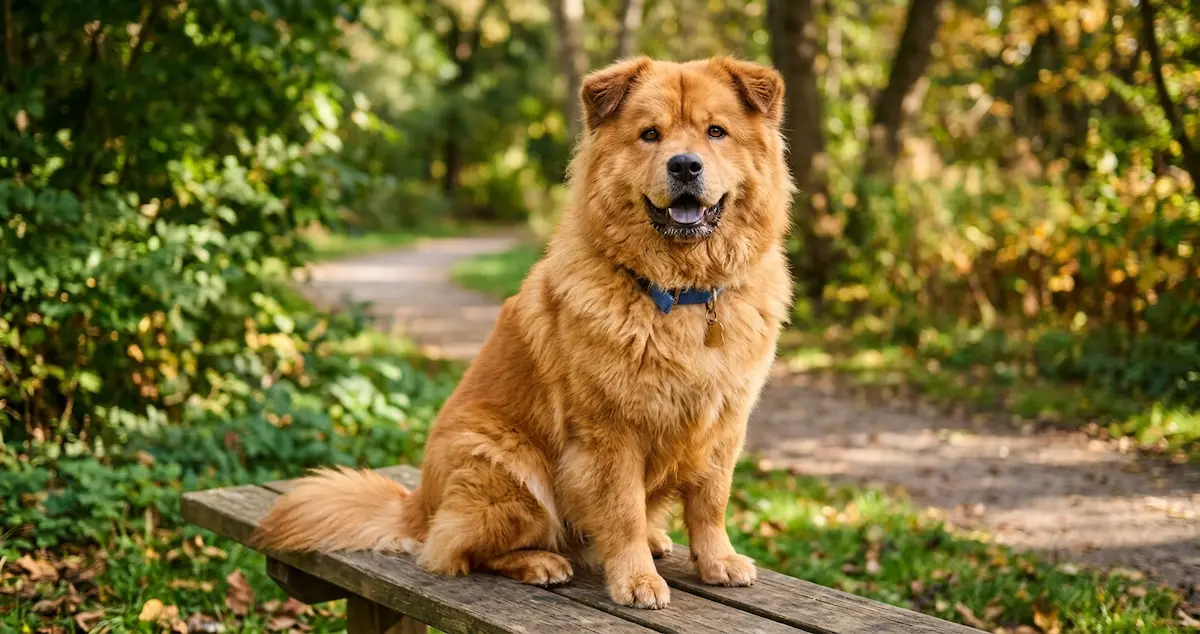
Half sunshine, half stubborn: that is the Golden Chow in a sentence. A chow and golden retriever mix is a crossbreed that usually grows into a fluffy, medium-to-large, loyal dog, either friendly like a Golden or reserved like a Chow. Most fall somewhere in between.
No two dogs from this cross turn out the same. One puppy may greet every visitor with a wagging tail, while its littermate watches guests from across the room. This guide covers size, looks, temperament, training, grooming, health, cost, and who this dog suits best, so you can decide with realistic expectations.
Golden Chow at a Glance
A Golden Chow is a crossbreed of a Golden Retriever and a Chow Chow. Most adults weigh roughly 45 to 75 pounds, carry a thick double coat, and live about 10 to 12 years. Temperament ranges from outgoing and eager to reserved and protective. No major kennel club recognizes the mix as its own breed.
| Trait | Typical range |
| Weight | About 45 to 75 pounds |
| Height | About 18 to 24 inches at the shoulder |
| Coat | Thick double coat, short to long |
| Shedding | Heavy, with seasonal peaks |
| Energy | Moderate, about an hour of activity daily |
| Lifespan | Roughly 10 to 12 years (an estimate) |
| Temperament | Loyal and affectionate, but can be wary of strangers |
| First-time owners | Possible, but a stubborn streak makes it harder |
These numbers come from combining the parent breeds’ standard ranges. An individual puppy can land outside them, so treat the table as a rough guide rather than a promise.
Where the Mix Comes From
Nobody has documented when or where the first Golden Chow appeared. Breeders and accidental litters have produced these dogs for years, and there is no breed standard, registry, or agreed-upon origin story. The term “designer mix” simply means two purebred parents were bred together on purpose.
You will see several names for the cross, including Golden Chow, Chow Golden mix, and Golden Chow Retriever. They all describe the same idea.
The parents’ history matters less than the parents’ traits. Golden Retrievers were developed in Scotland in the 1800s to retrieve waterfowl for hunters, which explains their gentle mouths and eagerness to please. Chow Chows are an ancient Chinese breed, used for guarding and work, which explains their independence and reserve.
It also matters whether the litter is a first-generation cross or the result of breeding mixed dogs together. First-generation puppies tend to split the difference more evenly. Later generations can swing much further toward one side.
aslo read Where Did English Cream Golden Retrievers Originate
Golden Retriever vs. Chow Chow: Side-by-Side Comparison
Looking at the two parents together shows why the mix can vary so much. They differ in size, energy, and how they treat strangers.
| Feature | Golden Retriever | Chow Chow |
| Height | About 21.5 to 24 inches | About 17 to 20 inches |
| Weight | About 55 to 75 pounds | About 45 to 70 pounds |
| Lifespan | About 10 to 12 years | About 8 to 12 years |
| Temperament | Friendly, eager, social | Aloof, independent, loyal |
| Coat | Dense, water-repellent double coat | Very dense double coat, often with a mane |
| Energy | High | Moderate |
| Trainability | High | Lower, more independent |
| Shedding | Heavy | Heavy, with seasonal blowouts |
| Common health risks | Hip and elbow dysplasia, cancers, heart and eye conditions | Hip and elbow dysplasia, entropion, joint problems |
These figures are typical breed-club ranges, and individual dogs vary.
Size and Growth: What a Puppy Becomes
Since both parents are medium to large, the adult is usually a sturdy, well-built dog. A Golden-leaning puppy may end up taller and leaner, while a Chow-leaning puppy is often stockier with a broader chest. Females tend to finish smaller than males, as they do in both parent breeds.
Growth follows a fairly predictable pattern for a dog this size, though the timing differs from puppy to puppy. These stages are estimates only.
| Age | What to expect |
| 8 to 12 weeks | A small, fluffy, teddy-bear-like puppy with oversized paws |
| 3 to 6 months | Fast growth, with legs and body lengthening quickly |
| 6 to 9 months | Height nears its final range, though the body still looks lanky |
| 9 to 12 months | Most of the height is set, and the coat thickens |
| 12 to 24 months | The chest and body fill out, and the dog reaches full maturity |
Puppies of this cross often look like plush toys, with round faces and thick fur. That cuteness hides how much dog is coming. Large paws are a hint, though not a reliable predictor, of a bigger adult.
Many vets suggest feeding a large-breed puppy formula and avoiding forced, high-impact exercise during growth. Your vet can check your puppy’s growth curve at each visit.
Looks and Coat: Colors, Fur Types, and the Tongue
The coat is where this mix gets creative. Coats can be short, medium, or long, and many dogs show the thick ruff around the neck that Chows are known for. Some look more like a fluffy Golden with a broader head, while others resemble a slimmed-down Chow with softer features.
Colors depend on the parents. Golden Retrievers range from pale cream to deep gold, while Chow Chows come in red, black, blue, cinnamon, and cream. A Golden Chow can be solid gold, red, cream, or black, and some carry patches or shading of two colors. Black and red coats appear often in photos of the mix, though neither is guaranteed.
Then there is the tongue. Chow Chows are famous for a blue-black tongue, and some of their mixes show full or spotted dark coloring. Others have a plain pink tongue like a Golden. Since the trait comes from the Chow side and genes shuffle unpredictably, you cannot count on it.
Faces vary as well. Ears may fold forward like a Golden’s or sit smaller and more upright like a Chow’s, and the muzzle can be medium length or a bit shorter.
Temperament and Personality
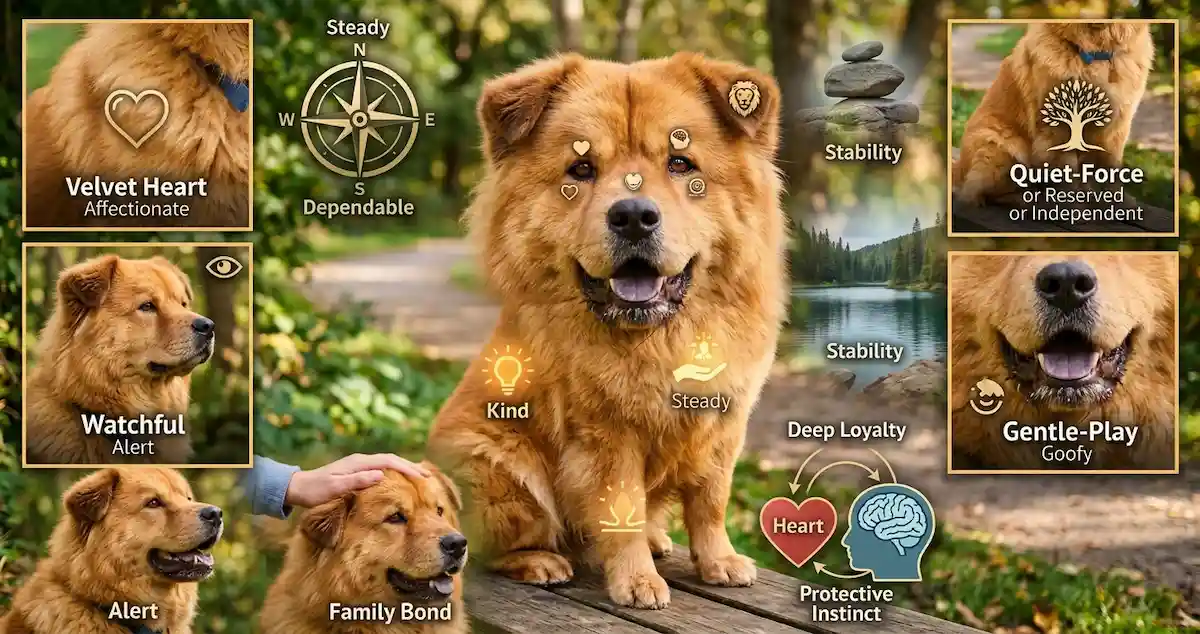
The two parents pull in different directions. Golden Retrievers greet almost everyone with enthusiasm and love to please. Chow Chows are dignified and loyal to their own people, and they often prefer to size up newcomers before warming up.
Most Golden Chows end up affectionate with their family and more careful with outsiders. Owners often describe them as cat-like: independent, sometimes aloof, and affectionate on their own schedule. Many also describe a goofy side that shows up at home.
This is the reason that personality is the hardest part of the mix to predict. Genes are only part of the story. A large 2022 study in Science, which drew on data from thousands of dogs, found that breed explains only a small share of behavior differences between individual dogs. Early experiences, training, and each dog’s own makeup carry a lot of weight. The research section below covers this in more detail.
Golden-Leaning, Chow-Leaning, or Blended: The Temperament Spectrum
Think of temperament as a dial rather than a switch. Puppies tend to fall into one of three broad groups, and you can often spot early clues.
- Golden-leaning: Approaches new people and dogs with a wagging body, follows you from room to room, and picks up commands quickly.
- Chow-leaning: Watches strangers before approaching, tolerates rather than seeks out petting, and goes its own way during training.
- Blended: Friendly at home, cautious in new places, and eager to learn when treats are involved.
Puppy behavior at eight weeks is only a hint, and it can shift with age and experience. Meeting the parents, when possible, gives a much better preview.
Behavior With Kids, Strangers, and Other Pets
Many Golden Chows do well with children they grow up with, and owners often describe them as gentle with kids in the family. Still, size and a Chow’s dislike of rough handling mean supervision matters. Teach children to leave the dog alone while it eats or sleeps, and never allow ear or tail pulling.
With strangers, expect some caution. Guests may need to let the dog approach on its own terms. Around other dogs, early and repeated positive meetings help. Small pets like cats can work out fine if introduced early, but the prey drive some of these dogs show means small animals need careful management.
Protectiveness, Reactivity, and Aggression: What Is Normal
Some Golden Chows bark at people passing the house, guard their yard, or pull hard toward other dogs on walks. That is common for a mix with Chow ancestry, since Chows were bred partly as guardians. Barking and watchfulness are normal. Lunging, snapping, or guarding food and toys are not something to shrug off.
Reactivity, which means strong reactions such as barking and lunging at triggers, often comes from fear or poor early exposure rather than a mean nature. Dogs that had little contact with new people or dogs as puppies are more likely to react.
Prey drive is another factor. Some of these dogs chase squirrels, rabbits, and other small animals, so a secure fence and a leash in open areas make sense.
Certain signs call for a professional. Growling or snapping without warning, a sudden change in behavior, or aggression toward family members deserves a visit to a vet, since pain and illness can cause it. If the vet finds nothing, a certified trainer or veterinary behaviorist can help.
Aggression is a possibility to manage, not a guarantee. Most well-socialized dogs of this cross never become dangerous.
Is a Golden Chow a Good Family Dog?
Yes, for the right family. A Golden Chow can be a loyal, affectionate companion, but it asks for more effort than a typical Golden Retriever. Socialization, consistent training, and daily grooming are part of the deal.
Owner reviews on breed-profile sites include glowing praise and honest warnings, and both are worth reading. The difference usually comes down to the individual dog and how much preparation the family put in.
Who This Mix Suits Best
- Households with a fenced yard and time for daily walks
- Owners who are patient and consistent with training
- Families with older, dog-savvy children
- People who do not mind fur on furniture and clothes
- Owners willing to invest in early socialization classes
- Those who enjoy an independent, loyal dog over a clingy one
Who Should Think Twice
- First-time owners who want an easy, automatic-obedience dog
- Homes with toddlers or frequent unsupervised visits from children
- People who travel often or leave a dog alone for long hours
- Apartment dwellers without easy access to outdoor space
- Anyone who wants a dog that greets every stranger warmly
- Those living in very hot climates without air conditioning or shade
Training and Socialization
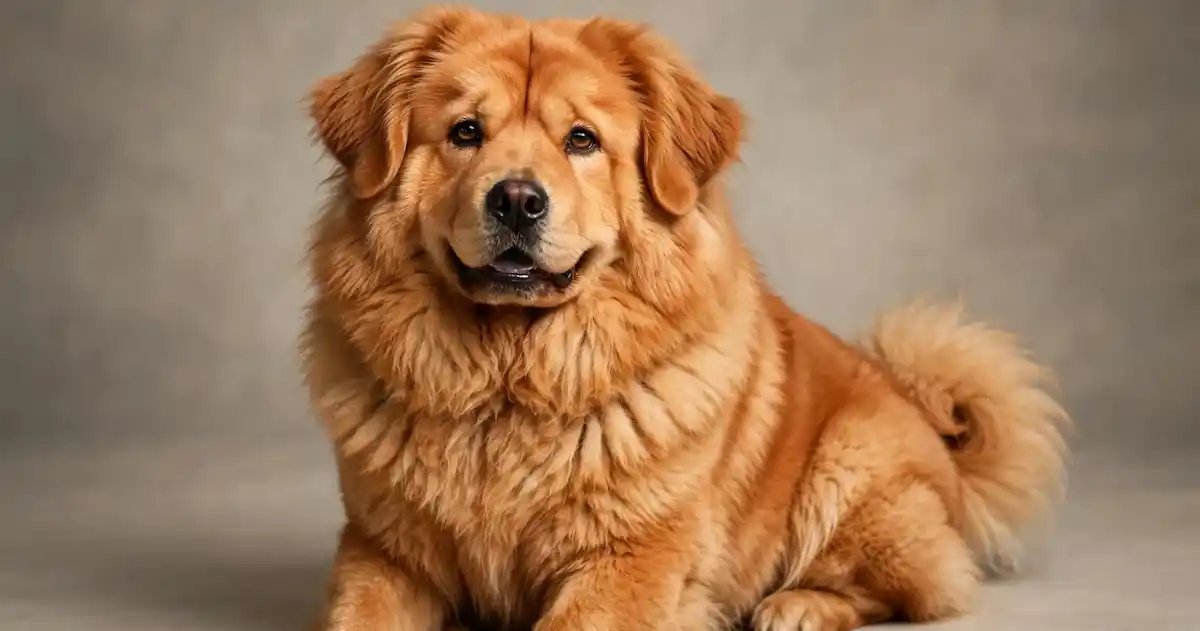
Early socialization matters more for this mix than for a typical Golden Retriever. A puppy that meets many people, places, sounds, and calm dogs during the first few months is far more likely to grow into a relaxed adult. A puppy raised in a quiet home with few visitors may become suspicious of anything new.
Training works best when it is early, short, and rewarding. Basic obedience, including sit, stay, come, and loose-leash walking, should start as soon as the puppy settles in. Handling practice matters too. Touch the paws, ears, mouth, and coat gently every day so grooming and vet visits feel routine.
A Socialization Timeline
Timing is approximate, and your vet can advise on vaccinations before your puppy visits public areas.
- 8 to 12 weeks: Meet a variety of calm people at home, hear household sounds, and practice gentle handling. Attend a puppy class once your vet approves.
- 3 to 4 months: Widen exposure to new places, surfaces, cars, and friendly, vaccinated dogs. Keep every experience positive and short.
- 4 to 6 months: Continue outings, and practice leash manners around distractions. Watch for fear and back up if the puppy looks overwhelmed.
- 6 to 12 months: Keep meeting new people and dogs regularly. Adolescence can bring wariness, so avoid dropping socialization at this stage.
Training Tips for a Stubborn Streak
Many owners describe their Golden Chows as smart but stubborn, especially those leaning toward the Chow side. Harsh methods often backfire. Reward-based training, which uses treats, praise, and play, is the approach recommended by veterinary behavior groups, and it tends to work well with this mix.
Keep sessions to five or ten minutes so the dog stays interested. Use high-value treats when teaching something new. Be consistent, because a dog that gets away with ignoring a command once will try again. If progress stalls, a group class or a private trainer can help, and it also gives the dog more social practice.
Exercise and Heat Tolerance
Most adult Golden Chows need about an hour of activity a day, though the Golden-leaning ones may want more. Split it into a couple of walks plus playtime. Many enjoy fetch and swimming, and puzzle toys or short training games tire the mind as well as the body.
Puppies need shorter, gentler sessions, and many vets advise avoiding long runs and repeated jumping while the bones are still growing. Seniors slow down and may prefer shorter, more frequent walks.
Heat deserves serious attention. The thick double coat holds warmth, and Chows in particular are known to struggle in hot weather.
- Exercise early in the morning or after sunset.
- Provide shade and fresh water at all times.
- Give the dog a cool indoor space, such as tile flooring, with a fan or air conditioning.
- Test pavement with your hand before a walk, because hot ground can burn paws.
- Never leave the dog in a parked car.
Heavy panting, drooling, weakness, or vomiting can signal heatstroke. Move the dog to a cool place and call a vet right away.
Grooming and Shedding
Expect a lot of hair. Both parents shed year-round, and the coat tends to release in large clumps once or twice a year during seasonal shedding, often called a coat blow. During those weeks, daily brushing keeps loose fur from covering your floors and forming mats.
A dog with a thick double coat also traps dirt and moisture close to the skin. Regular grooming lets you catch skin problems, hot spots, and parasites early.
A Simple Grooming Routine
A steady schedule keeps the work manageable.
- Brushing: A few times a week most of the year, daily during heavy shedding. A pin brush, a slicker brush, and an undercoat rake handle most coats.
- Bathing: About every six to eight weeks, or when the dog is dirty. Dry the coat completely to prevent skin irritation.
- Nails: Trim every few weeks.
- Ears: Check weekly for redness, odor, or buildup.
- Teeth: Brush several times a week, and ask your vet about dental care.
Why Some Groomers Refuse Chow Chows
Some groomers decline Chow Chows, and the mix can get caught in the same policy. A few reasons come up often. The dense coat takes long to dry and mats easily, which makes the job long and physically demanding. Some Chows dislike being restrained or handled and may react defensively, and groomers have to weigh safety.
Policies vary by shop, so a refusal does not always mean your dog is a problem. To improve your chances, tell the groomer about the mix and any handling sensitivities when you book. Start with short sessions, practice handling at home, and ask whether the shop has experience with thick-coated or nervous dogs.
Feeding Guidelines
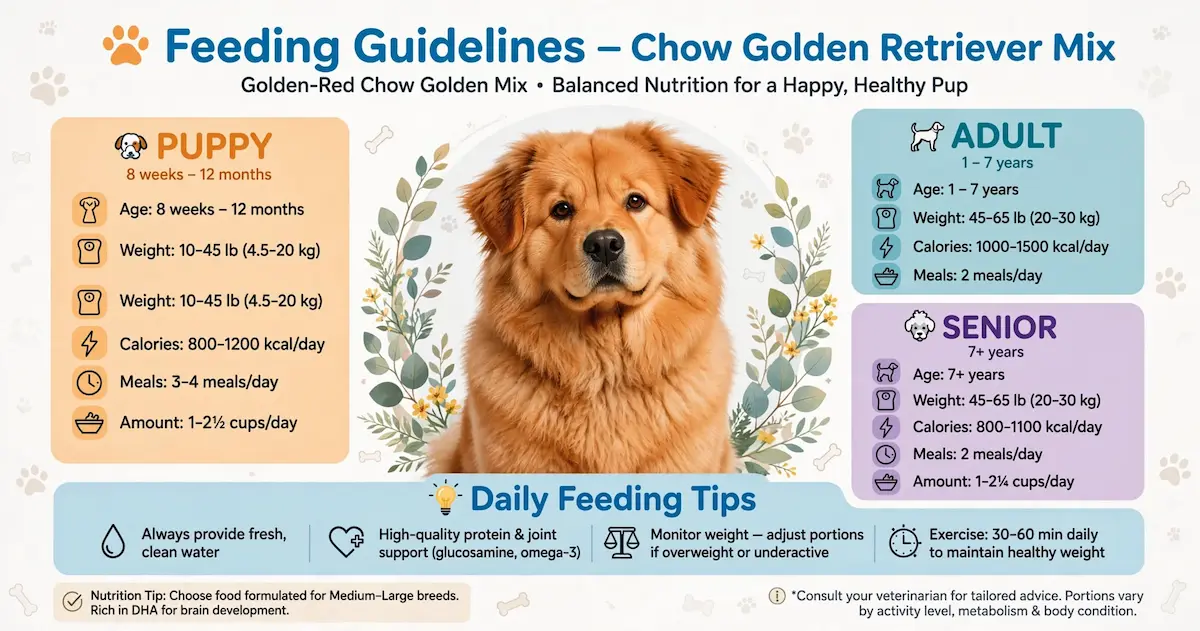
Feed a high-quality dog food that fits your dog’s life stage. Puppies of large breeds do better on a large-breed puppy formula, which is balanced to support steady growth. Adults do well on a complete adult food, and seniors may need a formula suited to slower metabolism.
Portion sizes depend on the food, the dog’s weight, and its activity level. Use the feeding guide on the bag as a starting point, then adjust based on body condition. You should be able to feel the ribs under a thin layer of fat. Your vet can recommend an exact amount.
Weight control is important. Golden Retrievers are known for loving food, and extra weight adds stress to hips and elbows. Measure meals, limit treats, and count training rewards as part of daily food.
Split the daily amount into two meals. Fresh water should be available at all times, especially in warm weather. If you want to change foods, switch gradually over about a week to avoid stomach upset.
Common Health Issues and Lifespan
Mixed dogs inherit health risks from both sides, and the risks are not always lower than in purebreds. Your dog will not necessarily get any of these conditions, but knowing them helps you watch for early signs.
| Concern | Parent breed most linked | What it involves |
| Hip and elbow dysplasia | Both | Poor joint fit that can cause pain and arthritis |
| Entropion | Chow Chow | Eyelids that roll inward and irritate the eye |
| Eye conditions | Both | Cataracts and other eye disorders |
| Skin allergies | Golden Retriever | Itching, ear infections, and hot spots |
| Hypothyroidism | Both | Low thyroid hormone, causing weight gain and coat changes |
| Cancer | Golden Retriever | A leading cause of death in Goldens |
| Heart disease | Golden Retriever | Including some inherited heart conditions |
This table is general information and not veterinary advice. Regular checkups are the best way to catch problems early.
How Long Do They Live?
The Golden Retriever typically lives about 10 to 12 years, and the Chow Chow about 8 to 12 years. Since those ranges overlap around 10 to 12, many people use that as a rough guide for the mix.
An average lifespan cannot predict a single dog’s future. Genetics, weight, diet, exercise, and veterinary care all play a part. A lean dog that gets regular checkups often lives longer than one that is overweight. Some Golden Chows live well beyond the average, and others face health problems sooner.
Health Screening Checklist for Buyers
If you buy from a breeder, ask for proof rather than promises.
- Hip and elbow clearances for both parents, ideally through the Orthopedic Foundation for Animals (OFA)
- Eye examination results for both parents
- Heart screening for the Golden Retriever parent
- Vet records and vaccination history for the puppy
- Details about how long the litter stayed with the mother
- A written health guarantee and a return policy
What the Research Says About Mixed Breeds
Science does not back many popular beliefs about crossbreeds, and it helps to know what studies actually found.
Breed and behavior. A Science study on ancestry-inclusive dog genomics (Morrill et al., 2022) analyzed data from thousands of dogs and found that breed explains only about 9 percent of behavioral differences between individual dogs. Some traits, such as how easily a dog is trained, showed a stronger link to breed than others. For a Golden Chow, that means the parents offer clues, not certainty.
Mixed breed and inherited disease. A JAVMA study of inherited disorders in mixed-breed and purebred dogs (Bellumori et al., 2013) reviewed more than 27,000 cases at a veterinary teaching hospital. Of 24 genetic disorders studied, 13 were more common in purebreds, one was more common in mixed-breed dogs, and the rest showed no clear difference. So mixed dogs are not automatically healthier, though they can avoid some breed-specific problems.
Joint health data. The Orthopedic Foundation for Animals keeps public databases on hip and elbow dysplasia, and both parent breeds appear in them. Checking parents’ results is one of the few practical steps that lowers the risk.
Common Myths About Chow Mixes
“Chow mixes are always aggressive.” Some Chows are protective and wary, but many mixes are gentle. Socialization and training shape the outcome as much as genes.
“Mixed breeds are always healthier than purebreds.” Research shows the picture is mixed. Some inherited disorders are more common in purebreds, but many show no difference. A mix can also inherit problems from both parents.
“The blue tongue always appears.” It comes from the Chow side and does not always pass on. Many Golden Chows have pink tongues, and some show spotted or partial coloring.
“A Golden parent makes any mix easy to train.” The Golden side helps, but the Chow’s independent streak can show up strongly. Expect to put in the work.
“A thick coat means the dog needs a summer shave.” Many vets and groomers advise against shaving a double coat, since it helps insulate against both heat and sun, and the coat may grow back unevenly. Regular brushing, shade, and water are safer ways to keep the dog comfortable.
Other Chow Crosses and Three-Way Mixes
Adding a third breed changes the puzzle. Some litters are labeled as Chow, Husky, and Golden mixes, and others as Chow, German Shepherd, and Golden mixes. These are not standardized either, so results vary even more than with a two-breed cross.
A Husky in the mix often raises energy and exercise needs, and it can bring a thicker coat and a stronger urge to roam. A German Shepherd usually adds height, trainability, and a more watchful, protective style. Both can make the dog larger and more active than a plain Golden Chow.
If you see a puppy advertised as a three-way mix, ask what evidence supports the claim. A DNA test can confirm the breeds involved, and it is worth doing before you plan around size or energy.
Price, Breeders, and Adoption
Prices vary widely by region, breeder, and demand. Since there is no standard for this cross, no fixed figure applies. Compare current listings in your area, and be cautious of prices that seem far too low or too high.
Think about lifetime cost as well. The main categories are food, routine vet care, vaccines, grooming, training classes, supplies, and possibly pet insurance. A large dog with a thick coat costs more to feed and groom than a small, short-haired one.
Finding a Responsible Breeder and Spotting Red Flags
A responsible breeder welcomes questions, shows you the parents, and provides health clearances. They keep puppies until at least eight weeks and offer a written contract.
Red flags include:
- Refusing to let you meet the mother or see where the puppies live
- Having several litters of different breeds available at once
- Offering no health testing or vet records
- Pressuring you to pay a deposit quickly
- Selling puppies before eight weeks of age
Adopting From a Rescue
Rescues and shelters sometimes have Golden Chows and similar mixes, often listed as Chow mix or Golden Retriever mix. Adoption fees are usually lower than breeder prices, and many rescues have already vaccinated and neutered the dog.
Ask about the dog’s history, behavior around children and other animals, and any known health issues. Since a rescue’s ancestry is often a guess, a DNA test can clarify which breeds are present and help you plan for grooming, exercise, and health screening.
What Owners Commonly Report
Public owner reviews on breed-profile sites give a useful, if unscientific, picture. These are anecdotes, and each one describes a single dog.
Many owners describe a loyal, affectionate dog that bonds strongly with the family. Common themes include wariness of strangers, protectiveness of the home and yard, and heavy shedding, including large clumps in shedding season. Several mention a stubborn streak during training, especially in puppyhood, that improved with time and reward-based methods.
Some owners also report that their dogs react to other dogs on walks, while others say their dogs get along well with other pets. A number describe playful, goofy personalities with quiet, cat-like independence.
That range is the point. Reviews cannot predict what your dog will be like, but they show which traits deserve attention when you plan.
Other Breeds That Mix Well With a Golden Retriever
The Golden Retriever pairs with many other breeds, and each cross has its own size, coat, and temperament. If you are still deciding, compare this mix with others in the same family, such as the Golden Chi, which combines a Golden with a Chihuahua. Reading about a few options side by side makes it easier to pick the one that fits your home, energy level, and experience.
Frequently Asked Questions
Do Golden Chows bark a lot?
They can. Chow ancestry makes many of these dogs alert, and they often bark at passersby, unfamiliar sounds, or visitors. Early training helps, such as teaching a “quiet” cue and rewarding calm behavior. Boredom and lack of exercise also raise barking, so a tired dog usually makes less noise.
Can a Golden Chow live in an apartment?
It is possible, but harder. The dog needs about an hour of daily activity, and a thick coat makes heat a concern. Apartment life works better with reliable walks, a cool indoor space, and neighbors who tolerate some barking. A house with a fenced yard suits the mix better.
Can they be left alone during the day?
Adult dogs can usually manage a few hours, but long stretches often lead to boredom, barking, or chewing. Golden Chows tend to bond closely with their families. Build alone time gradually, provide puzzle toys, and arrange a midday walk or sitter if your workday is long.
Do they get along with cats?
Often yes, when introduced early and supervised. A Golden Chow raised with a cat usually learns to live peacefully with it. Prey drive can be a problem, especially with an adult dog meeting a cat for the first time. Go slowly, keep the dog leashed at first, and give the cat escape routes.
How can I find out which breeds my mixed dog really has?
A canine DNA test is the most reliable method. You swab the dog’s cheek, mail the sample, and receive a breed breakdown, and some tests also screen for certain health conditions. Looks alone can mislead, since many mixes resemble breeds they do not carry.
Final Verdict: Is This Mix Right for You?
A Golden Chow suits an owner who wants a loyal, thick-coated companion and is willing to put in the work. It rewards early socialization, patient training, and steady grooming. It is a poorer fit for anyone who wants an effortless, stranger-loving dog or who lacks space and time.
Your next step is simple. Meet the parents if you can, ask a breeder for health clearances or visit a rescue, and book a vet check within the first week of bringing a dog home. Then sign up for a puppy class right away. Those early weeks shape the dog it becomes.

Hi, I’m Jack Austin, founder of Cool Goldens. I share practical, research-backed advice on training, nutrition, and daily care to help you give your Golden Retriever the happiest, healthiest life possible.