


A corgi and golden retriever mix is a hybrid dog that pairs a Pembroke Welsh Corgi with a Golden Retriever, blending a stubby-legged, alert little herder with a big, easygoing family dog. On paper, that sounds like an odd match.
In practice, it tends to work better than expected, though the results can vary more than people assume from one puppy to the next. Before deciding if one belongs in your home, it helps to know what traits actually carry over from each side, what health issues to watch for, and where some of the common claims about this mix don’t quite hold up.
Corgi x Golden Retriever Mix Appearance
The physical result of this pairing depends heavily on which traits each puppy inherits, and litters from the same parents can look surprisingly different from one another. Some puppies favor the corgi side with a longer body and stubby legs, while others come out closer to a small, stocky golden retriever with a slightly shorter build. There’s no way to guarantee which traits will show up strongest until the puppy is a few months old.
Size and Weight at Maturity
Most corgi and golden retriever mix puppies land in the medium-size range once fully grown, though the spread can be wide. A Pembroke Welsh Corgi typically weighs 22 to 31 pounds, while a golden retriever runs much larger at 55 to 75 pounds, so the mix usually settles somewhere between the two. Expect a height of roughly 12 to 20 inches at the shoulder and a weight between 25 and 50 pounds, though outliers in either direction aren’t unusual with any first-generation cross.
“mix puppy size predictor”, “how big will your mix puppy get”
Coat Type and Common Colors
This mix almost always inherits a double coat, since both parent breeds carry one, which means a soft undercoat beneath a coarser topcoat. Coat length can vary from the corgi’s shorter, denser fur to the golden retriever’s longer, feathered look, and sometimes puppies end up somewhere in the middle. Common colors include gold, red, cream, and sable, occasionally with white markings on the chest or paws carried over from the corgi parent.
Corgi Characteristics in the Mix

The corgi side brings a compact, muscular build built for the herding work these dogs were originally bred for in Wales. Corgis are known for being alert, sometimes vocal, and quick to notice movement or unfamiliar sounds around the house. That watchfulness can translate into a mix that barks more readily than a purebred golden retriever would on its own.
Corgis also tend to have an independent streak, which is a trait that shows up occasionally in this hybrid depending on which genes dominate. This isn’t stubbornness for its own sake; corgis were bred to make quick decisions while herding cattle, and that instinct can carry over into everyday behavior, like nipping at heels during play. Understanding this background helps explain quirks that might otherwise seem confusing in a mixed litter.
Golden Retriever Traits in the Mix
Golden retrievers were originally developed as hunting companions in Scotland, valued for their eagerness to retrieve game from water and rough terrain. That working history shaped a dog that’s naturally cooperative, food-motivated, and quick to bond with its family. In a mixed litter, this often shows up as a puppy that responds well to structure and enjoys having a job to do, even a simple one like fetching a toy.
Golden retrievers also carry a strong social drive, and this typically softens any of the more reserved tendencies from the corgi side. Puppies with a heavier golden retriever influence tend to warm up to strangers faster and show less wariness around new environments. This blend of traits is part of why the mix often does well in busy, social households.
Temperament: What This Mix Is Really Like
Overall, expect a dog that’s affectionate, energetic, and eager to be involved in whatever the family is doing. This isn’t a breed that does well being left alone for long stretches, since both parent lines tend to form close attachments to their people. Early socialization matters here, especially around unfamiliar dogs, since the corgi’s herding instinct can occasionally lead to chasing or nipping behavior if it isn’t addressed young.
Corgi Temperament Influence
Corgis bring confidence and a strong sense of territory, which can make this mix a decent watchdog even at a smaller size. They’re smart dogs, sometimes to a fault, since that intelligence can turn into mischief if they’re bored. Corgis also have a reputation for being food-driven, a trait that makes training easier but also means portion control matters more than it might with other breeds.
Golden Retriever Temperament Influence
Golden retrievers soften a lot of the corgi’s sharper edges, adding patience and a generally calm approach to new situations. This influence tends to make the mix more tolerant of handling, grooming, and being around children, since golden retrievers are widely known for their gentle nature. That said, no two puppies inherit these traits in exactly the same ratio, so some individual variation should always be expected.
Living With a Corgi Golden Retriever Mix

Daily life with this mix means planning around a dog that needs both physical activity and mental engagement. Skipping either one for too long tends to show up as restlessness, chewing, or excessive barking, since both parent breeds were working dogs originally. Owners who enjoy an active routine, whether that’s daily walks or backyard play sessions, tend to have the best experience with this hybrid.
Exercise Needs
Plan on at least 45 to 60 minutes of activity a day, split across walks, play, or training sessions. Because this mix can lean toward extra weight gain, especially on the corgi side, regular movement isn’t optional if you want to avoid joint strain later in life. A mix of physical exercise and puzzle toys or scent games works well, since it also addresses the mental stimulation this dog needs.
Apartment Living: Fact vs. Assumption
It’s common to see this mix labeled “apartment-friendly” simply because of its medium size, but that label misses some context. A corgi and golden retriever mix can adapt to apartment life if its exercise needs are met consistently, but size alone doesn’t determine whether a dog is a good fit for small spaces. Barking tendencies inherited from the corgi side are actually the bigger factor to consider, since noise complaints are more likely in shared housing than space constraints are.
Training a Corgi and Golden Retriever Mix Puppy
This mix tends to be highly trainable, largely thanks to the golden retriever’s cooperative streak and the corgi’s sharp intelligence. Positive reinforcement, using treats, praise, or play as rewards, works better than correction-based methods for both parent breeds, and that holds true for the mix as well. Start training early, ideally as soon as the puppy comes home, since bad habits like heel-nipping or excessive barking are easier to prevent than to undo later.
Consistency matters more than intensity here. Short, five-to-ten-minute sessions a few times a day tend to produce better results than one long session, especially with a young puppy that has a shorter attention span. Because this dog is smart enough to get bored quickly, mixing up commands, environments, and rewards helps keep training sessions engaging instead of repetitive.
Corgi and Golden Retriever Grooming Needs
Both parent breeds shed heavily, and their offspring almost always inherit that trait, so this mix isn’t a good choice for anyone hoping for a low-maintenance coat. Brushing two to three times a week helps manage loose fur, and that frequency should increase to daily during seasonal shedding periods in spring and fall. A slicker brush or undercoat rake tends to work better than a basic bristle brush, given the double coat this mix typically carries.
Beyond brushing, plan on a bath every four to six weeks unless the dog gets particularly dirty, since over-bathing can strip natural oils from the skin. Regular nail trims, ear checks, and teeth brushing round out a basic grooming routine, and starting these habits early makes the dog far more tolerant of handling as an adult. Owners who don’t want to deal with a vacuum cleaner on a near-weekly basis should think carefully before bringing this mix home.
also read Golden Retrievers Need to Be Groomed
Mixed Breed Health: What to Watch For
Because this hybrid draws from two distinct gene pools, it can inherit health conditions from either parent breed, and sometimes both. Being aware of what each parent breed is prone to gives you a realistic picture of what to watch for, rather than assuming a mixed dog is automatically healthier across the board.
Health Conditions Inherited From Each Parent Breed
From the corgi side, watch for degenerative myelopathy, a progressive spinal cord condition, along with a tendency toward obesity if diet and exercise aren’t managed. Corgis’ long backs and short legs can also predispose them to back problems, which is worth discussing with a veterinarian if your mix inherits a similar body shape. On the golden retriever side, common concerns include hip and elbow dysplasia, certain cancers, hypothyroidism, and skin allergies.
None of these conditions are guaranteed to appear, and a well-bred mix from health-tested parents lowers the risk considerably. Routine veterinary checkups, especially as the dog ages, remain the most reliable way to catch problems early regardless of which conditions a given dog turns out to be more prone to.
Corgi Golden Retriever Mix Life Expectancy
Life expectancy for this mix typically falls between 10 and 14 years, based on the average lifespans of both parent breeds. Corgis tend to live 12 to 13 years, while golden retrievers average closer to 10 to 12 years, so the mix generally lands somewhere in that overlapping range. Diet, exercise, weight management, and regular veterinary care all play a bigger role in actual lifespan than breed alone.
“Golden Retriever mix age calculator”, “convert dog years to human years”
What Science Says About Mixed Breed Health and Genetics
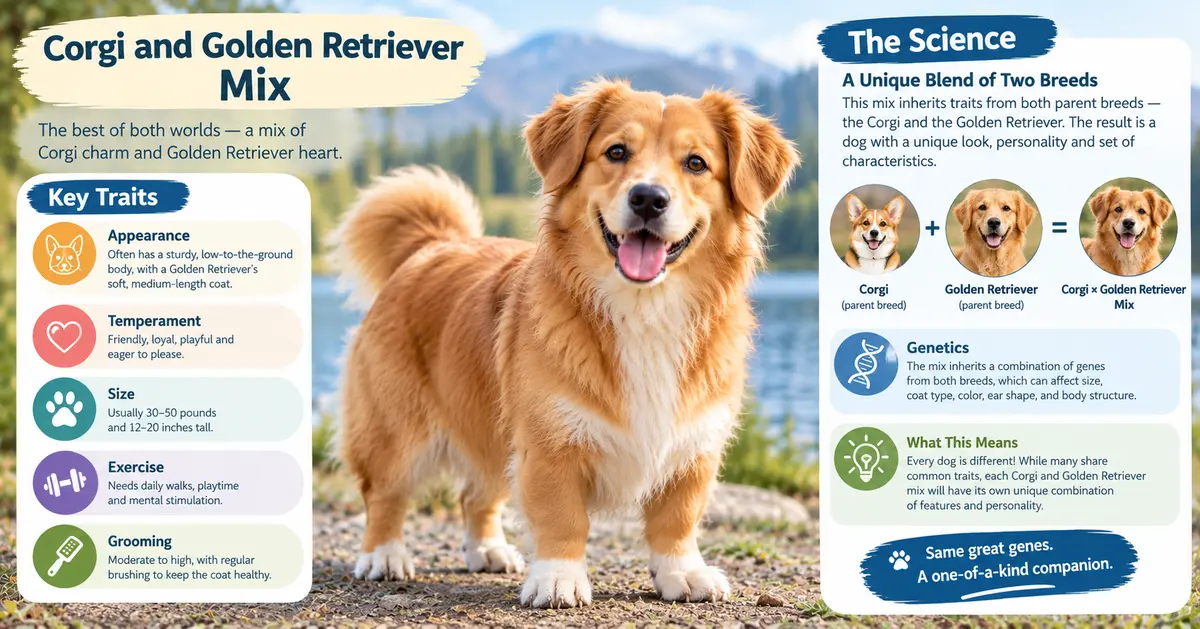
There’s a long-standing assumption that mixed breed dogs are automatically healthier than purebreds, based on a concept called hybrid vigor, or heterosis. The idea traces back to Charles Darwin’s observations of cross-pollinated plants, and it later became applied to animal breeding as well. The theory holds that combining genetically distinct parents reduces the chance of inheriting harmful recessive traits that build up in more limited gene pools.
However, actual research findings on this topic are more measured than the popular version of the theory suggests. Data gathered through the Dog Aging Project, a large-scale U.S. research initiative with tens of thousands of enrolled dogs, compared medical conditions across the most common purebred lines against mixed breed dogs in the same database. The difference in reported health outcomes between the two groups turned out to be small in practical terms, even though it reached statistical significance due to the size of the sample. This suggests that while genetic diversity can help reduce the risk of specific inherited conditions tied to a narrow gene pool, it doesn’t function as a blanket guarantee of better overall health. A corgi and golden retriever mix may avoid some breed-specific issues concentrated in either parent line, but responsible breeding, nutrition, and veterinary care still matter more than hybrid status alone.
Corgi and Golden Retriever Mix vs. Other Popular Mixes
Comparing this hybrid against other golden retriever crosses helps put its traits into perspective, since size, energy, and grooming needs vary quite a bit across mixes.
| Trait | Corgi Golden Retriever Mix | Goldador (Golden x Lab) | Golden Shepherd (Golden x GSD) |
| Weight | 25–50 lbs | 60–80 lbs | 55–85 lbs |
| Shedding | Heavy | Heavy | Heavy |
| Exercise Needs | Moderate-High | High | High |
| Trainability | High | High | High |
| Watchdog Tendency | Moderate | Low | High |
| Good for Small Spaces | Conditional | Rarely | Rarely |
The corgi mix stands out mainly for its smaller size and stronger watchdog instinct, both inherited from the corgi parent. Larger golden retriever mixes tend to need more space and higher activity levels, which makes the corgi cross a reasonable option for people who want golden retriever temperament traits without committing to a large-breed dog.
“Golden Retriever mix comparison tool”, “compare the two mixes side by side”
Common Myths About This Mix, Debunked
A few misconceptions come up repeatedly with this hybrid, and clearing them up helps set realistic expectations before bringing one home.
- “This mix is hypoallergenic.” Neither parent breed is hypoallergenic, and combining them doesn’t change that. Both corgis and golden retrievers shed heavily, so allergy sufferers should look elsewhere.
- “Mixed breeds are always healthier than purebreds.” As covered above, research shows the health advantage is smaller and less consistent than commonly assumed.
- “You can predict exactly what the puppy will look like.” Because this is typically a first-generation cross, physical traits can vary significantly even within the same litter.
- “Smaller size means less exercise is needed.” Energy level here comes from both working-breed parents, not from size, so this mix still needs regular activity regardless of how compact it looks.
also read Australian Shepherd Golden Retriever Mix
How Much Does a Corgi and Golden Retriever Mix Puppy Cost?
Pricing for this mix varies widely depending on the breeder, location, and whether the parents have undergone health testing. Because this isn’t a standardized or widely recognized breed, there’s less pricing consistency compared to purebred corgis or golden retrievers, which can make comparison shopping trickier.
“Golden Retriever mix cost calculator”, “estimate the yearly cost”
Breeder Costs vs. Adoption Fees
Breeder prices for this mix generally range from $500 to $1,500, though prices can climb higher if the breeder specializes in designer mixes or if demand is high in your area. Adoption through a shelter or breed-specific rescue typically costs far less, often between $50 and $300, and usually includes vaccinations, microchipping, and spay or neuter surgery already completed. Rescue routes also tend to bring home a dog whose adult size and temperament are already established, which removes some of the guesswork that comes with a young puppy.
Questions to Ask a Breeder or Rescue
Before committing to a puppy, ask whether the parents have had health screenings for conditions common to corgis and golden retrievers, such as hip evaluations or eye exams. Request to meet at least one parent in person if possible, since this gives you a better sense of temperament and physical traits the puppy might inherit. A responsible breeder should also be willing to answer questions about the puppy’s early socialization and provide documentation of any veterinary care given before adoption.
Is a Corgi and Golden Retriever Mix Right for You?
This mix tends to work well for active individuals or families who can commit to daily exercise and regular grooming, and who don’t mind a dog that sheds year-round. It’s a strong match for households with children or other pets, given the golden retriever’s typically gentle nature, though early introductions and supervision still matter. People living in smaller spaces can make it work, provided they’re realistic about the barking tendency and committed to meeting the dog’s activity needs regardless of square footage.
This probably isn’t the right fit for anyone who travels frequently and can’t provide consistent companionship, since both parent breeds tend to form strong attachments and don’t do well with long stretches of isolation. Allergy sufferers should also look elsewhere, given the heavy shedding from both sides of the family tree. If you can handle regular brushing, daily walks, and a dog that wants to be part of everything you do, this mix tends to be a rewarding companion.
Frequently Asked Questions
How big does a corgi and golden retriever mix get?
Most reach 12 to 20 inches tall and weigh between 25 and 50 pounds as adults, though individual size can vary depending on which parent’s genes dominate. Puppies from the same litter can grow into noticeably different sizes, so exact predictions aren’t possible until the dog is close to full growth.
Are corgi golden retriever mixes good with kids?
Yes, in most cases, thanks largely to the golden retriever’s gentle, patient temperament balancing out the corgi’s more alert nature. Early socialization and supervised interactions still matter, especially with younger children, since any dog can nip or herd if it isn’t taught boundaries.
Do they shed a lot?
Yes, heavily. Both parent breeds carry a double coat and shed year-round, with heavier shedding during seasonal coat changes in spring and fall. Regular brushing helps manage loose fur but won’t eliminate shedding altogether.
Is this considered a recognized breed?
No. This is a designer hybrid, not a breed recognized by major kennel clubs like the AKC. Because it isn’t standardized, physical traits and temperament can vary more than they would with an established purebred line.
If this mix sounds like a fit, the next step is finding a breeder or rescue that can show health testing records for the parent dogs, or, if you’re adopting, spending time with the dog before bringing it home to get a feel for its individual temperament. Either way, going in with realistic expectations about grooming, exercise, and the natural variation of a first-generation mix will serve you better than assuming this dog will behave exactly like either parent breed on its own.

Hi, I’m Jack Austin, founder of Cool Goldens. I share practical, research-backed advice on training, nutrition, and daily care to help you give your Golden Retriever the happiest, healthiest life possible.