


Are Red and Standard Golden Retrievers Really Different?
A red golden retriever and a standard golden retriever are the same breed. The only guaranteed difference is coat shade. Everything else — energy, size, temperament — comes down to breeding line, not color.
Understanding the Golden Retriever Coat Color Spectrum
Golden retrievers don’t come in fixed color categories. Breeders and owners use terms like cream, gold, dark golden, and mahogany, but these labels describe points along one continuous range rather than separate types. A puppy’s exact shade often shifts as it grows, and adult coats can darken or lighten with age and sun exposure.
Cream, Gold, Dark Golden, and Mahogany Explained
Cream goldens sit at the pale end, almost ivory in some cases. Standard gold is the shade most people picture when they think of the breed. Dark golden moves toward a richer amber tone, and mahogany or “red” sits at the deepest end, closer to a chestnut or rust color. None of these shades reflect a different breed or subtype. They’re variations within one accepted color range, and a single litter can produce puppies across several shades depending on the parents’ genetics.
What Pheomelanin Has to Do With Coat Color
Coat color in dogs comes down to two pigments: eumelanin (black/brown) and pheomelanin (red/yellow). Golden retrievers carry genes that suppress eumelanin almost entirely, leaving pheomelanin to determine shade. How much pheomelanin a dog produces, and how it’s distributed in the hair shaft, decides whether a puppy ends up pale cream or deep red. Multiple genes influence this, which is why coat color can vary so much even among full siblings from the same litter.
Is “Red Golden Retriever” an Official AKC Classification?
No. The American Kennel Club breed standard describes an acceptable color range but does not name “red” as its own category. This matters for anyone comparing a red golden retriever vs golden retriever as if they were separate breeds or types recognized by kennel clubs, because officially, they aren’t.
How AKC Breed Standards Describe Acceptable Coat Colors
The AKC standard calls for shades of gold, and it specifically states that extremely pale or extremely dark coats are not favored in the show ring, even though they don’t disqualify a dog from AKC registration as a golden retriever. A deep red or mahogany coat can fall outside what conformation judges prefer, which is one reason red-coated dogs are more common in field and hunting lines than in show lines.
American Golden Retriever vs British/English Cream Lines
American-bred goldens tend to run toward gold and dark golden shades with a leaner, more athletic build. British-style goldens, often marketed as “English cream,” lean toward the pale end of the spectrum and typically have a stockier frame and blockier head. These are regional breeding traditions, not separate breeds, and both fall under the same overall AKC standard when registered in the US.
Red vs Yellow Golden Retriever: Side-by-Side Comparison
| Feature | Red / Dark Golden | Standard Gold / Yellow |
| Coat shade | Deep amber to mahogany | Classic gold to light yellow |
| Common line association | Field/working lines | Show lines (varies) |
| Typical build | Leaner, more athletic | Slightly stockier, especially in cream lines |
| Energy level | Often higher, line-dependent | Moderate to high, line-dependent |
| AKC recognition | Same breed, no separate category | Same breed, closer to standard preference |
| Price trend | Sometimes higher due to demand | Standard market range |
This table reflects general tendencies reported by breeders and owners, not fixed rules. Line and individual breeding matter more than the color itself.
Field-Line vs Show-Line Golden Retrievers: The Real Source of Differences

Most of the temperament and build differences people notice between red and standard goldens actually trace back to breeding purpose, not pigment. Field-line goldens are bred for retrieving work and tend to run leaner and higher-energy, while show-line goldens are bred toward the AKC conformation standard and tend to carry more coat and a calmer pace.
Red coats show up more often in field lines simply because that’s a breeding pattern, not a biological rule. A red puppy from a calm show line won’t automatically inherit field-line drive, and a pale puppy from working stock can be just as high-energy as its darker littermates.
also read: Field Goldens or Show Goldens? The Real Differences Explained
What a Field-Line (Working-Line) Golden Looks and Acts Like
Field-line goldens are bred to work: retrieving in water and heavy cover for long stretches. They tend to be leaner, with less feathering and a more streamlined body. Owners commonly describe them as higher energy, more focused on tasks, and quicker to pick up retrieving instincts. This working background is also where most working-line red goldens come from, which explains why red coats and high drive often get linked together in casual observation.
What a Show-Line Golden Looks and Acts Like
Show-line goldens are bred toward the AKC conformation standard: a heavier coat, more feathering, and a blockier, more classically “golden” appearance. Temperament here still varies by individual dog and breeder, but show lines are often described as a bit more laid-back and better suited to a slower household pace, though plenty of exceptions exist in both directions.
Temperament and Personality: Does Color Predict Behavior?
Coat color alone does not predict temperament. What predicts temperament more reliably is the combination of breeding line, individual genetics, early socialization, and how a puppy is raised. Two puppies of identical color from different breeders can turn out very differently.
Energy Levels and Exercise Needs
Coat color has no direct effect on energy level. What matters is whether a puppy comes from field or show breeding, and red-coated dogs are simply more likely to come from field lines. If a breeder can’t tell you which line a red puppy comes from, ask about the parents’ typical activity level directly rather than assuming from coat shade alone.
Size and Build: Red vs Standard Golden Retrievers
Build differences follow the same field-versus-show pattern as temperament. Field-line goldens, which produce more red-coated dogs, tend to be leaner and more athletic, with longer legs and less bulk. Show-line goldens, more often gold or cream, tend to carry more coat and a heavier frame. Within the AKC standard, males typically range from 65 to 75 pounds and females from 55 to 65 pounds, but individual dogs vary based on line, diet, and exercise. A red golden retriever isn’t automatically smaller or larger than a standard one. What changes the silhouette is whether the dog comes from working or conformation stock, along with individual genetics from both parents.
Grooming and Shedding: Does Coat Color Change Care Needs?
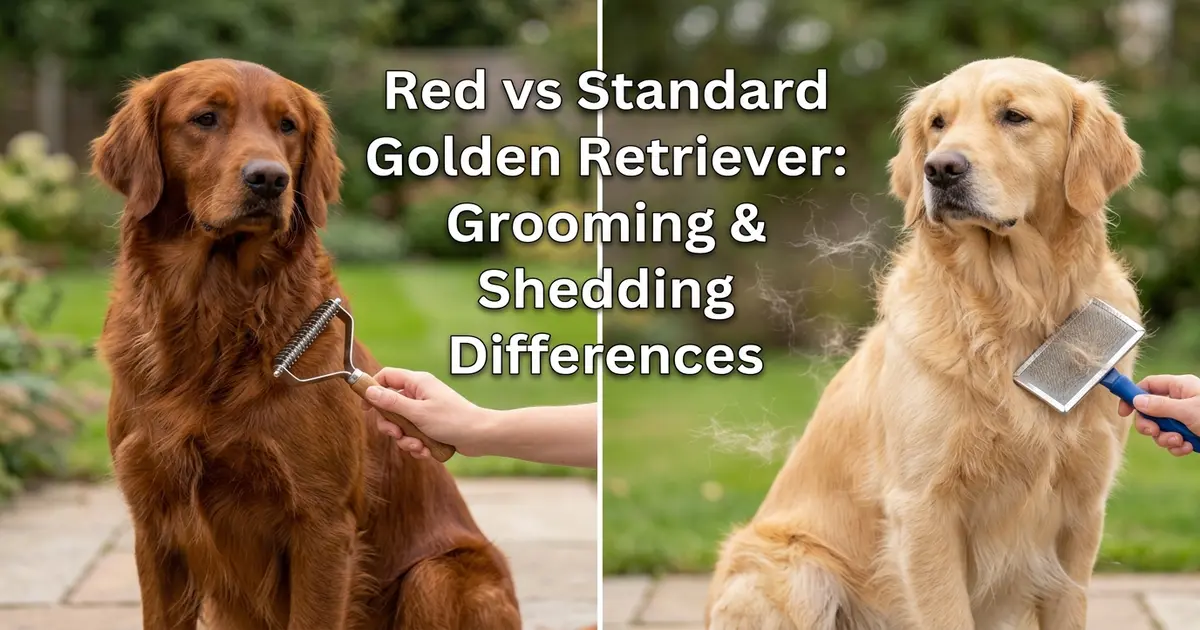
Coat color has no meaningful effect on grooming needs. What matters is coat density and length, and that comes down to line and individual dog rather than shade.
Double Coat and Feathering Basics
All golden retrievers, regardless of color, have a double coat: a water-resistant outer layer and a soft undercoat for insulation. Feathering, the longer hair on the ears, legs, chest, and tail, tends to be heavier in show-line dogs and lighter in field-line dogs. Since red coats show up more in field lines, red goldens often have slightly less feathering to manage, though this isn’t guaranteed.
Shedding Season and Deshedding Tools
Golden retrievers shed year-round and go through heavier seasonal shedding, usually in spring and fall, as the undercoat turns over. Regular brushing several times a week helps manage loose hair, and a slicker brush or undercoat rake works well for reaching the dense undercoat beneath the topcoat. Coat color doesn’t change how much a dog sheds; coat type and season do.
Health, Lifespan, and OFA Clearances: What Color Doesn’t Tell You
Coat color has no established link to a golden retriever’s health outcomes. What matters far more is the health testing behind a specific dog’s parents.
Hip Dysplasia and Other Breed-Wide Concerns
Golden retrievers as a breed are prone to hip and elbow dysplasia, certain heart conditions, and several cancers, regardless of coat shade. These risks come from the breed’s genetic background as a whole, not from being red, gold, or cream.
also read Golden Retriever’s Nose Turning Pink
Why OFA and Health Clearances Matter More Than Coat Shade
The Orthopedic Foundation for Animals (OFA) evaluates hips, elbows, hearts, and eyes in breeding dogs and issues clearances for dogs that meet healthy standards. A reputable breeder, whether producing red or standard-colored puppies, should be able to show OFA clearances for both parents. This single factor does more to predict a puppy’s future health than any observation about its coat color.
Red Golden Retriever Lifespan Compared to Standard Goldens
No credible evidence shows that red-coated golden retrievers live shorter or longer lives than standard-colored ones. The breed’s average lifespan, generally cited as 10 to 12 years, applies across the color spectrum. Line-specific health issues, individual genetics, and general care have far more influence on lifespan than coat shade does.
What Research and Breed Experts Actually Say About Color and Temperament

Large-scale research on golden retrievers has focused mainly on disease risk rather than coat color and behavior specifically. Morris Animal Foundation’s Golden Retriever Lifetime Study follows more than 3,000 purebred golden retrievers throughout their lives, collecting nutritional, environmental, genetic, and behavioral data to better understand cancer and other health challenges in the breed. This kind of long-term data collection is where reliable answers about golden retriever health and behavior are likely to come from, rather than casual observation of coat color.
At this stage, no major veterinary or genetics body has published findings tying coat shade itself to temperament traits. Breed clubs and canine genetics researchers generally attribute behavioral differences within the breed to breeding purpose and individual lineage. Anyone researching this topic should treat coat-color-based temperament claims as informal pattern-matching from owners and breeders rather than settled science. Golden Retriever Lifetime Study, Morris Animal Foundation
Common Myths About Red Golden Retrievers
Several claims about red goldens circulate widely online without solid backing. Clearing these up helps set realistic expectations before choosing a puppy.
- “Red goldens are more aggressive.” No evidence supports this. Golden retrievers as a breed are known for a friendly, non-aggressive temperament, and coat color doesn’t override that trait.
- “Red goldens aren’t purebred.” Red and mahogany shades fall within the accepted AKC color range. A red coat alone doesn’t indicate mixed breeding.
- “Red goldens have a shorter lifespan.” No credible data ties coat color to lifespan differences in this breed.
- “Red goldens always come from field lines.” Most do, but exceptions exist, and coat shade alone can’t confirm a dog’s breeding background without pedigree information.
How to Choose Between a Red and Standard Golden Retriever Puppy
Choosing based on coat color alone skips the factors that actually shape a puppy’s future behavior, health, and fit with your household. A more useful approach starts with the breeder and the parents, then treats color as a secondary preference.
Questions to Ask a Breeder Beyond Coat Color
Ask whether the parents have current OFA clearances for hips, elbows, heart, and eyes. Ask whether the breeding focuses on field work, conformation showing, or a general companion line, since this shapes energy level and build more than color does. Ask to meet at least one parent to get a sense of temperament, and ask about the breeder’s experience with health issues common in their specific line.
Why Line and Breeder Reputation Matter More Than Shade
A well-bred puppy from a responsible breeder, regardless of coat color, is more likely to have a stable temperament and fewer inherited health problems than a poorly bred puppy chosen for its shade alone. Reputable breeders health-test their dogs, plan pairings thoughtfully, and can describe what to expect from a specific litter based on the parents’ documented traits, not just how the puppies will look.
Frequently Asked Questions
Are red golden retrievers rarer than standard ones?
Red and mahogany shades are less common than standard gold, mainly because most breeding programs, especially show lines, favor lighter shades. Rarity varies by region and by breeder network rather than being fixed across the whole breed population.
Do red golden retrievers cost more?
Sometimes. Demand for red and mahogany coats has grown in recent years, which can push prices higher from breeders who market the color specifically. Price still depends more on health testing, pedigree, and breeder reputation than on coat shade alone.
Can two standard-colored goldens produce a red puppy?
Yes. Because coat color involves multiple genes, parents with lighter coats can carry genetics for darker shades and produce puppies across a range of colors within one litter, depending on what each parent carries.
Are dark golden and red golden retrievers the same thing?
They sit close together on the same color spectrum, and the terms are often used interchangeably by breeders and owners. “Red” or “mahogany” usually refers to the deepest end of that range, while “dark golden” can describe a slightly lighter but still rich shade.
If you’re choosing between a red and a standard golden retriever, the color itself shouldn’t be the deciding factor. Ask about the breeding line, request OFA health clearances for both parents, and meet the parents if possible to get a real sense of temperament. That approach tells you far more about the puppy you’ll actually live with than coat shade ever will.

Hi, I’m Jack Austin, founder of Cool Goldens. I share practical, research-backed advice on training, nutrition, and daily care to help you give your Golden Retriever the happiest, healthiest life possible.