

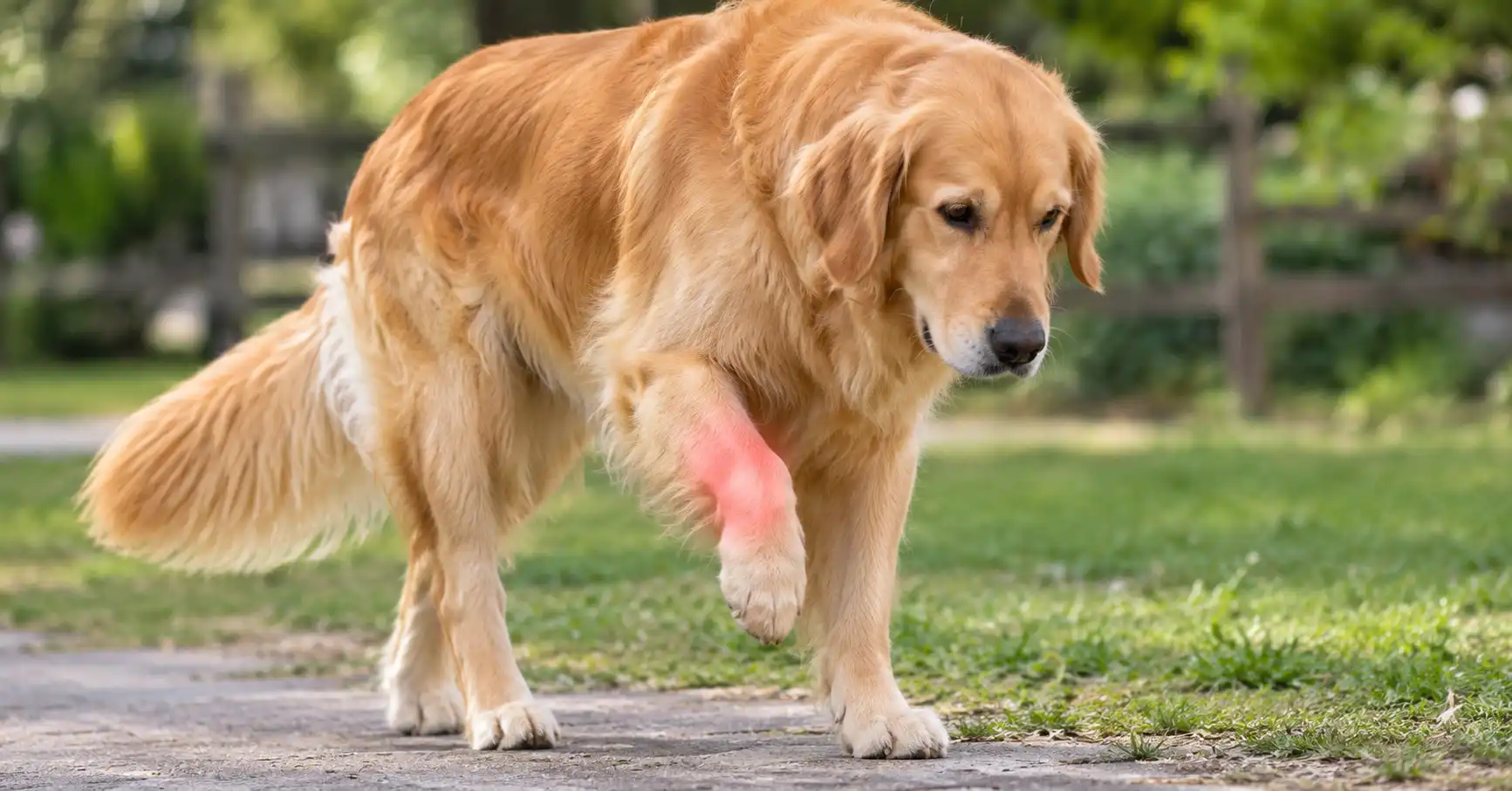
Your Golden bounces up to greet you, then holds one front paw off the floor. A golden retriever limping front leg is most often dealing with a paw injury, a pulled muscle, or a sore joint, and a limp that lasts more than a day needs a vet.
Goldens hide pain well, so a dog who still eats and wags can be hurting. Below, you will find a clear urgency guide, a safe way to check where it hurts, and the causes that fit each age, starting with the signs that cannot wait.
Why Is Your Golden Limping, and Do You Need a Vet?
Most front leg limps in Goldens come from a paw injury, a muscle strain, or a joint problem such as arthritis or elbow disease. A mild limp that clears within a day often needs only rest. A limp that lasts longer than 24 hours, keeps returning, or comes with any red flag needs a vet exam.
Call a vet right away if you see any of these signs:
- Your dog will not put the paw on the ground at all
- The leg hangs at an odd angle or looks out of shape
- The leg or paw is swollen, hot, or bleeding
- Your dog cries out, snaps, or pulls away when you touch the leg
- Your dog has a fever, seems very tired, or stops eating
- The gums look pale, or your dog collapses
Sudden, severe lameness never counts as a “wait and see” problem. It is better to have a vet rule out a fracture than to guess at home.
When to Go to the Vet: Emergency, Same Day, or Watch at Home
Many articles give mixed timing advice, which leaves worried owners stuck. This one rule is simple: the more severe the signs, the sooner your dog needs care.
| Situation | What it may mean | What to do |
| Dangling leg, no weight on the paw, heavy bleeding, or a visible deformity | Fracture, dislocation, or deep wound | Go to an emergency vet now |
| Limp with fever, collapse, pale gums, or a cry of pain when touched | Serious injury, infection, or a systemic illness | Go to an emergency vet now |
| Limp that started suddenly, with swelling or heat in the leg | Sprain, bite or sting reaction, or joint injury | Call your vet and be seen the same day |
| Mild limp that has lasted more than 24 hours | Strain, early joint disease, or a hidden paw injury | Book a vet visit within a day or two |
| Mild limp that appeared after hard play and is clearly improving | Minor strain or a small paw irritation | Rest strictly for up to a day and watch closely |
While you wait for care, limit your dog’s activity and keep them on one floor of your home. Block the stairs and keep the leash short for bathroom breaks. Do not give human pain medicine. Common drugs such as ibuprofen and naproxen can seriously harm dogs, and acetaminophen is not safe for them either unless a vet directs it.
Is the Limp Still Serious If Your Dog Seems Fine?
Yes, it can be. A Golden that limps but eats well, wags, and wants to play is still telling you that something hurts. Dogs do not complain the way people do, and many keep up their normal routine through real pain.
The limp may be the only obvious sign, but others tend to appear if you look for them. Watch for shorter walks, slower rising after a nap, or a dog who lags behind on a usual route. Some dogs lick one paw again and again. Others shift weight to the opposite leg, so the stride looks uneven even when the limp is hard to spot.
A mild limp with no visible injury is a common reason owners wait too long. Eating and playing do not rule out a sprain, a joint problem, or an early bone issue. If the limp has no clear cause and lasts beyond a day, book an exam. Catching a problem early usually makes treatment simpler, and it spares your dog weeks of quiet discomfort.
How to Find Where It Hurts: Paw, Wrist, Elbow, Shoulder, or Neck
The front leg has several joints and a lot of soft tissue, and pain from the neck can travel down the limb. Narrowing down the area helps your vet and helps you decide how quickly to act. You cannot make a diagnosis at home, but you can gather useful clues.
A Safe 5-Minute Home Check
Pick a calm moment and keep your dog standing or lying comfortably. Start with the paw. Spread the toes and look between them and across each pad for cuts, thorns, grass seeds, swelling, or redness. Check each nail and the dewclaw, which sits higher on the inside of the leg.
Next, run your hand slowly up the leg, from the paw to the wrist, elbow, and shoulder. Feel for heat, swelling, or a spot where your dog flinches. Compare the sore leg with the healthy one. Stop right away if your dog yelps, growls, or tries to pull away. Pushing through that reaction can make an injury worse, and a dog in pain may bite even when they have never done so before.
Clues That Point to Each Area
| Area | Common signs | Possible causes |
| Paw or nail | Licking, visible cut, bleeding, swelling between toes | Cuts, thorns, torn nail, cyst, sting |
| Wrist | Swelling, stiffness, short steps | Sprain, strain, joint injury |
| Elbow | Stiffness after rest, a shortened stride, elbow held out | Elbow dysplasia, arthritis |
| Shoulder | Pain when the leg is pulled back, reluctance to extend it | Biceps tendon problem, shoulder joint disease |
| Neck | Lowered head, cries when turning the head, limp that shifts | Disc disease, neck injury |
Does Left or Right Matter?
Owners often search for a limp on the front right or front left leg. The side matters less than you might think. Most causes can affect either leg, and your vet will examine both anyway. What matters more is the pattern: when it started, whether it comes and goes, and whether it changes after rest or exercise. Note the side for your vet, but do not rely on it to guess the cause.
Common Causes of Sudden Limping
Sudden limping usually follows an event you may or may not have seen. A walk, a game of fetch, a jump off the couch, or a romp in tall grass can all set it off. The causes below range from minor to serious.
Paw Pad Cuts, Thorns, and Foxtails
The paw pad takes the most wear, so it is the first place to look. Glass, sharp rocks, thorns, and hot pavement can all cause pain. Grass seeds, including foxtails, are a special risk because they can work their way between the toes and into the skin.
A visible cut is easy to spot, but a tiny splinter can cause a strong limp with almost nothing to see. Rinse a minor scrape with clean water and keep it dry. Do not dig at an embedded object, since that can push it deeper. If you see something lodged in the skin, or the paw swells or drains, your vet should take care of it.
Torn Nails and Dewclaw Injuries
A split or torn nail can hurt a great deal, and it often bleeds more than owners expect. The dewclaw is easy to snag on brush, carpet, or a fence. Some dogs lick the area constantly, and others hold the paw up completely.
Mild nail cracks may heal with protection and time, but a torn nail is painful and can get infected. Look for redness, swelling, a bad smell, or discharge in the days after the injury. Your vet can trim the damaged nail, clean the area, and recommend pain relief that is safe for dogs.
Insect Stings, Burns, and Interdigital Cysts
A sting from a bee or wasp can swell a paw fast. Hot pavement can burn pads, and winter salt or ice melt can irritate them. In each case the limp may come with licking, redness, or blisters.
Interdigital cysts are painful lumps that form between the toes. They can look like small red bumps and may drain. Allergies that make dogs lick their feet can make them more likely. Because swelling can also signal an allergic reaction, facial swelling or trouble breathing after a sting needs emergency care. Other paw problems are worth a vet visit if they last more than a day.
Muscle Strain and Ligament Sprain
Strains and sprains are among the most common reasons for a sudden limp in active dogs. A sharp turn, a slip on a smooth floor, or a leap for a ball can overstretch a muscle or ligament. The leg may look normal, but your dog limps and may seem sore the next morning.
Mild cases often improve with strict rest. Because soft tissue injuries rarely show up on a plain X-ray, a vet may diagnose one after ruling out bone and joint damage. A bad sprain can leave a joint unstable and may need a brace, rehab, or surgery. Do not return to full play just because your dog looks better. Muscle and ligament tissue heals more slowly than the pain fades.
Fractures and Dislocations
A broken bone or a dislocated joint is an emergency. Falls, collisions, car accidents, and awkward landings are common causes. Dogs with a fracture usually refuse to bear weight, and the leg may look bent, swollen, or out of place.
Do not try to straighten the leg or test the joint. Keep your dog as still as you can, support the body when moving, and go straight to a vet. X-rays usually confirm the problem. Some breaks heal with a splint and rest, while others need surgery with plates or pins. Fast care also reduces pain and lowers the risk of further damage.
Tick-Borne Disease and Neck Pain
Two less obvious causes can look like a simple limp. Tick-borne illnesses, including Lyme disease, can cause joint pain, and the lameness sometimes shifts from one leg to another. Blood tests can help your vet find these infections, and treatment usually involves antibiotics along with pain relief.
Neck problems, such as a slipped or inflamed disc, can send pain down a front leg. These dogs may hold the head low, cry out when they turn it, or seem stiff and reluctant to move. Neck pain can progress, so it deserves a prompt vet visit. Year-round tick prevention, discussed with your vet, lowers the risk of tick-borne disease.
Causes of Slow-Onset or On-and-Off Limping
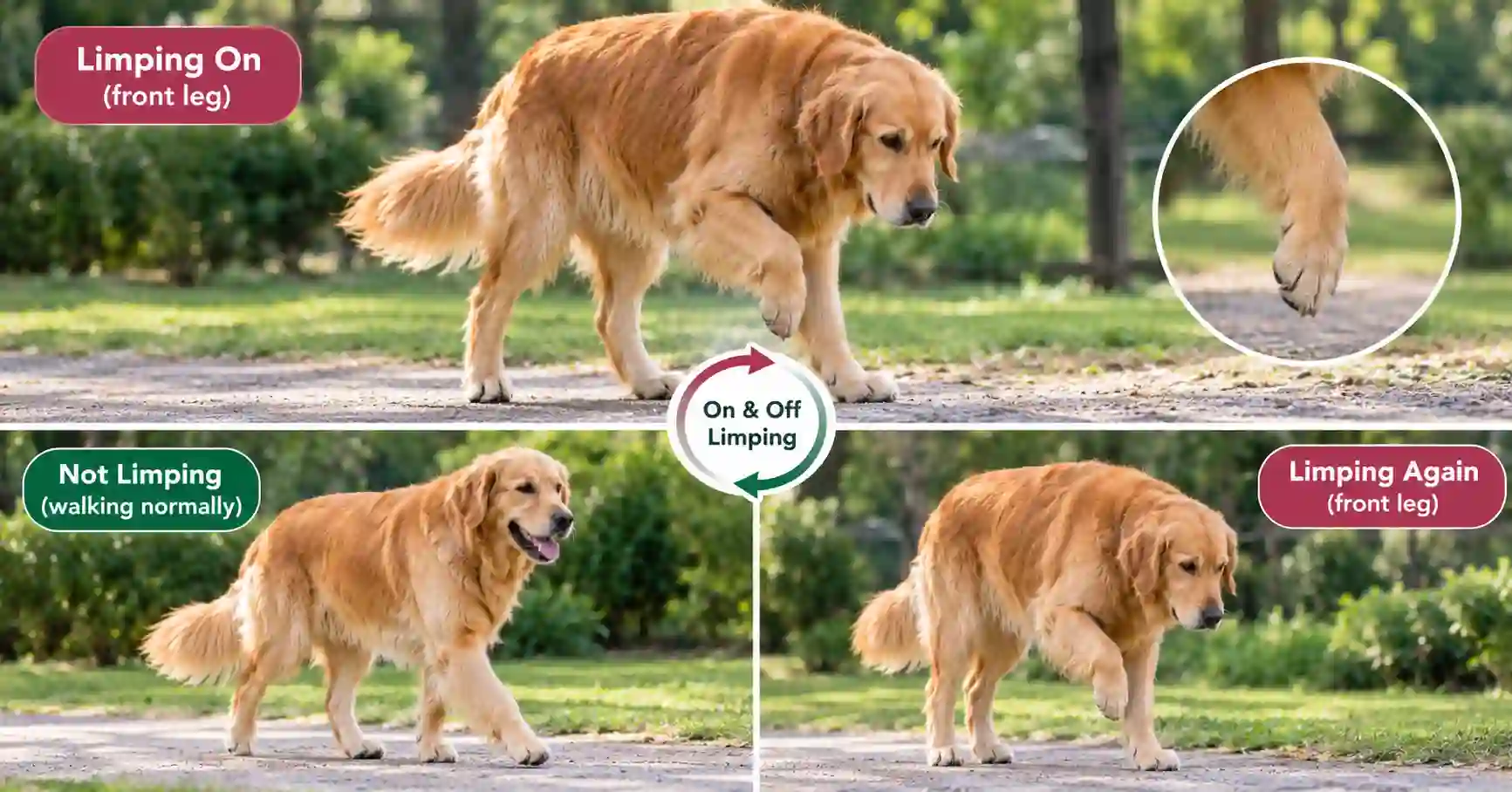
Some limps creep in. They may appear after a nap, vanish during a walk, and return at the end of the day. This pattern points toward chronic joint or bone problems rather than a single injury.
Arthritis and Morning Stiffness
Arthritis is a long-term joint disease where cartilage wears down and the joint becomes inflamed and painful. It is common in older dogs and in dogs with old injuries or joint malformation. The classic sign is stiffness after resting that eases as your dog warms up.
You may notice slow rising, trouble with stairs, or a shorter stride. Some owners see the limp worsen in cold or damp weather. It is not a cure-all fact for every dog, but many owners report it. Arthritis cannot be reversed, yet pain relief, weight control, gentle exercise, and rehab can help your dog stay comfortable and active for years.
Elbow Dysplasia
Elbow dysplasia is a group of inherited growth problems in the elbow joint. It affects larger breeds, including Goldens, and it often shows up as a front leg limp. Some dogs show signs as puppies, while others do not limp until early arthritis sets in.
Typical signs include stiffness, a short stride, and a limp that gets worse after exercise. Both elbows can be affected, which makes the limp harder to see. Your vet can find the problem through an exam and X-rays, and sometimes advanced imaging. Treatment ranges from weight control and pain management to surgery, depending on the severity and your dog’s age.
Shoulder and Biceps Tendon Problems
The shoulder is an easy area to overlook, because the limp may look like a general stiffness in the leg. Active dogs can strain the biceps tendon, and young dogs of large breeds can develop cartilage problems in the shoulder joint.
You may see pain when your dog extends the leg forward or backward. Some dogs limp most after play and improve with rest. Because these problems are easy to confuse with elbow or neck issues, your vet may need a careful exam and imaging to locate the source. Treatment may include rest, rehab, medication, and sometimes surgery.
Immune-Mediated Joint Disease
In immune-mediated joint disease, the immune system attacks the dog’s own joints. It may affect several joints at once, so the lameness can shift between legs. Unlike a simple strain, it often comes with fever, low energy, and a poor appetite.
A diagnosis can take several steps. Your vet may use blood work, X-rays, and a joint fluid sample to rule out infection and other causes. Treatment typically involves medicines that calm the immune system, so an accurate diagnosis matters before starting them. If your dog limps and seems generally unwell, get them seen promptly.
Bone Cancer (Rare, but Worth Knowing)
Bone cancer, or osteosarcoma, is not a common cause of limping, but Goldens are a breed where owners should know about it. It usually causes a painful limp that worsens over time, often with firm swelling over a bone. In the front leg it commonly affects the upper arm near the shoulder or the lower forearm near the wrist.
Most limps are not cancer, so there is no reason to panic. Still, a persistent limp that keeps getting worse, especially with swelling, needs X-rays. Early evaluation gives your vet and you the most options.
Limping by Age: Puppy, Adult, and Senior Goldens
The likely cause of a limp changes with your dog’s age. Knowing the pattern helps you describe the problem to your vet and judge how fast to act.
Why Puppies Limp
Puppies grow fast, and their bones, joints, and growth plates are still developing. Large breeds like Goldens can develop growing-bone conditions, including elbow and shoulder cartilage problems and a painful bone inflammation that tends to shift from leg to leg. Rough play, jumping off furniture, and slippery floors can add to the strain.
Some puppy limps come from simple soreness after a busy day. Others signal a developmental problem that needs early care. A limp that lasts more than a day, returns often, or appears with swelling or pain should be checked. Early treatment of joint disease in a growing dog can protect the joint for life.
Adult Dogs
Adult Goldens are usually active, which makes injuries common. Strains, sprains, torn nails, paw wounds, and tick-borne illness all show up in this group. Dogs with mild elbow dysplasia may also begin to limp in early adulthood as arthritis starts.
An adult dog that limps once after a hard game and recovers fast likely strained something minor. A dog that limps again and again in the same leg should have a full orthopedic exam. Repeat limps suggest an underlying joint or tendon problem rather than bad luck.
Senior Dogs
In older Goldens, arthritis is the most common reason for a front leg limp. Stiffness after rest, slower walks, and trouble with stairs all fit the pattern. Older dogs also face a higher chance of tumors, including bone cancer, so a new or worsening limp deserves attention rather than the assumption that it is just age.
Pain relief can improve an older dog’s life a great deal. Many senior dogs act younger once their joint pain is managed. Do not accept slowing down as inevitable without an exam.
A puppy that cries, refuses to walk, or has a hot, swollen joint needs a vet visit the same day.
Golden Retriever Joint and Bone Risks at a Glance
This table sums up the conditions that most often come up in Goldens. It is a general guide, not a diagnostic tool, and many conditions overlap.
| Condition | Typical age | Main signs | Urgency level |
| Paw, nail, or dewclaw injury | Any age | Licking, visible wound, sudden limp | Same day if bleeding, swollen, or very painful |
| Muscle strain or sprain | Young to middle-aged adults | Sudden limp after activity, soreness | Vet visit if it lasts more than 24 hours |
| Elbow dysplasia | Puppies to adults | Stiffness, short stride, limp after exercise | Vet visit soon |
| Shoulder cartilage or biceps tendon problem | Young and active dogs | Pain when extending the leg, limp after play | Vet visit soon |
| Growing-bone pain in puppies | Growing puppies | Limp that may shift legs, soreness | Vet visit within a day or two |
| Arthritis | Middle-aged to senior | Morning stiffness, slow rising | Vet visit to plan pain control |
| Tick-borne disease | Any age | Shifting limp, fever, tiredness | Vet visit soon |
| Fracture or dislocation | Any age | No weight on the leg, swelling, deformity | Emergency |
| Bone cancer | Mostly older dogs | Worsening limp, firm swelling | Vet visit promptly |
What Research Says About Goldens and Orthopedic Health
Goldens are one of the most closely studied breeds in veterinary medicine. That helps owners, but it also means some data focus on cancer more than on joints.
The Morris Animal Foundation Golden Retriever Lifetime Study began in 2012 with 3,044 dogs and follows them for life. By 2023 it had recorded more than 500 diagnoses of four major cancers, one of which was osteosarcoma. The foundation also reports that the study has looked at the timing of spay and neuter surgery and its link to orthopedic injury, which shows that joint health is part of the research.
The study’s cohort profile in PLOS ONE cites a necropsy study of 652 Golden Retrievers in which 65% of deaths were cancer-related. It also notes that studies in the UK and Scandinavia found lower cancer rates, between 20% and 39%. The gap shows that numbers vary by population and method, so no single figure tells the whole story.
For elbows, the Golden Retriever Club of America’s elbow dysplasia FAQ describes how the Orthopedic Foundation for Animals grades elbow X-rays. It also cites Swedish Kennel Club data showing that matings of affected parents produced more affected puppies, and more severe cases. For you, the practical lesson is that elbow disease runs in family lines. If you own a puppy, ask the breeder about elbow results for the parents.
None of this means your dog’s limp is serious. It means a persistent limp in a Golden deserves a proper look.
What Your Vet Will Do to Find the Cause
A good limp exam is methodical. Your vet starts broad and narrows down, because the same sign can come from a small paw injury or a deep joint problem.
Exam, X-rays, and Other Tests
The visit usually begins with a history and a look at how your dog walks. Then the vet feels each part of the leg, flexes the joints, and checks the neck and spine. Some dogs need sedation for a full exam, since pain makes them tense.
From there, the tests build step by step:
- X-rays show fractures, arthritis, bone changes, and some tumors.
- Blood tests help check for infection, tick-borne disease, and general health.
- Joint fluid sampling helps identify infection or immune-mediated disease.
- Advanced imaging, such as CT or MRI, shows soft tissue and hidden joint damage.
Many cases need only the first one or two steps.
What to Tell Your Vet Before the Visit
You can speed up the diagnosis with a few notes. Write them down before you go, since details are easy to forget.
- Which leg limps, and since when
- Whether it started suddenly or built up slowly
- What makes it better or worse, such as rest, stairs, or cold weather
- Whether the limp is worse after waking or after exercise
- Any recent falls, rough play, tick exposure, or new activities
- Changes in appetite, energy, or behavior
A short phone video of your dog walking can also help, since some dogs stop limping in the exam room.
What a Visit May Cost
Costs vary widely by region, clinic, and the tests needed. An exam alone usually costs the least. X-rays, sedation, blood work, and joint fluid tests add to the total, and CT, MRI, or surgery cost the most. Emergency clinics typically charge more than regular practices.
Ask your vet for an estimate before you agree to a plan, and ask which steps matter most first. Pet insurance, if you have it, may cover part of the cost, so check your policy before the visit.
Treatment Options for a Limping Dog
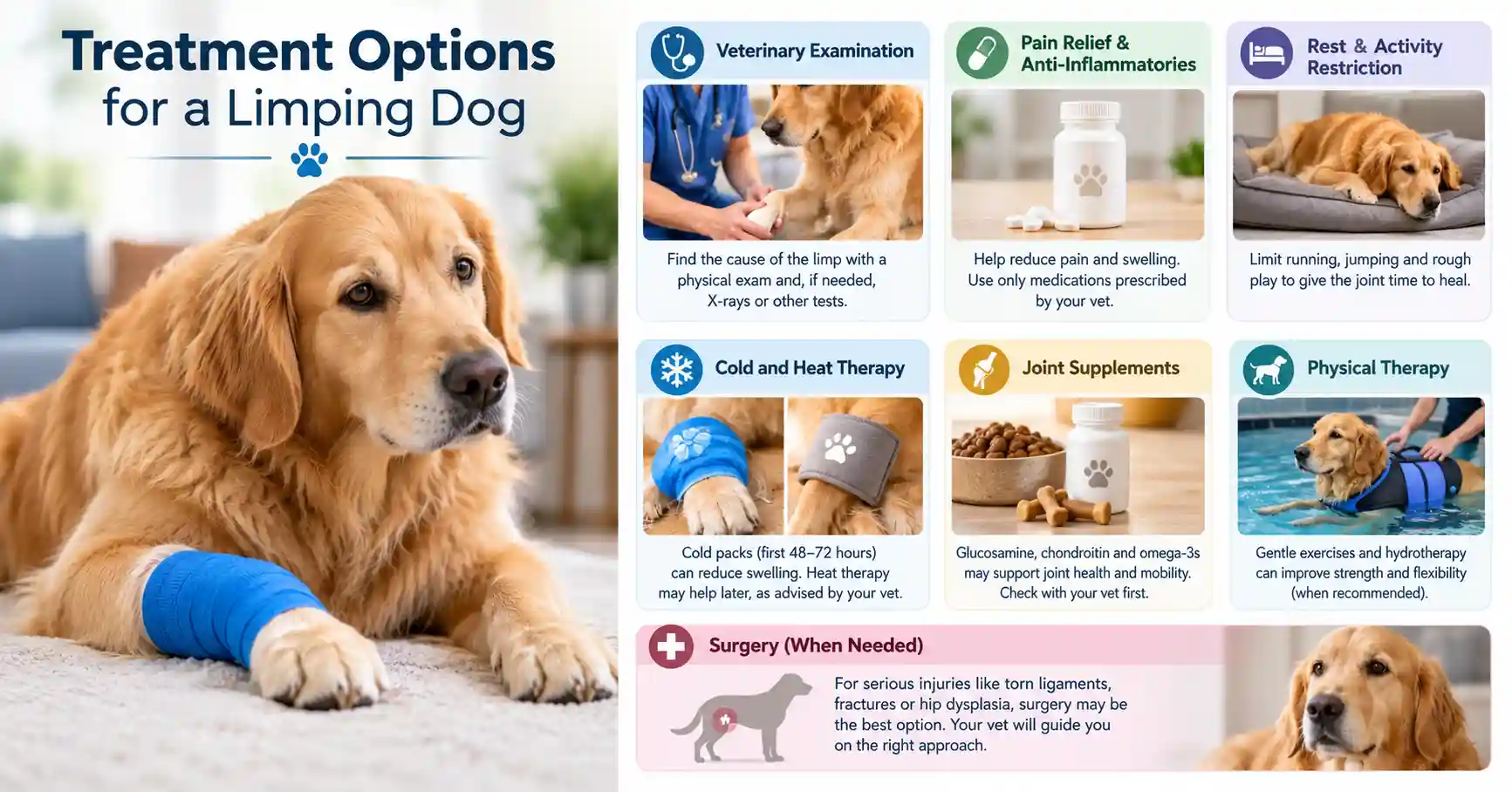
Treatment depends on the cause, so no single plan fits every dog. Your vet will pick the options that match the diagnosis and your dog’s age, weight, and health.
Rest and activity limits are the starting point for most injuries. This means short leash walks and no running, jumping, or rough play until your vet says it is safe. Rest works best when it is strict. Many dogs feel better after a few days and re-injure themselves when owners relax too soon.
Pain medication from your vet is often needed. Vets choose the drug and dose based on your dog’s weight, age, kidney and liver health, and other medicines. That is why you should never give leftover or human medicine. Some drugs that are common for people are dangerous for dogs.
Physical therapy, bracing, and surgery help with some conditions. Rehab can restore strength and range of motion, braces can steady unstable joints, and surgery may repair fractures, torn ligaments, or severely damaged joints.
Joint supplements are popular for arthritis. Ingredients such as omega-3 fatty acids, glucosamine, and chondroitin are common. Research on supplements is mixed, and results vary from dog to dog. Ask your vet which products are worth trying and whether they fit with your dog’s other treatment.
Safe Home Care While You Wait for the Vet
You cannot treat most limps at home, but you can keep your dog comfortable and avoid making things worse. Think of home care as support, not a replacement for an exam.
Set up a quiet, comfortable space on one level of your home. A thick bed helps, and a non-slip rug or yoga mat on smooth floors gives better footing. Keep outdoor trips short and on a leash, and carry or support your dog on steps.
If the paw is dirty, rinse it gently with clean water and dry it well. For a minor paw problem, a loose, clean wrap can protect the area on the way to the vet. Check it often. A tight wrap cuts off blood flow and can cause serious harm. Remove it right away if the toes swell or the wrap gets wet.
Avoid these common mistakes:
- Forcing your dog to walk it off
- Massaging or stretching a leg when you do not know the cause
- Giving human pain medicine
- Using a tight bandage
- Letting your dog play because the limp “looks better”
Most online home remedies for limping skip the most important step, which is finding the cause. Rest and comfort are safe. Guesswork is not.
Myths About Limping That Can Delay Care
Some beliefs about limping sound reasonable, but they lead owners to wait too long. Here are the most common ones.
“If he’s eating and playing, it’s fine.” Dogs often keep their routine through pain. A good appetite does not rule out a strain, a joint problem, or a fracture.
“A limp always means a break.” Most limps come from paw problems, strains, or joint disease. A fracture is only one possibility, though it does need quick care.
“Rest alone fixes everything.” Rest helps with minor strains, but it will not cure elbow dysplasia, an infected nail, or a tick-borne illness. A limp that returns after rest needs a diagnosis.
“A small dose of human pain medicine is safe.” It is not. Many human drugs can cause stomach bleeding, kidney damage, or liver damage in dogs, even in small amounts.
“Limping from arthritis is just aging.” Age is a risk factor, but arthritis is a medical condition with treatments. Many older dogs improve a lot when their pain is managed.
Dropping these myths can save your dog time in pain and save you worry.
Recovery: Rest Rules and What to Expect
Recovery depends on the cause, and your vet’s plan overrides any general advice. Even so, a few rules apply to most dogs.
Keep walks short and on a leash during recovery. Skip stairs when you can, block access to furniture, and keep your dog off slippery floors. Take the time to build exercise back slowly once your vet clears it. A common mistake is going from rest to full play in a single day.
General timing varies. A minor paw irritation may settle within days, a nail injury often needs a few weeks, and soft tissue injuries and fractures can take much longer. Chronic conditions such as arthritis and elbow dysplasia need ongoing management rather than a fixed recovery date.
Contact your vet if you see any of these setbacks:
- The limp gets worse or returns after improving
- Swelling, heat, or discharge appears
- Your dog stops eating or seems unusually tired
- Your dog starts licking or chewing at a bandage or the injured area
- A medication seems to upset the stomach
Report changes early. Small adjustments to the plan often prevent bigger problems.
How to Protect Your Golden’s Front Legs Long Term
You cannot prevent every limp, but several habits lower the risk and make injuries easier to catch.
Keep your dog lean. Extra weight puts more stress on the elbows and shoulders, and it raises the risk of arthritis. Your vet can help you set a healthy target weight and a feeding plan.
Take care of the paws. Trim nails regularly and check the pads and toes after walks, especially in tall grass, on hot pavement, or on salted winter roads. A quick look can catch a thorn before it turns into a limp.
Choose joint-friendly exercise. Steady walking and swimming are gentler than repeated hard stops and jumps. For puppies, keep play moderate and avoid long runs or jumping from high places while the bones are still growing.
Prevent ticks and keep up with vet visits. Ask your vet about tick control that suits where you live, and schedule regular checkups. Older dogs benefit from exams that include a joint check, even when the limp seems small.
FAQ
Can a limp go away on its own?
Sometimes. A small strain or a minor paw irritation may fade within a day with strict rest. But a limp that lasts past 24 hours, returns, or comes with swelling or pain needs an exam. Fading pain does not always mean the problem healed.
Is it okay to walk my dog if the limp is mild?
Keep walks very short and on a leash, only for bathroom breaks, until you know the cause. Exercise can turn a minor injury into a bigger one. If the limp is gone after a day of rest, return to activity slowly instead of jumping into full play.
Why does the limp come and go?
An on-and-off limp often points to a chronic problem, such as arthritis, elbow dysplasia, or a tendon issue. Pain may ease when your dog is warm and active, then return after rest or hard play. A pattern like this deserves an exam even when the limp seems to disappear.
Why does my dog limp after resting and then seem fine?
Stiffness after rest is a typical sign of arthritis. Joints tighten while your dog lies still, and movement warms them up. Dogs often look normal after a few minutes of walking. Report this pattern to your vet, because treatment can improve comfort.
Key Takeaways and Next Steps
Start with the urgency rule. A dangling leg, no weight on the paw, heavy bleeding, fever, or collapse means an emergency vet now. A limp that lasts more than a day, comes back, or comes with swelling means a vet visit within a day or two.
Today, do three things. Rest your dog and limit stairs, check the paw and leg gently if your dog allows it, and write down which leg is sore, when it started, and what changes it. Bring those notes and, if you can, a short video of your dog walking.
Do not give human pain medicine, and do not wait for the limp to fix itself when your dog has red flags. Most limps have a treatable cause, and an early exam gives your Golden the best chance of a quick and comfortable recovery.
This article is for general information and does not replace a veterinarian’s exam or advice. If you are worried about your dog, contact your vet or an emergency clinic.

Hi, I’m Jack Austin, founder of Cool Goldens. I share practical, research-backed advice on training, nutrition, and daily care to help you give your Golden Retriever the happiest, healthiest life possible.