

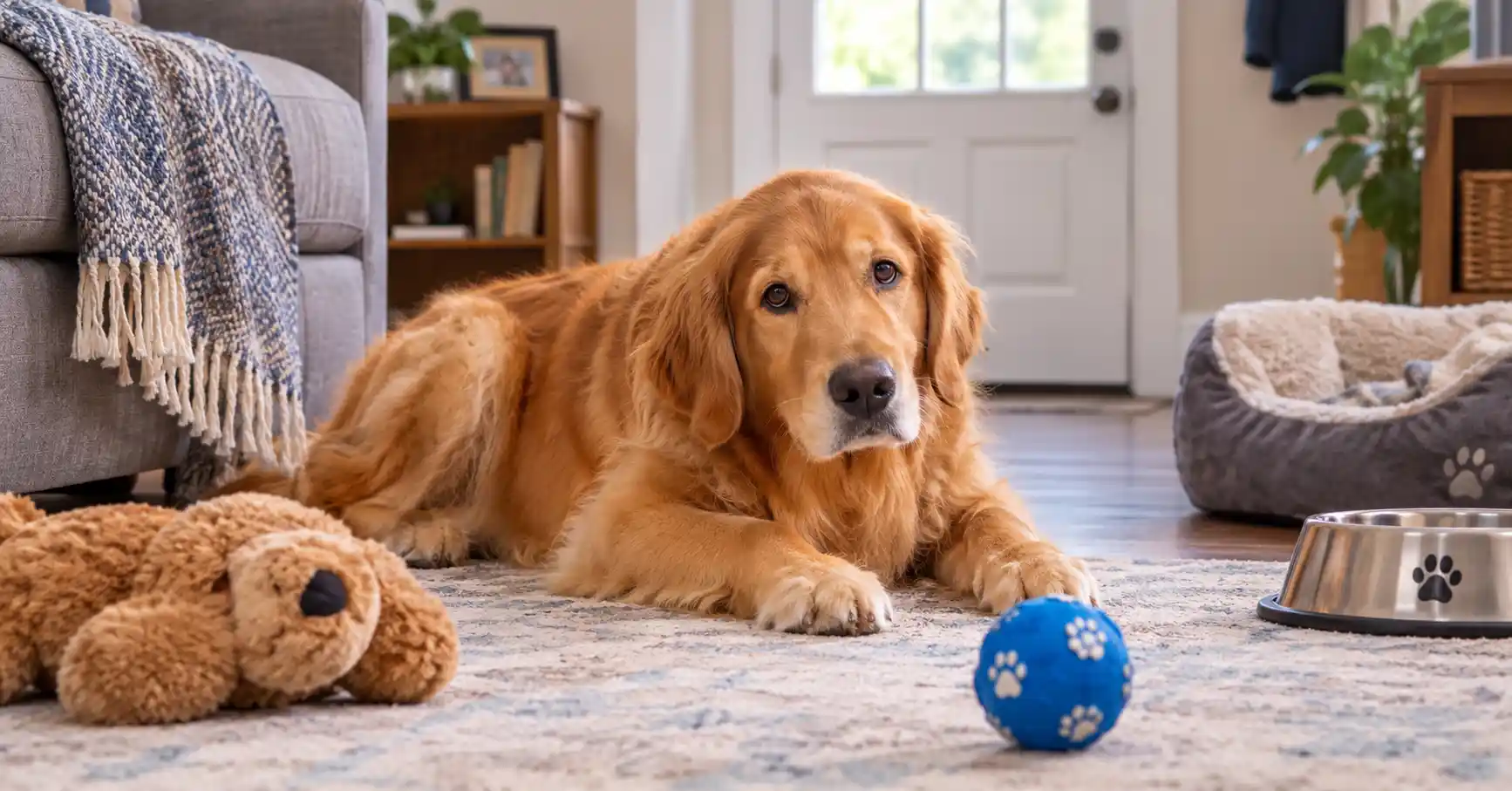
Ask how long can a golden retriever be left alone, and online answers range from two hours to a full workday. Welfare groups are more consistent. Most healthy adults do best with about four hours, a few manage six, and puppies need far less.
Eight hours goes beyond what most of them advise. Those numbers still shift with age, health, and training, and some dogs show no obvious sign when they are struggling. This guide covers limits for each life stage, the signs your dog is not coping, and practical ways to make long workdays easier. The quick answer comes first.
How Long Can a Golden Retriever Be Left Alone?
Most adult Golden Retrievers should be left alone for no more than about four hours at a stretch, and a well-trained, well-exercised adult may handle up to six. Puppies need much shorter breaks. Senior dogs often do too. Eight hours is longer than most welfare charities recommend.
| Life stage | Typical limit | What to keep in mind |
| Puppy (under 6 months) | About 1 to 3 hours | Frequent toilet breaks; build up very slowly |
| Adult (1 to 7 years) | About 4 hours, up to 6 for some | Depends on training, exercise, and health |
| Senior (roughly 7 and older) | About 2 to 4 hours | Joint comfort and bathroom needs |
These ranges draw on guidance from groups such as the RSPCA and PDSA, which put the regular limit for adult dogs near four hours, plus common rules of thumb for puppies.
Read them as ceilings for a calm, prepared dog, not goals to aim for. If your Golden shows stress when you leave, the right number is lower, and the rest of this guide explains how to find it.
Alone Time Limits by Age
Needs change a lot between the first weeks at home and the senior years. Each stage has its own limits and its own reasons.
Puppies (8 weeks to 6 months)
Young puppies cannot hold their bladders for long, and they are still learning that home stays safe when you are out of sight. A common rule of thumb is about one hour for each month of age, with a ceiling of roughly three hours even for puppies close to six months. A three-month-old, for example, should not wait much longer than three hours.
Rescue groups such as Battersea advise that very young puppies should not really be left at all at first, and that time alone should grow very gradually. In the early weeks, plan for short absences, frequent toilet trips, and a helper who can drop in if you work away from home.
Adult Goldens (1 to 7 years)
Between one and seven years old, most Goldens fit the four-hour range that welfare charities recommend. PDSA’s guide, written with Dogs Trust and the RSPCA, says most dogs should not be left much longer than four hours. It also advises building up gradually once a dog is comfortable with short absences.
The AKC’s breed notes, approved by the Golden Retriever Club of America, say the breed needs daily exercise and social interaction and should not be left alone all day.
Some adults do well with five or six hours when they are healthy, trained, and well exercised. Treat that as the upper edge, and use it only while your dog stays relaxed.
Senior Goldens
Older Goldens often need more frequent bathroom breaks and a softer, more comfortable place to rest. Stiff joints can make it hard to get up, change position, or reach water. The AKC’s breed notes list hip dysplasia among the health issues sometimes seen in Goldens, so mobility is worth watching as your dog ages.
Some pet-care sources suggest keeping senior dogs to around two to four hours without someone checking in. Your vet is the best guide here. A dog with joint pain or other health needs may need an even shorter gap.
Is It Okay to Leave Your Golden Home for 8 Hours?
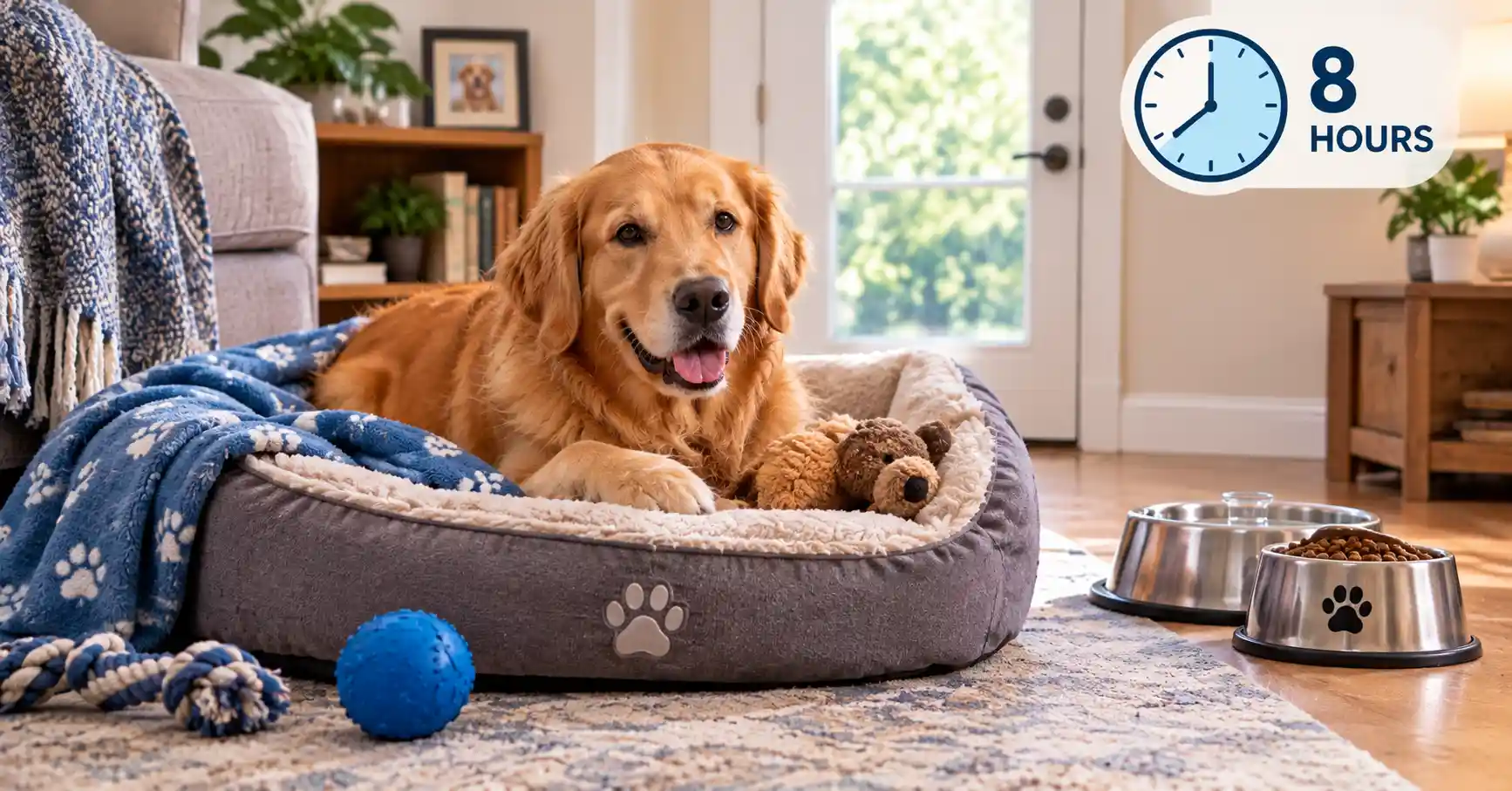
A standard workday plus a commute easily adds up to eight or nine hours away, so this is the question many owners face. It is also common. In an RSPCA survey, 39% of owners said their dog was home alone for seven hours or more on an average day.
Even so, eight hours is double the four-hour guideline. For most of that time, your Golden would have no chance to go outside, no company, and little to do. Puppies and seniors should not be left that long at all.
For a healthy, fully house-trained adult, the schedule can work if someone breaks up the day. A midday dog walker, a daycare visit, or a neighbor who lets your dog out turns one long stretch into two shorter ones. A dog with a good morning walk, a safe space, and something to chew may cope well with that setup.
Watch your dog’s behavior for the verdict. Pacing, barking, or accidents in a trained adult mean the schedule is too long. If midday help is not possible, look at other options, such as work-from-home days, a flexible start time, or dog daycare a few days each week.
Why Goldens Struggle More Than Some Other Breeds
The breed was developed as a bird dog, mainly for retrieving waterfowl, according to Hill’s Pet. That job means working beside a person and staying tuned in to a handler. The same traits that make Goldens easy to train and friendly with families also make long stretches of solitude hard. The AKC says they love to please their owners, and Hill’s rates the breed’s social and attention needs as high.
A friendly, easygoing dog is not the same as a dog who is comfortable alone. A Golden can greet strangers with a wagging tail and still feel unsettled once the door closes.
Energy adds to the problem. The AKC notes that Goldens who do not get enough exercise are prone to misbehaving, which can show up as chewing or restlessness when nobody is home.
Breed is not destiny, though. In the Generation Pup study covered below, breed showed no significant link to separation-related behavior. Early experiences and the way owners train and respond appear to matter more than the breed label.
What the Research Says About Dogs Left Alone
Research on dogs left alone is still growing, and much of it relies on owner reports. Even so, a few findings and several organizations’ guidelines give useful guardrails.
Studies on Separation-Related Behavior
A study in the journal Animal Welfare from the Royal Veterinary College and Dogs Trust, Canine separation-related behaviour at six months of age, followed 145 puppies from the Generation Pup project. Owners reported that 68 of them (46.9%) showed signs such as pacing, whining, or chewing when left alone at six months.
Puppies were less likely to show these behaviors if they had spent nights in a crate or room and slept at least nine hours a night before 16 weeks old. Puppies whose owners fussed over them on return, in response to unwanted behavior, were six times more likely to show them.
The authors call the work exploratory and correlational, so cause and effect are not proven. They also note that earlier studies reported rates from 6% to 55%, partly because the behaviors happen when nobody is watching.
What Welfare Organizations Recommend
The RSPCA recommends no more than four hours at a time for dogs who are happy being left, as its #DogKind campaign manager stated. PDSA’s guide, produced with Dogs Trust and the RSPCA, gives the same rule of thumb. The AKC gives no number. It says only that Goldens should not be left alone all day.
The groups agree on the bigger points: build alone time gradually, and watch how your dog behaves. The RSPCA also suggests filming your dog while you are out.
The Generation Pup paper cites the four-hour recommendation too. It adds that the longest time alone did not stay significant in its final analysis, and it calls for larger studies. Until those exist, the charities’ guideline remains the safest benchmark.
Signs Your Golden Is Not Coping When You Leave
A dog cannot tell you how the day went, so the signs come from behavior and from what you find when you get home. Some are loud and obvious. Others are quiet.
Separation Anxiety vs. Plain Boredom
The Generation Pup authors use the term “separation-related behavior” because the feeling underneath could be frustration, fear, anxiety, or boredom. You may not be able to tell which one is at work. A few clues can still help you describe what you see to a vet or trainer.
| Clue | Often points to distress | Often points to boredom |
| Timing | Starts within minutes of you leaving | Builds after a quiet stretch |
| Location | Damage or noise near doors and exits | Chewing spread around the house |
| Body language | Pacing, spinning, panting, drooling | Wandering, then settling down |
| Your return | Frantic, very excited greeting | Ordinary greeting |
Treat this table as a general guide, not a diagnosis. Filming your dog and sharing the footage with a vet or behaviorist gives a much clearer picture.
Destructive Behavior and Other Red Flags
The Generation Pup paper lists chewing and scratching near the door, barking, howling, whining, and toileting indoors as the most commonly reported signs. Pacing and spinning also appear. Subtler signs, such as panting, lip-licking, and drooling, may show up only on video, and owners can miss them.
The RSPCA has warned that half of all dogs show no signs that they are struggling. A quiet dog is not always a comfortable one.
Call your vet if accidents begin in a house-trained dog, since the paper notes toileting problems can have medical causes. A vet or qualified behaviorist should also see any dog whose signs get worse, or who hurts itself trying to escape.
What Changes How Long Your Dog Can Cope
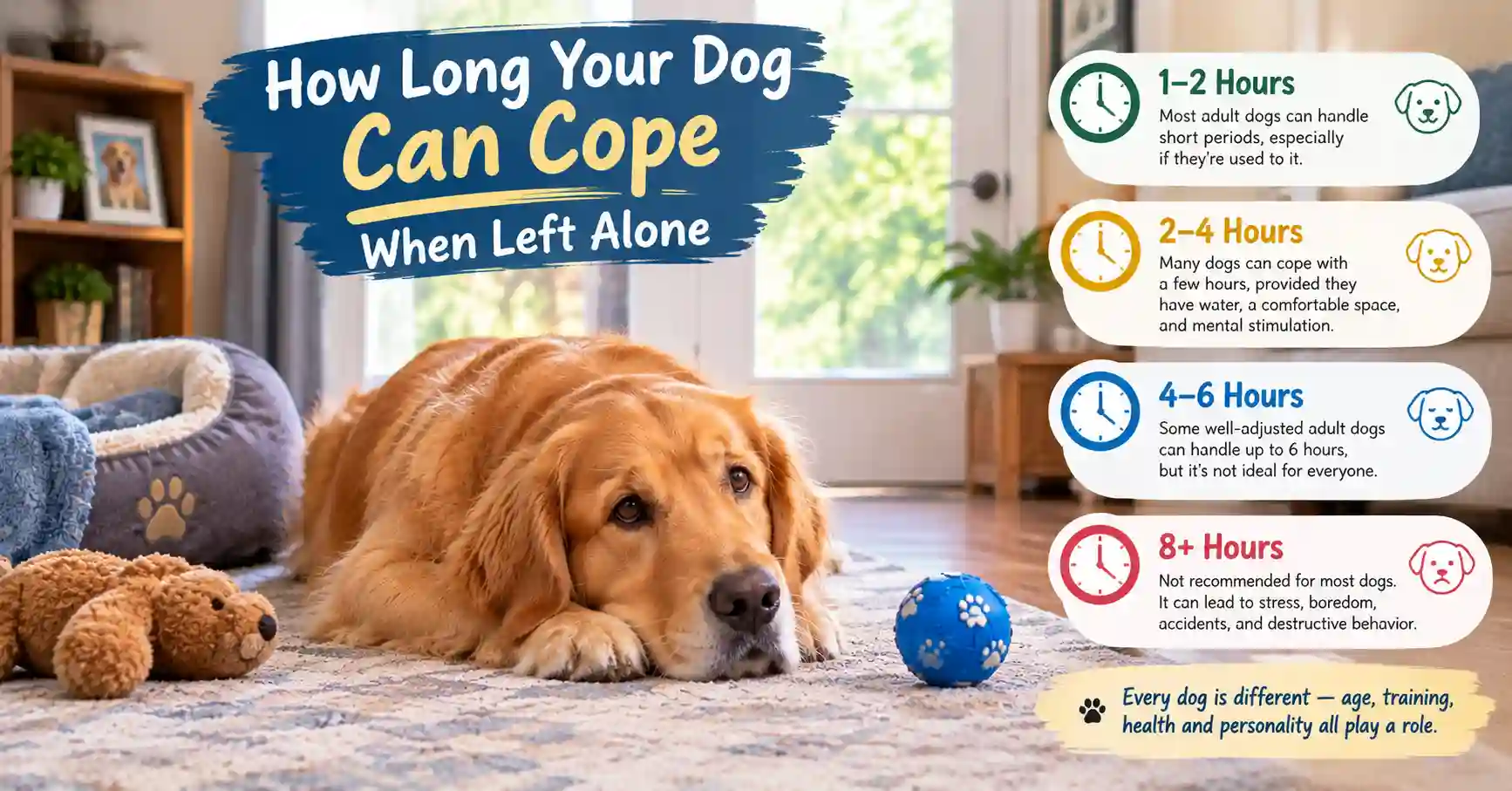
Four hours is a starting point. These factors can move the number up or down:
- Age and health. Puppies, seniors, and dogs with joint, bladder, or other medical needs usually cope with less time alone than a healthy adult.
- Past experience. A dog who has built up alone time slowly handles it better than one who is suddenly left for long periods. Earlier research cited in the Generation Pup paper reported higher rates of separation-related behavior in dogs from shelters and rescue centres, so adopted dogs may need extra patience.
- Exercise level. One earlier study cited in that paper linked lower daily exercise to more separation-related behavior. A tired, satisfied Golden is more likely to rest.
- Home setup. A safe room, fresh water, and a comfortable temperature matter. The AKC notes the breed’s thick coat, so a hot, stuffy room is a poor choice.
- Weather. PDSA warns that vehicles can become dangerously hot within minutes, so a car is never a place to leave your dog.
Several of these factors stack. A young, fit, well-trained Golden in a cool, safe home can manage more than an older dog with sore joints in a warm one.
How to Prepare Your Dog Before You Walk Out
Start with exercise. The AKC says daily exercise plays a key role in a Golden’s behavior, and Hill’s lists more than 40 minutes a day as a baseline for the breed. Treat that figure as a floor, since many Goldens enjoy much more.
Time the main walk shortly before you leave, and finish with a toilet break at the door. The RSPCA’s leaflet on learning to be left alone lists a toilet trip before leaving as part of good preparation.
Mental stimulation adds effort without extra miles. A slow sniffing walk, a short round of “find it,” a few minutes of retrieving, or a food puzzle can all help a Golden settle afterward.
Keep your departure low-key. The RSPCA suggests rewarding your dog for being relaxed, and the Generation Pup authors advise against effusive greetings when you return. Calm comings and goings teach your dog that leaving is ordinary and nothing to worry about.
Setting Up a Safe, Comfortable Space at Home
A good setup gives your dog a place to rest and something useful to do. Two choices matter most: whether to use a crate, and what to leave for entertainment.
Crate Training Basics
The research on crates is mixed. In the Generation Pup study, puppies who spent nights in an enclosed space, either a crate or a room, were less likely to show separation-related behavior. The authors caution that this result is correlational. They also cite an earlier video study in which crated dogs showed more yawning and lip-licking while alone.
A crate helps when your dog sees it as a den, introduced slowly with treats and calm praise. It does not help when it becomes a place of punishment. Common mistakes include forcing a dog inside, using it as a time-out, and leaving the dog there for long stretches. If your Golden resists, a gated, dog-proofed room is a fair alternative.
Toys and Puzzle Feeders That Keep a Golden Busy
The RSPCA’s leaflet suggests rewarding relaxed behavior when you leave and mentions long-lasting treats as one option. Hollow rubber toys stuffed with dog-safe food, puzzle feeders, and sturdy chews sized for a large breed all fit that idea.
Check each item for wear before every absence, and remove anything that is splintering or coming apart. Ask your vet about safe chews if you are unsure. Rotating toys, and saving a few favorites for the times you leave, can keep them interesting.
Teaching a Puppy to Be Comfortable on Their Own
PDSA notes that training is often easier to start in puppyhood, so your dog learns that time alone is not scary. A gradual approach works best:
- Start tiny. Practice while you are in the next room, then step out of sight for a few seconds.
- Reward calm. Give praise or a chew when your puppy stays relaxed, not when they fuss.
- Add time slowly. Lengthen the gap in small steps, and go back a step if your puppy gets upset.
- Move toward real departures. Once short absences go well, practice with the door closed and your puppy in their usual space.
- Keep returns quiet. Greet your puppy calmly, and avoid making a fuss about unwanted behavior.
Skip long, emotional goodbyes and sudden long absences. The Generation Pup study linked heavier use of aversive training, such as telling a puppy off or using noise to distract it, to higher odds of separation-related behavior, so punishment is a poor tool here.
The paper’s authors also suggest that brief early experiences of being alone, along with plenty of sleep, may help prevent later problems. Plan rest times into your puppy’s day.
Midday Help: Daycare, Sitters, and Other Options
If your workday is longer than your dog’s limit, a midday break splits it into shorter stretches. Each option has trade-offs.
| Option | Best for | Drawbacks |
| Dog daycare | Social, high-energy adults | Costs add up; busy groups do not suit every dog |
| Dog walker | Dogs who need a toilet break and exercise | A walk covers only part of the day |
| Dog sitter (home visit) | Dogs who prefer their own space | Visits are short, so gaps remain |
| Trusted neighbor or friend | Occasional or backup help | Depends on their schedule and reliability |
Whoever you choose, ask about their experience with large dogs and how they handle emergencies. Ask what they will do if your Golden seems unwell or stressed, and whether they will send updates. A short trial visit while you are home lets you see how your dog responds before you rely on the arrangement.
Common Myths About Leaving Goldens Alone
“A calm dog doesn’t need company.” A quiet dog can still be struggling. The RSPCA says half of all dogs show no sign that they are not coping, so calm behavior at the door tells you little about what happens after you leave.
“A second dog solves everything.” Sometimes it helps. One study cited in the Generation Pup paper found that dogs raised with another dog were less likely to show separation-related behavior at 21 months. The authors call this a novel finding and say the effect may vary, so a second dog is no guaranteed fix.
“Tiring them out means they can be left all day.” Exercise helps a dog rest, but it does not replace toilet breaks or company. The AKC’s breed notes still say Goldens should not be left alone all day.
“A dog who sleeps while you are gone is fine.” Rest is normal, and the Generation Pup study linked more night sleep in early life to fewer problems later. Sleep during one stretch does not show how your dog feels across the whole day. A camera gives a clearer view.
Realistic Weekday Plans for Working Owners
These sample schedules show how exercise, bathroom breaks, and company can fit around work. They are examples, not rules. Adjust the details to your dog’s age, health, and energy.
| Schedule | Morning | Midday | Evening |
| Office worker (away about nine hours with commute) | Main walk, breakfast, toilet break before leaving | Walker, daycare, or sitter visit with a short walk | Play, training, and a second walk |
| Hybrid worker (two to three office days) | Same routine on office days; short walk on home days | Home days: a lunchtime break; office days: sitter or daycare | Longer walk on home days |
| Long-shift worker (10 hours or more) | Early walk and breakfast | Daycare for the full shift, or two sitter visits | Calm evening; weekend exercise and training |
For long shifts, a single visit is not enough. Plan on full-day daycare, a second person who can stay, or two breaks during the day. If none of those is possible, it may help to rethink the schedule or wait to adopt a Golden until your routine fits the dog’s needs.
What Owners Say Online vs. What Works

Online forums are full of strong opinions. Some owners say their Golden happily stays home for eight or ten hours. Others describe dogs that chew doors or bark for hours after a short trip. Both kinds of stories are real, and they show that individual dogs vary.
Forum posts have limits, though. Most owners report what they see when they get home, not what happens while they are gone. Since the RSPCA says half of dogs show no sign of struggling, an owner may truly believe their dog is fine when the dog is quietly coping.
Stories that describe gradual training, midday breaks, and camera checks reflect good practice. Stories that rest on “mine is fine” with no sign of what the dog does while alone can mislead. The safest approach is to watch your own dog, ideally on video, and let that evidence outweigh anyone else’s experience.
Frequently Asked Questions
Can a Golden Retriever be left alone overnight?
Sleeping in the same house as you is not the same as being left alone. A Golden can rest overnight with family nearby, ideally in a comfortable crate or room. Leaving the house empty overnight creates a gap far longer than the four-hour guideline, so it is not advisable. If you must travel, arrange a sitter who stays with your dog.
Can I leave my Golden for a weekend with only a visit from a sitter?
A short daily visit leaves most of the day empty, so it falls well short of what a Golden needs. Dogs need company, toilet breaks, and exercise throughout the day. A live-in sitter, a trusted home boarder, or a reputable boarding kennel is a better fit. Arrange a trial stay before the trip to see how your dog copes.
Does a second dog help with loneliness?
Sometimes, but not always. One study cited in the Generation Pup paper found that dogs raised with another dog were less likely to show separation-related behavior at 21 months. The authors call this a novel finding that may vary between dogs. Treat a second dog as a possible help, not a cure.
Are pet cameras worth using?
Yes, for most owners. The RSPCA suggests filming your dog while you are out to spot signs of loneliness, and PDSA says a pet camera or app can show whether your dog is comfortable and help you get back if they become distressed. A camera shows what is happening but does not fix it.
Final Thoughts
Most healthy adult Goldens do best with about four hours alone, and a few handle six. Puppies and seniors need less, and eight straight hours is more than welfare groups advise. Build alone time slowly, exercise your dog before you leave, and set up a safe space with something to chew.
Your next step is simple: film your dog during a normal absence this week. Watch for pacing, panting, whining, or damage near the door, and note when it starts. If you see any of those, shorten the gap and arrange midday help. If signs continue, talk to your vet first, then a qualified behaviorist.
If your work hours leave long gaps, daycare, a sitter, or a trusted neighbor can split the day into manageable parts. Small, steady changes add up: a midday walker, a few minutes of calm practice, and a low-key greeting at the door. Your Golden does not need perfection. Your dog needs a routine that fits their limits and a person who pays attention to how they cope.

Hi, I’m Jack Austin, founder of Cool Goldens. I share practical, research-backed advice on training, nutrition, and daily care to help you give your Golden Retriever the happiest, healthiest life possible.