

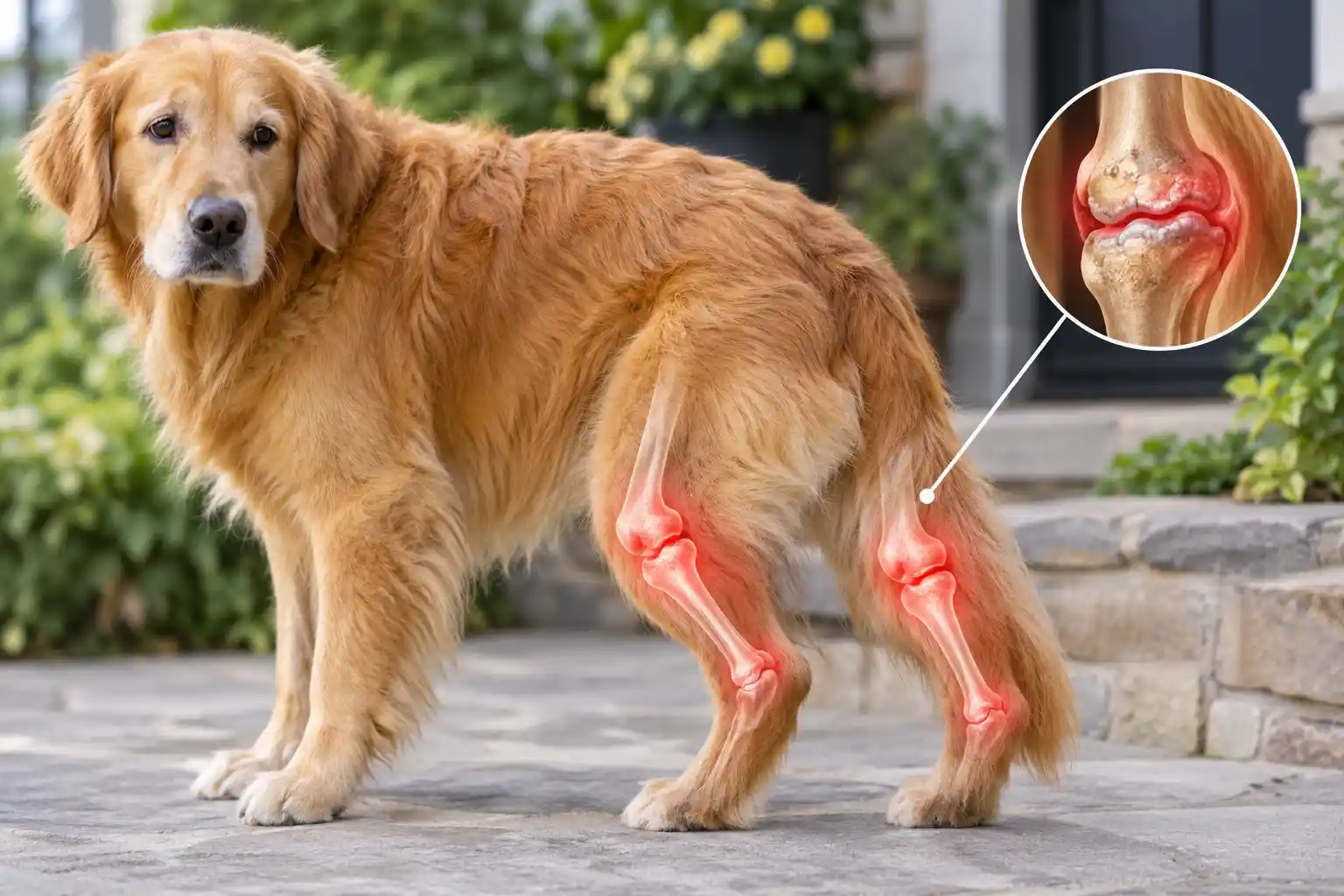
The tennis ball rolls to a stop at your Golden’s feet, and he doesn’t chase it. Arthritis in a Golden Retriever’s back legs is a common reason for that change. It usually builds after hip dysplasia or a knee injury, and only a vet exam can confirm it. The good news is that the pain can often be managed well.
Not every weak back leg is arthritis, though, and a few causes need help within hours. The sections below sort out which signs can wait and which cannot, which treatments and supplements have real evidence behind them, and which common beliefs about “old dog stiffness” are worth dropping. First, the short version of what helps.
Why a Golden’s Back Legs Weaken and What Helps
Back leg weakness in a Golden Retriever most often comes from osteoarthritis, a long-term joint condition in which cartilage wears down and the joint becomes inflamed and painful. It commonly follows hip dysplasia or a cruciate ligament injury. A vet can confirm it with an exam and X-rays, and care usually combines pain control, weight management, and home changes.
Here is the short version of what helps:
- Get a diagnosis. A vet exam and X-rays show which joint is involved and rule out other causes.
- Control pain and weight. Vet-approved medicine, a measured diet, and a lean body shape take pressure off sore joints.
- Adjust daily life. Traction on slippery floors, a soft bed, ramps, and short, steady walks protect the joints without taking away your dog’s activity.
Arthritis has no cure, but many dogs feel much better when pain is treated early and the plan is adjusted over time. One warning comes before everything else. If your Golden suddenly cannot use the back legs, drags them, or loses control of the bladder or bowels, go to an emergency vet right away. The next section explains what to watch for.
Back Leg Warning Signs That Need a Vet Right Away
Not every change in the back legs carries the same urgency. Sorting what you see into three groups helps you decide how fast to act.
Go to an emergency vet now:
- Sudden inability to stand, or back legs that give way or drag
- Severe pain, crying out, or a hunched, trembling posture
- Loss of bladder or bowel control
- A back leg held off the ground after a fall or accident
Book a visit within a few days:
- New limping that lasts more than a day or two
- Stopping on walks, or refusing stairs and car jumps
- Yelping when you touch the hips or lower back
- Licking or chewing at one joint, or a joint that looks swollen or feels warm
Mention it at the next checkup, and start taking notes:
- Slower rising in the morning that eases after a few minutes
- Shorter play sessions
- Mild stiffness after a long rest
The top group matters most. Sudden weakness can point to a spinal disc problem or another serious condition, and some of these get worse quickly. Waiting a day to see what happens can cost a dog function it might otherwise keep. When you are unsure which group your dog belongs in, call your vet and describe what you see. Most clinics will tell you how fast to come in.
What Is Happening Inside the Joint, and Why Goldens Are at Risk
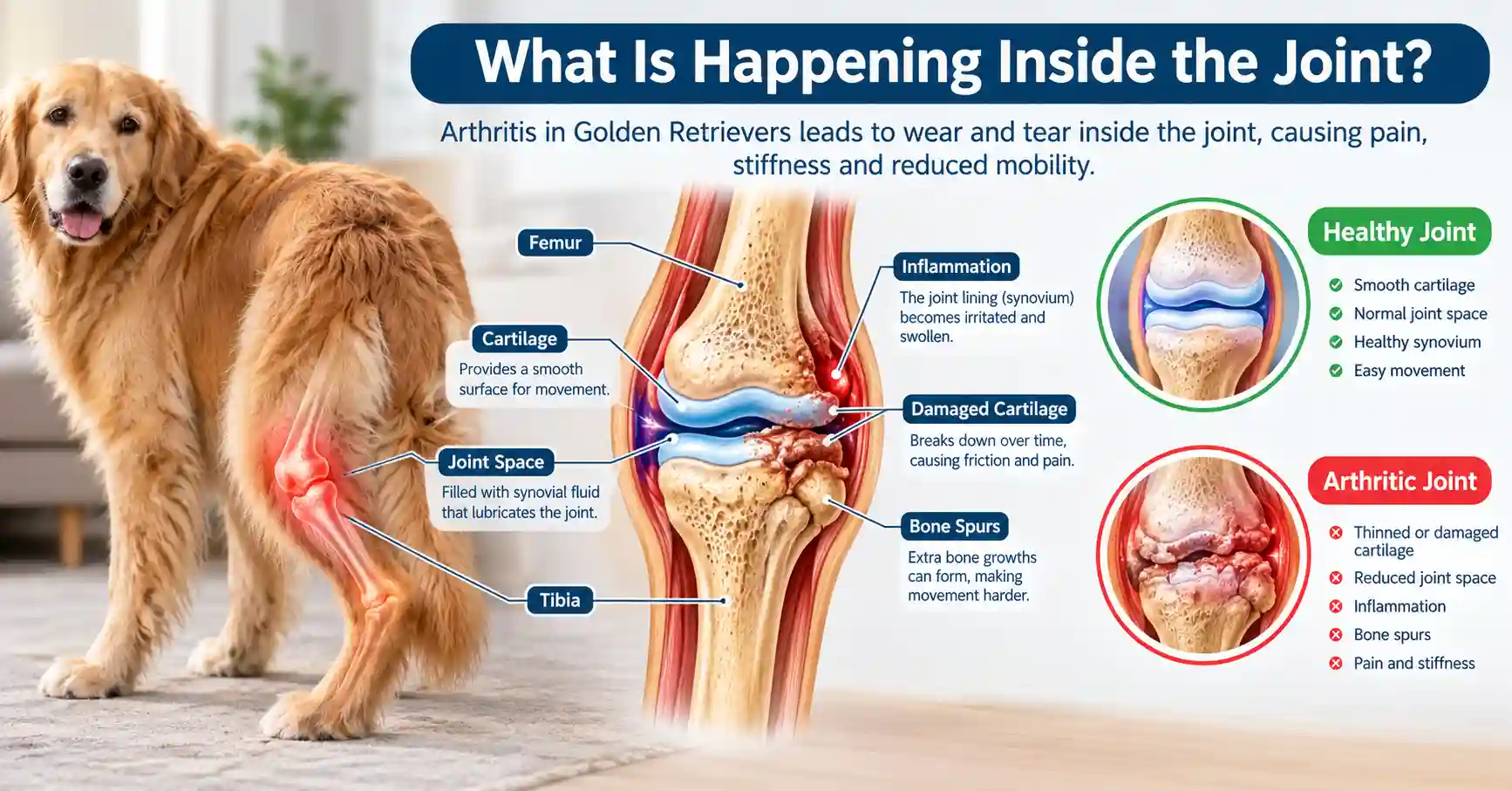
Arthritis builds slowly, and a few traits of the breed speed it along. Knowing how the process works makes the treatment choices later in this guide easier to follow.
How canine arthritis (osteoarthritis) develops
A healthy joint has smooth cartilage that cushions the bone ends, plus a thin layer of fluid that lets them glide. In osteoarthritis, that cartilage thins and roughens. The joint lining becomes inflamed, the fluid loses some of its protective quality, and the body may add extra bone around the edges. The joint gets stiffer and hurts more with use.
In the back legs, four areas take most of the wear: the hips, the knees (called stifles), the hocks (the ankle-like joints), and the lower spine. Many dogs have more than one affected joint, which is why the problem often looks like general weakness instead of a single sore leg.
Hip dysplasia and cruciate ligament injury
Two conditions often sit behind arthritis in Goldens. Hip dysplasia means the ball and socket of the hip do not fit together well, usually because of how the joint developed. The loose fit causes extra wear, and arthritis follows. The condition runs in families, so breeding choices matter.
The cruciate ligament is the main stabilizer inside the knee. A tear or partial tear lets the joint slide in ways it should not. Even after treatment, the damaged knee tends to develop arthritis over time. Both conditions are common in large breeds, and either one can start the process years before you see obvious stiffness.
Weight, age, and retriever drive
Extra body weight adds load to every joint and also releases inflammatory chemicals, so it speeds up the damage. Age matters too, since cartilage has had more years of wear. Then there is the breed’s personality. Goldens love to fetch, swim, and please their owners, and many keep playing through discomfort.
The thick coat adds another problem. It can hide swelling, weight gain, and thinning thigh muscles. Many vets say Goldens hide pain well, though this is a common observation and not a measured fact. The practical lesson is to feel your dog’s body, not just look at it.
Signs of Arthritis in Golden Retrievers
Arthritis rarely announces itself with a dramatic limp. It shows up as small changes in routine that pile up over months. Spotting them early gives your vet more options.
Early signs owners often miss
The first clues usually appear around rest and effort. Your Golden may take longer to stand up after a nap, then loosen up after a few minutes of walking. He may stop at the bottom of the stairs, hesitate before jumping into the car, or cut play sessions short.
Other early signs include licking one joint, sitting down more often on walks, and lagging behind. Some dogs become a little grumpy when touched near the hips or when another dog bumps into them. Mood shifts count as symptoms. A dog who pulls away from a hug he used to love may be telling you something hurts.
Signs of advanced joint pain
As arthritis progresses, the signs get harder to miss. Look for “bunny hopping,” where both back legs move together when your dog runs, and for sitting with one leg kicked out to the side. Slipping on tile or wood floors, struggling to climb into the car, and yelping when rising are common.
Muscle loss, called muscle atrophy, is another important sign. Because dogs spare a painful leg, the thigh muscles shrink from lack of use. Run your hands down both thighs and compare them. A visible or palpable difference between sides, or very thin hindquarters compared with the shoulders, deserves a vet visit. Some dogs also pant at night, pace, or struggle to settle.
Is It Arthritis or Something Else? Conditions That Look Alike
Weak or stiff back legs have several possible causes, and some need very different care. This table shows how the main ones compare. It is a guide for your conversation with the vet, not a way to diagnose your dog at home.
| Condition | Typical signs | How it differs from arthritis | Urgency |
| Hip dysplasia | Bunny hopping, trouble rising, stiff back end | Often starts in a young dog; arthritis often develops from it | Vet visit within days |
| Cruciate ligament tear | Sudden hind-leg limp, toe-touching, sitting with the leg out | Often begins suddenly after activity; the knee feels unstable | Vet visit within a day or two |
| Lumbosacral disease | Pain at the lower back or tail base, trouble jumping, low tail | Pain centers on the lower spine and may involve nerves | Vet visit soon |
| Intervertebral disc disease | Back pain, wobbling, scuffing or knuckling of paws | Nerve signs can appear and worsen fast | Emergency if sudden or worsening |
| Degenerative myelopathy | Slow back leg weakness, scuffing toes, crossing legs | A nerve disease, usually not painful | Vet visit soon |
| Bone cancer (osteosarcoma) | Steady lameness, swelling at one spot | Gets steadily worse and does not settle with rest | Prompt vet visit and X-rays |
| Hypothyroidism | Weight gain, low energy, dull coat, stiffness | A hormone problem diagnosed by blood test; can add to weakness | Vet visit, usually not urgent |
Two points matter here. First, arthritis often sits on top of another condition, so a dog can have hip dysplasia and arthritis at the same time. Second, the right treatment depends on the cause. A torn cruciate may need surgery, a hormone problem needs medication, and a spinal condition may need strict rest. Treating all of them as simple “old dog stiffness” can delay the right care.
How Vets Diagnose Back Leg Arthritis
Diagnosis starts with a hands-on exam. Your vet will watch your dog stand, walk, and trot, then feel each joint, checking for pain, swelling, grinding, and range of motion. The thigh muscles get compared side to side. The vet may also check the spine and test reflexes to rule out nerve problems.
X-rays usually come next. They show bone changes around the joints, the fit of the hips, and signs that point to other conditions. Because a sore dog may not lie still, many clinics use light sedation for clear pictures. Bloodwork often follows, both to look for other causes and to check kidney and liver health before starting long-term medication.
Some cases need extra tests, such as advanced imaging or joint fluid analysis, especially when the vet suspects a spinal or cancer-related cause. Expect a plan that fits what the exam finds, not a single standard set of tests.
How to prepare for the appointment
A little preparation helps your vet see what you see at home. Dogs often move better in the clinic because of excitement, so evidence from home carries weight.
- Record a video of your dog walking, trotting, rising from rest, and climbing stairs or into the car.
- Note the pattern: when stiffness is worst, how long it lasts, and what makes it better or worse.
- List everything your dog takes, including supplements, treats with added ingredients, and any pain medicine.
- Write down activity history, such as past injuries, new exercise habits, or recent weight changes.
- Bring your questions, including what the plan will cost and how you will measure progress.
Medications and Vet Treatments for Joint Pain Relief
Most dogs do best with a combination of treatments that work in different ways. Your vet will choose based on your dog’s age, other health conditions, and how much pain he has. This table gives a plain overview. It does not include doses, which only your vet should set.
| Treatment type | Examples | What it does | Main cautions |
| NSAIDs | Carprofen, meloxicam | Reduce inflammation and pain | Need bloodwork and monitoring; stomach, kidney, and liver risks |
| Joint injections | Series of injections that support joint health | Aim to protect cartilage and ease signs | Given by a vet; response varies |
| Antibody injection | Monthly injection that targets a pain-signaling protein | Blocks a pain signal involved in arthritis | Availability and safety information have changed; ask for current details |
| Add-on medicines | Gabapentin, amantadine | Help hard-to-control or nerve-related pain | Can cause drowsiness; vet-directed use only |
Non-steroidal anti-inflammatory drugs (NSAIDs)
NSAIDs are the most common prescription for arthritis pain, and they often bring a clear improvement within days. Veterinary versions, such as carprofen and meloxicam, are made and tested for dogs. They lower inflammation inside the joint, which eases pain and stiffness.
These medicines can irritate the stomach and affect the kidneys and liver, so vets usually run bloodwork before starting and at regular checks afterward. Report vomiting, diarrhea, black or tarry stool, loss of appetite, unusual tiredness, or a big change in drinking and urination right away. Never combine an NSAID with another anti-inflammatory unless your vet says so.
Other prescription and injectable options
NSAIDs do not suit every dog, and some dogs need more than one type of help. Vets may add gabapentin or amantadine for pain that does not respond well to anti-inflammatories. These medicines work on the nervous system’s pain pathways, and both can cause sleepiness, especially at first.
Injectable choices include a series of joint-support injections and, in some countries, a monthly antibody injection that blocks nerve growth factor, a protein involved in arthritis pain. The details of approval, labeling, and safety information for newer drugs change over time and differ by country. Ask your vet what is currently available and what the known risks are for a dog like yours.
Never give human painkillers
Ibuprofen, naproxen, aspirin, and acetaminophen (paracetamol) are not safe to guess with in dogs. Ibuprofen and naproxen can cause stomach ulcers and kidney damage, even in small amounts. Acetaminophen can harm the liver and red blood cells. A dose that looks small for a person can be dangerous for a dog.
If your Golden is hurting and you cannot reach your regular vet, call an emergency clinic or a pet poison hotline instead of opening the medicine cabinet. They can tell you what, if anything, is safe to give. The same rule applies to leftover prescriptions meant for another pet or a family member.
Laser, acupuncture, and stem cell therapy
Some clinics offer therapeutic laser, acupuncture, and stem cell treatments. Each has supporters, and some owners report better comfort in their dogs. The research is less settled. Studies on these options vary in size and quality, and results differ from dog to dog.
Stem cell therapy deserves particular care. It is often described as repairing cartilage, but research is still limited, and most vets treat it as an add-on, not a first choice. It does not cure arthritis. If a clinic promises dramatic results, ask what evidence supports that claim, what the treatment costs, and how they will measure whether it worked.
Canine Joint Supplements: What Has Evidence and What Does Not

Supplements can support a treatment plan, but they cannot replace one. The market is crowded, and quality varies, so it helps to know which ingredients have research behind them.
- Omega-3 fatty acids (EPA and DHA from fish oil): Among common options, these tend to have the stronger research support in dogs for easing joint discomfort.
- Glucosamine and chondroitin: Very popular, but studies give mixed results. Some dogs seem to benefit, and others show little change.
- Green-lipped mussel: Some studies suggest benefit, though quality varies.
When you shop, check the label for the amount of active ingredient per serving, not just the ingredient name. Look for a quality seal, such as the National Animal Supplement Council (NASC) seal, which signals that the maker follows quality standards. Skip human products unless your vet approves, since some contain xylitol, which is toxic to dogs.
Give a new supplement a fair trial of several weeks before judging it, and change only one thing at a time so you can tell what helps. Tell your vet about everything your dog takes, because some products can interact with medication.
Weight Management: The Most Useful Thing You Can Control
Few changes help an arthritic Golden more than staying lean. Every extra pound adds load to the hips and knees, and body fat releases substances that feed inflammation. Many owners underestimate how heavy their dog is, because the thick coat hides the shape underneath.
Use your hands. Run them along the ribs. You should feel them easily under a thin layer of padding, much like the back of your hand. Look down from above, and you should see a waist behind the ribs. From the side, the belly should tuck up toward the hind legs. Vets use a 9-point body condition score, and most dogs do best near the middle of that scale. Ask your vet to score your dog and set a target weight.
Practical steps work better than strict rules:
- Measure meals with a scale or measuring cup instead of scooping by eye.
- Count treats as part of the daily food total, and switch to low-calorie options.
- Weigh your dog every few weeks and record the numbers.
- Ask your vet before cutting food. Some dogs need a special weight-loss diet.
Weight loss is slow and boring, and it works.
check our free Golden Retriever Weight & Growth Calculator
Exercise, Physical Therapy, and Hydrotherapy Benefits
Rest alone does not help an arthritic joint. Movement keeps the muscles strong, and strong muscles absorb shock that the joints can no longer handle. The goal is steady, controlled activity that avoids sudden strain.
Safe daily movement
Several short walks usually beat one long outing. Two or three 15 to 20 minute leash walks at an even pace are gentler than a long weekend hike. Keep the surface level and forgiving, such as grass or packed dirt. Skip jumping, sharp turns, and long ball-chasing sessions, which cause the injuries that arthritis makes worse.
Retrieving can stay in your dog’s life in a modified form. Roll the ball a short distance on the ground instead of throwing it far, and stop while your dog still wants more. Watch him afterward. Stiffness or limping later that day or the next morning means you did too much, so scale back next time.
Hydrotherapy and swimming
Water supports body weight, so joints take less impact while muscles still work. Many Goldens already love swimming, which makes this a natural fit. Hydrotherapy at a rehab clinic often uses an underwater treadmill, where a trained therapist controls water depth and speed for your dog’s needs.
Swimming at a lake or pool can also help, with care. Dry your dog afterward and keep him warm, since cold, wet joints stiffen. Avoid rough water, long sessions, and slippery exits. A dog with certain conditions, such as an unhealed surgery site, should not swim until the vet approves.
Home physical therapy basics
A rehab therapist or vet can teach simple exercises to do at home. Common examples include slow sit-to-stand repeats, weight-shifting, walking slowly uphill, and stepping over low poles. These build the muscles that protect the hips and knees.
Learn the exercises in person first. Done wrong, even gentle movements can strain a sore joint. Ask to see them demonstrated on your dog, and ask how many repetitions to do and what signs mean you should stop. Short, regular sessions work better than occasional long ones.
Home Changes and Mobility Aids That Make Daily Life Easier
Small changes around the house can cut the number of painful moments in your dog’s day. Many cost little, and the effects show up quickly.
Floors and traction
Smooth floors are a major hazard for weak back legs. Every slip strains the joints. Lay rugs or runners along the paths your dog uses most, such as from the bed to the door and from the kitchen to the water bowl. Yoga mats and rubber-backed runners work well and are easy to replace.
Trim your dog’s nails so they do not push the paws out of position, and trim the hair between the paw pads for better grip. Some dogs also do well with traction-grip toe products or boots with grippy soles. Check that anything you add stays in place, since a sliding rug creates a new hazard.
Beds, ramps, and stairs
A thick orthopedic bed, usually memory foam, cushions the joints and makes standing up easier. Place it away from drafts and where your dog can reach it without climbing. Keep food and water at an easy height, and bring the bed to the room where the family spends time.
A ramp helps with the car and the couch, and it protects the back legs from repeated jumping. Choose one with a non-slip surface and a gentle slope, and train your dog to use it with treats. Baby gates can block stairs when your dog is unsupervised, which is safer than letting him decide.
Harnesses and leg support devices
A rear-support harness or sling lets you take some weight off the back legs while your dog climbs stairs, gets into the car, or walks after a hard day. Use one with padded straps and a handle you can grip comfortably. It should assist, not carry your dog’s full weight.
Braces and boots serve specific purposes. A knee brace, for example, is sometimes used after a cruciate injury, but only under vet guidance. Poorly fitted supports can rub the skin or shift the load to other joints. Ask your vet or a rehab professional to fit any device before you buy it.
Safe Heat, Cold, and Massage for Sore Joints
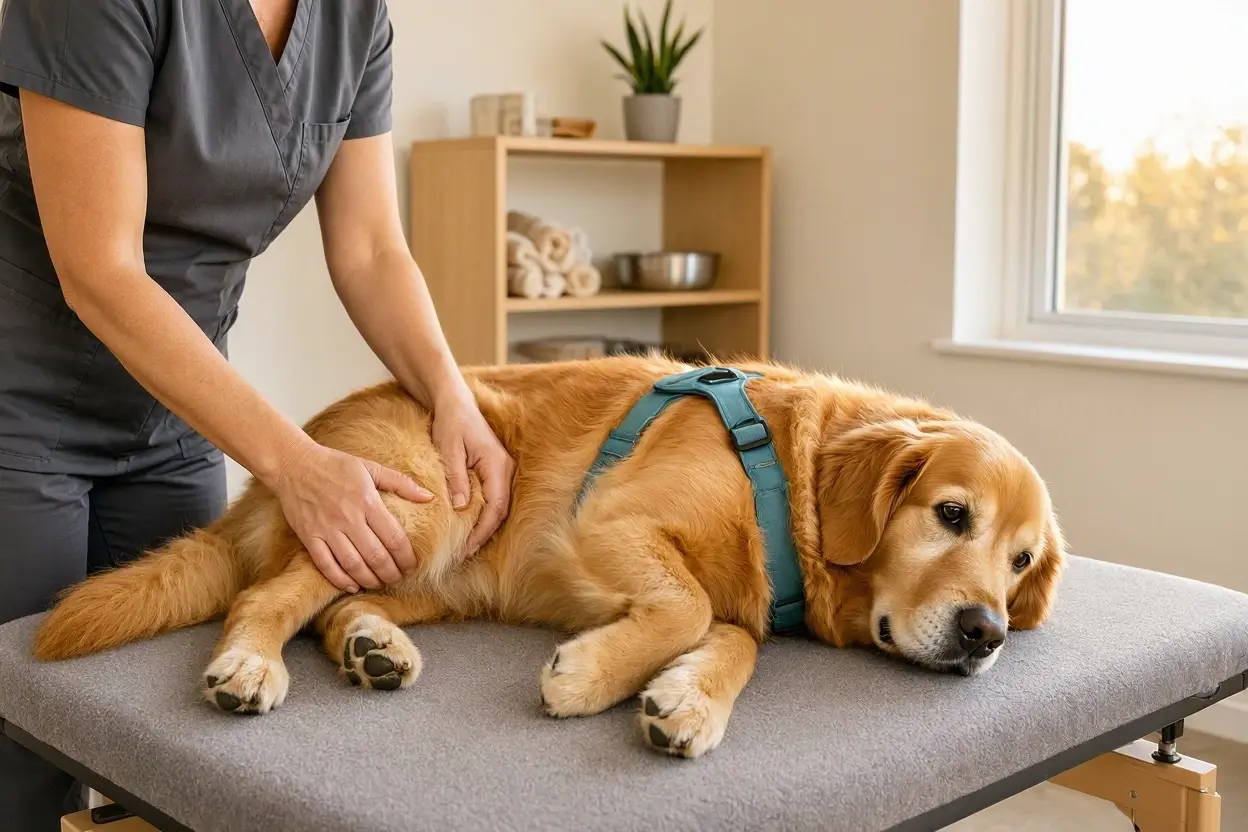
Heat and cold are simple comforts, but the wrong choice at the wrong time can backfire. As a general rule, vets often suggest warmth for stiff, chronic joints and cold for a sudden flare-up or fresh injury. Ask your vet which fits your dog’s situation.
For warmth, use a warm, damp towel or a heating pad on a low setting wrapped in a cloth. Keep sessions short, around 10 minutes, and stay with your dog the whole time. Check the skin often. Never use a heating pad on high, never place one directly against the skin, and never leave a dog unsupervised, because dogs can burn without showing it.
For cold, wrap an ice pack in a thin towel and apply it gently for a short session. Stop if your dog pulls away.
Gentle massage along the muscles around the hip and thigh can ease tension and help you notice changes. Use slow, light strokes, and stop if your dog tenses or turns away. If a joint is newly swollen, hot, or very painful, skip home treatment and call your vet first. These signs can mean an injury or infection that needs a different approach.
What the Research Says About Goldens and Joint Disease
Advice about Golden Retrievers is only as good as the evidence behind it. These studies give a clearer picture, and each comes with limits worth knowing.
Orthopedic health data for the breed
Hip dysplasia is among the best-documented joint problems in Goldens. A Michigan State University veterinary school article reported that the Orthopedic Foundation for Animals (OFA) had evaluated 152,272 hip X-rays since 1974, and that about 20 percent of the joints were abnormal. You can read it at Michigan State University College of Veterinary Medicine.
That figure comes from a voluntary database, so it does not describe every Golden. Breeders and owners choose whether to submit X-rays. It still shows why hip health matters in this breed and why breeders screen for it.
Neutering age and joint risk
Researchers at the University of California, Davis studied 15 years of hospital records for 35 breeds. According to the paper in Frontiers in Veterinary Science, earlier studies on Golden Retrievers, Labrador Retrievers, and German Shepherds linked neutering before one year of age to joint disorder rates two to four times those of intact dogs. The joint problems studied were hip dysplasia, cranial cruciate ligament tears, and elbow dysplasia. The UC Davis news summary explains the findings in plain language.
The study also found large differences between breeds and between sexes, and that in most breeds the age of neutering did not change the risk. These are hospital records, which show an association and not proof of cause. The authors say the timing decision belongs to the owner and the vet together.
Check our free Golden Retriever Age Calculator
Long-term Golden health research
The Morris Animal Foundation’s Golden Retriever Lifetime Study follows more than 3,000 Goldens over their lives. A published description of the study design says its main aim is to find risk factors for common cancers, while also collecting broader health and lifestyle information.
Because it tracks dogs from a young age, the study can notice patterns that one-time surveys miss. The UC Davis paper above also notes a report from the study that neutering before six months raised the risk of cruciate ligament injury. Results from this long project continue to appear, so ask your vet about newer findings.
Lean body weight and joint health
The best-known weight study followed 48 Labrador Retrievers from seven litters. In each pair, one dog ate 25 percent less food for life. As summarized in the British Journal of Nutrition, the leaner dogs had a median lifespan of 13.0 years compared with 11.2 years, and late-life diseases, especially osteoarthritis, started later.
Two limits apply. The dogs were Labradors, not Goldens, though both breeds are large, active retrievers. And a pet food company funded the research. The results still support what vets see in practice: leaner dogs tend to have healthier joints.
Common Myths About Arthritis in Older Goldens
Some beliefs about arthritis are common enough to cause real harm. Here are the ones vets hear most.
- “It’s just old age.” Age raises the odds, but pain is treatable at any age. Calling it normal can delay relief for years.
- “Rest is the best treatment.” Too much rest weakens the muscles that protect the joint. Controlled, regular exercise works better.
- “A supplement can cure it.” No supplement reverses arthritis. Some may ease signs, but they work alongside a vet plan.
- “A small dose of human painkiller is fine.” Even small doses can damage a dog’s stomach, kidneys, or liver. Use only medicine prescribed for your dog.
- “Heat always helps.” Warmth can soothe stiff joints, but it can worsen a fresh, swollen injury. Ask your vet first.
- “If he still wags his tail, he isn’t in pain.” A wagging tail shows a friendly dog, not a comfortable one. Goldens in particular may stay cheerful while hurting.
Tracking Pain and Quality of Life in a Senior Golden
Arthritis care works best when you measure it. Because pain changes slowly, it is easy to miss progress or decline unless you write things down.
Try a simple weekly check. Rate each of the past seven days as a good day or a bad day, and note appetite, how easily your dog rises, willingness to play, interest in walks, and sleep. Take a short video every month under similar conditions, such as walking down the same hallway. Comparing clips shows changes you might not otherwise notice.
Your vet may also use a validated pain questionnaire, such as the Canine Brief Pain Inventory, and a quality-of-life scale. These tools turn your daily observations into numbers that can guide treatment decisions.
Signs the plan is working include easier rising, longer walks, and more interest in play. Signs it needs a change include more bad days than good, new reluctance to move, or loss of appetite. If good days become rare and pain stays hard to control, talk openly with your vet about next steps, including how to protect your dog’s comfort in the long run. These conversations are hard, and you do not have to have them alone.
Can You Prevent Arthritis in a Golden Retriever?
You cannot guarantee a dog will never get arthritis, but several steps lower the risk and delay the start.
Choose carefully at the start. If you are getting a puppy, ask the breeder for the OFA or similar hip and elbow results of both parents. Screening does not remove risk, but it improves the odds.
Grow slowly. Keep puppies lean and avoid very rich diets that speed growth. Avoid repeated jumping, long runs on hard surfaces, and forced exercise during growth, when the joints are still forming.
Talk to your vet about neutering timing. The research above shows that timing can affect joint risk in some breeds, so it is worth discussing for your dog.
Protect the middle years. Keep your dog lean, trim nails, maintain traction at home, and build regular exercise early. Strong muscles cushion the joints for years.
Check often. Have your vet examine the hips and knees at annual visits, and report small changes early.
Prevention lowers risk, but it cannot remove it. Genetics, injuries, and age all play a part, so a dog who gets arthritis despite your efforts is not a sign that you did something wrong.
Frequently Asked Questions
Does cold weather make a Golden’s arthritis worse?
Many owners notice more stiffness in cold or damp conditions, and dogs often seem slower on chilly mornings. Research on weather and canine arthritis is limited, so treat it as a common observation. Keep your dog warm, offer a soft bed away from drafts, and allow a few minutes of gentle walking to loosen up before longer activity.
Is CBD oil safe or helpful for arthritis in dogs?
Evidence is still limited, and product quality varies widely. Labels may not match contents, and some products contain THC, which is harmful to dogs. CBD may also affect how other medicines work. Ask your vet before trying any product, and do not use it as a replacement for proven pain control.
Can arthritis affect only one back leg?
Yes. It often develops in a joint that has had a past injury, such as a knee after a cruciate tear, or in one hip that is more affected by dysplasia. The other leg usually takes extra load, so it can become sore too. Ask your vet to check both sides.
How much does arthritis care usually cost?
Costs vary by region, clinic, and treatment. Main expenses include the exam and X-rays, bloodwork, ongoing medication, supplements, rehab sessions, and sometimes surgery. Ask for a written estimate, and ask which items matter most. Pet insurance often excludes pre-existing conditions, so check the policy terms.
Can a young Golden have arthritis?
Yes. Conditions such as hip dysplasia and cruciate tears can cause joint damage and early arthritis in dogs under two. Limping, bunny hopping, or trouble rising in a young Golden deserves a vet exam. Early diagnosis opens more treatment options, and it protects the joint during the years of heavy activity.
Your Next Steps This Week
You do not have to fix everything at once. A few focused actions this week can make a real difference for your Golden.
- Book a vet visit, and bring a short video of your dog walking, rising from rest, and climbing stairs or into the car. List any supplements or medications your dog takes.
- Check body condition. Feel the ribs, look for a waist from above, and ask your vet for a target weight. Start measuring meals.
- Fix the floors. Put rugs or runners on slippery paths, trim nails, and add a soft, supportive bed.
- Start a simple pain log. Mark each day as good or bad and jot down one note about rising, walking, and play.
If your dog shows any emergency sign from earlier in this guide, skip the list and call a vet at once. Otherwise, take it one step at a time. Dogs with arthritis can still enjoy walks, swims, and time with their people when the pain is managed well, and the habits you build now will help your Golden stay comfortable in the years ahead.

Hi, I’m Jack Austin, founder of Cool Goldens. I share practical, research-backed advice on training, nutrition, and daily care to help you give your Golden Retriever the happiest, healthiest life possible.