


A border collie and golden retriever mix, sometimes called a Coltriever, is a crossbreed dog that pairs a herding dog’s sharp mind with a golden retriever’s gentle, people-focused nature. The result is usually intelligent, active, and eager to please, but that pairing also means a real commitment to daily exercise and mental work most households underestimate.
Size, coat, and temperament can vary quite a bit from one puppy to the next, depending on which parent’s traits come through stronger. Some owners end up with a dog that’s calm and biddable; others get a livelier shadow who wants a job to do. Knowing what shapes those differences, and what to actually expect week to week, makes the decision to bring one home far less of a gamble.
What Is a Border Collie Golden Retriever Mix?
A border collie golden retriever mix is a crossbreed dog produced by pairing a purebred border collie with a purebred golden retriever. These dogs typically stand between 18 and 24 inches tall and weigh anywhere from 40 to 75 pounds, though size can vary based on which parent a puppy takes after more.
They tend to inherit the golden retriever’s soft, friendly expression and the border collie’s alert, watchful eyes. Coat length and color vary quite a bit — some puppies come out looking almost like a small golden retriever, while others show more of the border collie’s black-and-white or merle patterning.
Behaviorally, this mix usually lands somewhere between the two parent breeds. Expect a dog that’s affectionate and social like a golden retriever, but with the border collie’s drive to work, learn, and stay busy. That combination makes for a rewarding pet, but only for owners who can keep up with the activity level.
Quick Facts Table
| Trait | Details |
| Size | 18–24 inches tall |
| Weight | 40–75 pounds |
| Lifespan | 10–14 years |
| Energy level | High |
| Shedding | Moderate to heavy, seasonal |
| Trainability | Very high |
| Good with kids | Yes, with proper socialization |
| Grooming needs | Moderate, weekly brushing minimum |
| Best living situation | House with yard or access to regular outdoor space |
This table gives a snapshot, but the sections below go into more detail on why these numbers matter and how they play out in daily life.
Border Collie Traits vs. Golden Retriever Traits
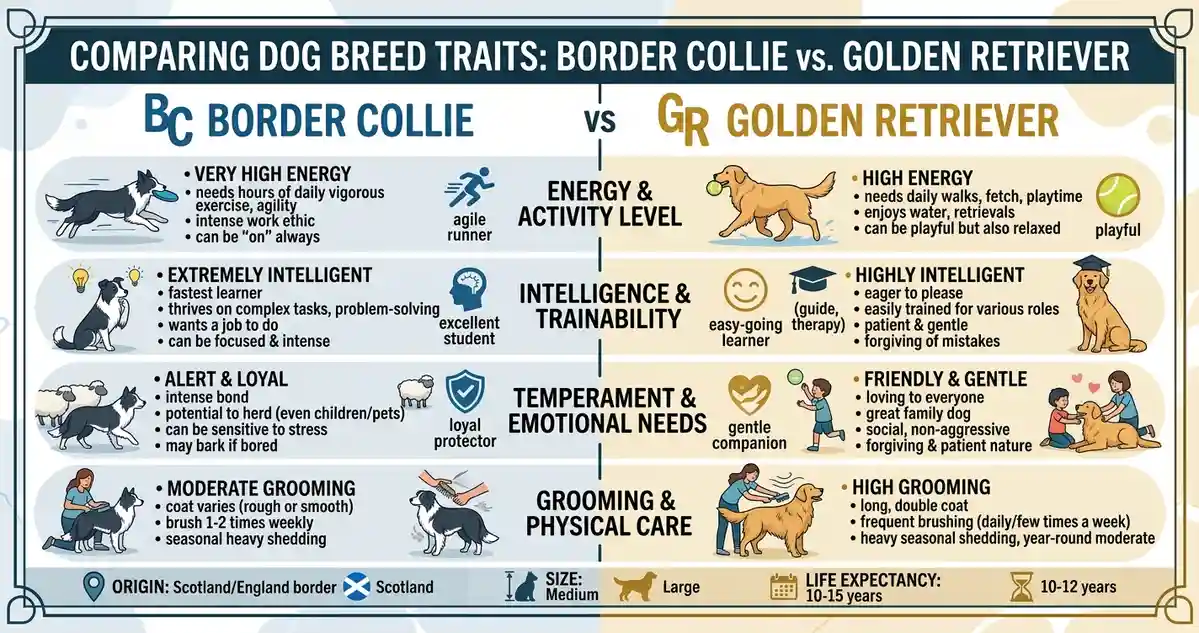
Knowing what each parent breed brings to the mix helps explain why these dogs act the way they do. Border collies were bred for herding livestock, which means they were selected for intense focus, problem-solving, and near-constant motion. Golden retrievers were bred as hunting companions, prized for their gentle mouths, cooperative attitude, and desire to stay close to people.
What the Border Collie Side Brings
Border collies are widely considered one of the smartest dog breeds, and that intelligence comes with a strong need for mental work. They notice small movements, react quickly, and can become anxious or destructive without enough to do. This mix often inherits that same alertness and problem-solving drive, along with a tendency to try herding kids, pets, or even cars if that instinct isn’t redirected.
What the Golden Retriever Side Brings
Golden retrievers bring warmth, patience, and a strong desire to please. They’re generally more relaxed than border collies and less prone to anxiety when routines change. In the mix, this often shows up as a dog that’s easier to socialize and less reactive to sudden noises or unfamiliar situations, balancing out some of the border collie’s intensity.
Appearance and Coat
Coat Type and Colors
Coat length in this mix ranges from medium to long, and most dogs have a double coat — a soft undercoat with a coarser topcoat. Common colors include black and white, gold, red and white, and occasionally the merle pattern if a border collie parent carried that gene. Ear shape can vary too, with some dogs showing the golden retriever’s floppy ears and others closer to the border collie’s semi-erect set.
How Big Do They Get (Size and Weight by Sex)
Males from this cross typically weigh between 50 and 75 pounds and stand 20 to 24 inches at the shoulder. Females tend to run smaller, usually 40 to 60 pounds and 18 to 22 inches tall. Genetics from both parents play a role, so littermates can differ noticeably in adult size, especially if the parents themselves were on the larger or smaller end for their breeds.
Temperament and Personality
Energy and Working-Dog Instincts
This mix carries real working-dog genes, not just a general love of activity. Many owners report their dogs need a job to stay mentally satisfied, whether that’s fetch, agility training, or structured obedience work. Without an outlet, that energy tends to come out as pacing, barking, or chewing, so this isn’t a breed to leave alone for long stretches with nothing to do.
How They Act Around Family and Strangers
Around their own family, these dogs are typically affectionate, loyal, and attentive to routines and moods. With strangers, reactions vary more — some take after the golden retriever’s easy friendliness, while others show a bit of the border collie’s initial caution before warming up. Early socialization during puppyhood makes a noticeable difference in how confident and relaxed the adult dog becomes around new people and situations.
Daily Exercise and Mental Stimulation Needs
This mix generally needs 60 to 90 minutes of physical activity every day, split across walks, play sessions, or structured exercise like fetch or swimming. A short walk around the block isn’t enough for most dogs with this much working-breed energy in their background.
Physical exercise only covers part of what this dog needs. Mental stimulation matters just as much, given the border collie side’s problem-solving instincts. Puzzle feeders, scent games, basic obedience drills, and even simple tasks like carrying items around the house can help burn off mental energy that would otherwise turn into restlessness.
Dogs that don’t get enough activity — physical or mental — often develop behavior problems like excessive barking, digging, or herding family members and pets. This isn’t a sign of a “bad” dog; it’s usually a sign of an under-exercised one. Owners who enjoy hiking, running, or dog sports tend to be a much better match for this mix than those looking for a low-key companion.
also read How Much Exercise Does a Golden Retriever Need
Training Tips That Actually Work
Training this mix generally goes smoothly because both parent breeds are known for wanting to work with their owners. Positive reinforcement methods — using treats, praise, and play as rewards for good behavior — tend to produce faster, more reliable results than punishment-based approaches, and they help build trust rather than fear.
Consistency matters more than strictness. Short, frequent training sessions work better than long ones, especially with puppies, since it keeps their focus sharp without causing frustration. Because of the herding instinct from the border collie side, it also helps to teach an early “leave it” or recall command, since these dogs may chase moving objects, bikes, or smaller animals without meaning any harm.
Socialization should start early and continue throughout the first year. Exposing a puppy to different people, environments, and other animals in a calm, positive way reduces the odds of fearfulness or overreaction later on. Group puppy classes are a solid option for combining training with controlled social exposure.
Grooming Requirements
This mix typically needs brushing two to three times a week to manage loose fur and prevent matting, with daily brushing during shedding season in spring and fall. A slicker brush or undercoat rake works well for reaching the soft undercoat beneath the topcoat.
Bathing every four to six weeks is usually enough, unless the dog gets into something messy. Overbathing can strip natural oils from the skin and coat, leading to dryness or irritation. Regular ear checks are worth adding to the routine too, especially for dogs with more floppy, golden-retriever-style ears, since trapped moisture can lead to infections.
Nail trims every three to four weeks and regular teeth brushing round out a basic grooming routine. None of this requires professional grooming visits for most owners, though some choose occasional trims to keep longer coats manageable in warmer months.
Common Health Issues and Lifespan

Conditions to Watch For
Both parent breeds carry a known risk for certain inherited conditions, and this mix can inherit them too. Hip and elbow dysplasia are common concerns in both border collies and golden retrievers, affecting joint development and potentially leading to arthritis later in life. Golden retrievers also have a higher-than-average risk for certain cancers, including hemangiosarcoma, while border collies can carry a gene linked to collie eye anomaly and a drug sensitivity called MDR1, which affects how their bodies process certain medications.
Regular veterinary checkups, along with genetic testing when available, help catch these issues early. Reputable breeders typically screen parent dogs for hip and eye health before breeding, which lowers the odds of passing on these conditions.
Average Lifespan and What Affects It
This mix typically lives 10 to 14 years, which falls in line with expectations for a medium-to-large mixed breed. Diet, exercise, weight management, and regular veterinary care all play a role in how long and how comfortably a dog lives. Keeping a healthy weight is especially important, since extra pounds put more strain on joints already prone to dysplasia in both parent breeds.
Is a Border Collie Golden Retriever Mix Right for Your Home?
Good With Children and Other Pets
With proper socialization, this mix generally does well with children, drawing on the golden retriever’s patience and gentle nature. That said, the border collie’s herding instinct can show up as nipping at heels or trying to “control” a child’s movement during play, so supervision and early training help prevent that habit from forming. With other pets, results vary — many do fine with cats and other dogs, especially if raised together, though the herding drive means some individual dogs may chase smaller animals.
also read Golden Retrievers Good With Kids
Apartment Living vs. Space Needs
This isn’t an ideal apartment dog for most owners, simply because of how much daily exercise and space it benefits from. A house with a securely fenced yard works better, giving the dog room to move without constant leash walks. That said, an apartment isn’t impossible if the owner is committed to multiple long walks and active play sessions every day — the limiting factor is exercise access, not square footage alone.
Risk of Separation Anxiety
Both parent breeds tend to form strong attachments to their people, which can translate into separation anxiety in this mix if left alone too often or for too long. Signs include destructive chewing, excessive barking, or pacing when the owner is away. Gradual crate training, puzzle toys, and building up alone-time tolerance slowly from puppyhood all help reduce this risk.
What Research Says About Mixed-Breed Temperament and Health
A large genetic study from UMass Chan Medical School, published in the journal Science, looked at more than 2,000 dogs — both purebred and mixed-breed — alongside behavior surveys from over 18,000 owners. The researchers found that breed explains only about 9 percent of the behavioral variation between individual dogs, which means factors like early environment, training, and individual personality carry far more weight than breed background alone. (Ancestry-inclusive dog genomics challenges popular breed stereotypes, Science)
This matters for anyone considering a border collie golden retriever mix, because it means predictions about temperament based purely on the parent breeds are useful as general guidance, not guarantees. On the health side, Border Collies carry a well-documented risk for Collie Eye Anomaly, an inherited condition affecting how the eye develops, along with a smaller but notable risk tied to the MDR1 gene mutation that affects how some dogs process common medications. The Orthopedic Foundation for Animals, Border Collie Breed Statistics tracks eye examination results across the breed and recommends CERF or OFA eye testing for breeding dogs. This is why health screening on the Border Collie parent matters just as much as the Golden Retriever side, since crossbreeding doesn’t automatically remove risks tied to a specific inherited mutation.
Common Myths About This Mix
One common myth is that this mix is automatically calmer than a purebred border collie because of the golden retriever influence. In reality, energy level and working drive vary from dog to dog, and some puppies lean much closer to the border collie temperament regardless of their golden retriever parentage.
Another myth is that mixed-breed dogs are automatically healthier across the board. While crossbreeding can reduce the risk of certain inherited conditions tied to a single breed’s gene pool, this mix can still inherit health issues common to either parent breed, so health screening remains just as important as it would be for a purebred dog.
A third myth worth addressing is the idea that this is a “hypoallergenic” dog. Neither border collies nor golden retrievers are low-shedding breeds, and this mix typically sheds a moderate to heavy amount, especially during seasonal coat changes. Anyone with allergies should spend time around the specific dog before committing, rather than assuming the mix will be allergy-friendly.
Adoption vs. Buying From a Breeder
Adoption is worth checking first, since mixed breeds like this one do show up in shelters and breed-specific rescues, sometimes as young adults already past the more demanding puppy stage. Adoption fees are typically lower than breeder prices and often include initial vaccinations and spay or neuter surgery.
Buying from a breeder gives more predictability about the puppy’s early environment and health screening, but it comes at a higher cost, and prices for this cross can range widely depending on the breeder’s reputation and location. Whichever route you choose, ask to see health clearances for hip, elbow, and eye conditions in the parent dogs, and avoid breeders or sellers who can’t answer basic questions about the puppy’s background or can’t produce any documentation.
How This Mix Compares to Other Golden Retriever Crosses
Compared to a Goldendoodle, the border collie golden retriever mix is typically more energetic and more focused on mental work rather than just physical play. Goldendoodles, crossed with poodles, often shed less and can suit allergy-sensitive households better, but they generally don’t carry the same intense working drive.
Compared to a golden retriever Lab mix, this cross tends to be more trainable and quicker to pick up commands, thanks to the border collie’s problem-solving ability, though it also demands more consistent mental engagement to stay well-behaved. Golden Lab mixes are often a bit more laid-back and easier for first-time owners who want a friendly, moderate-energy companion without as much structured training.
Frequently Asked Questions
How much does a border collie golden retriever mix cost?
Prices vary by breeder and location, but this cross typically costs between $600 and $1,500 from a breeder, while adoption fees from a shelter or rescue usually run $50 to $300, often including basic vet care already completed.
Are they easy to train for first-time owners?
They’re highly trainable thanks to their intelligence, but first-time owners should be ready for a dog that needs consistent structure and daily mental work. Without that commitment, training can become harder to manage despite the dog’s natural learning ability.
Do they bark a lot?
Barking tendencies vary, but this mix can be vocal, especially when under-exercised or bored. Regular physical and mental activity usually reduces excessive barking, since much of it stems from pent-up energy rather than a fixed personality trait.
Can they live with cats?
Many do fine with cats, particularly when raised together from a young age, though the herding instinct means some individual dogs may chase or nip at a cat’s movement. Slow, supervised introductions give the best chance of a peaceful household.
If you’re considering this mix, be honest about your daily schedule and activity level before bringing one home. This is a smart, active dog that thrives with owners who can commit to regular exercise, consistent training, and mental engagement — and for the right household, it makes an exceptionally loyal and capable companion.

Hi, I’m Jack Austin, founder of Cool Goldens. I share practical, research-backed advice on training, nutrition, and daily care to help you give your Golden Retriever the happiest, healthiest life possible.