


Golden Retrievers are pregnant for about 63 days, give or take a few, which is a lot less time than most humans get to prepare for a baby and about the same amount of drama, minus the swollen ankles.
One day she’s stealing socks off the couch, and nine weeks later there’s a pile of squeaking puppies where the sock used to be. It sounds simple, but the timeline hides a few surprises, like why “63 days” isn’t always exactly 63 days.
Before the nesting box comes out, it helps to know what’s actually happening week by week, and how to tell real pregnancy from a very convincing hormonal imposter.
Understanding the Golden Retriever Gestation Period
Gestation period simply means the length of time between conception and birth. For dogs, this process moves much faster than it does for humans, wrapping up in about two months instead of nine.
Vets usually count gestation from the day of ovulation rather than the day of mating. This distinction matters because a female dog can be fertile for several days, and sperm can survive inside her for a few days too. So the actual moment of conception might happen a day or two after mating occurs.
What Can Cause the Pregnancy Length to Vary
A few factors explain why one Golden Retriever’s pregnancy might run a bit longer or shorter than another’s:
- Litter size – Dogs carrying fewer puppies sometimes go slightly past the average, while larger litters may arrive a bit earlier.
- Timing of ovulation – If ovulation happened later than expected, the countdown from mating day can be misleading.
- Individual variation – Just like people, dogs don’t all follow the exact same internal clock.
None of these factors usually push the pregnancy far outside the 58–68 day range. If a dog goes noticeably beyond that window without giving birth, it’s worth a call to the vet.
Early Signs of Pregnancy in Golden Retrievers
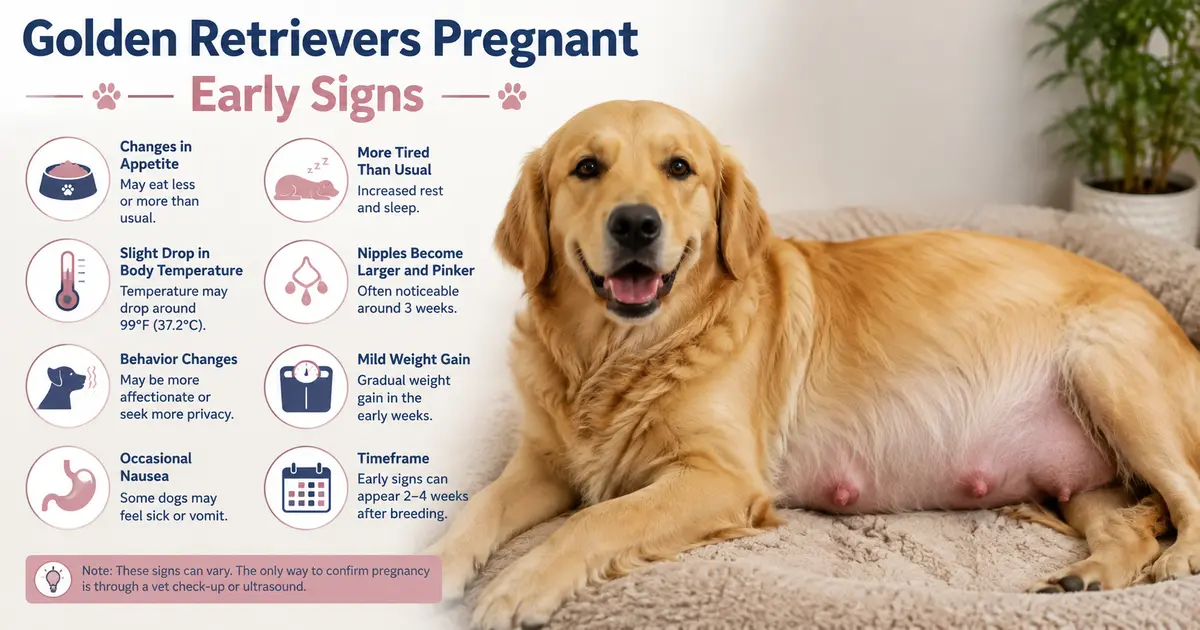
Pregnancy signs in dogs can be subtle in the first few weeks and easier to spot as the weeks go on. Here’s a general idea of what to watch for and roughly when it tends to show up.
| Sign | When It Often Appears |
| Reduced appetite or mild nausea | Weeks 3–4 |
| Nipple enlargement and color change | Weeks 3–4 |
| Weight gain and belly thickening | Weeks 5–6 |
| Nesting behavior | Final 1–2 weeks |
| Increased affection or clinginess | Varies throughout |
| Reduced activity level | Weeks 5 onward |
These signs can vary quite a bit between individual dogs. Some Golden Retrievers show barely any outward changes until the last few weeks, while others show early symptoms right away.
The only way to confirm pregnancy with confidence is through a veterinary exam. Palpation can sometimes detect puppies around day 28, while an ultrasound is generally more reliable and can also give an early idea of how many puppies to expect.
Real Pregnancy vs. False Pregnancy: How to Tell the Difference
This is one of the more confusing parts of dog pregnancy, and it trips up a lot of owners. A false pregnancy, also called pseudopregnancy, happens when a female dog’s body acts like she’s pregnant even though she isn’t.
False pregnancies are caused by normal hormone swings after a heat cycle, not by an actual mating that resulted in conception. The symptoms can look almost identical to real pregnancy, which is exactly why so many owners get confused.
| Symptom | Real Pregnancy | False Pregnancy |
| Nipple enlargement | Common | Common |
| Weight gain | Common | Sometimes |
| Nesting behavior | Common | Common |
| Milk production | Common near birth | Can occur without birth |
| Confirmed by ultrasound | Puppies visible | No puppies present |
| Resolves on its own | No, ends in birth | Usually within 1–3 weeks |
The clearest way to tell the two apart is a veterinary ultrasound. If your dog was never bred, or you’re unsure whether mating actually resulted in conception, a false pregnancy is worth considering. It’s harmless in most cases, but a vet visit rules out other causes and confirms what’s really going on.
Week-by-Week Development Stages of the Pregnancy
Breaking the roughly nine-week gestation into stages makes it easier to understand what’s happening inside and to know what kind of care matters at each point.
| Stage | Weeks | What’s Happening |
| Early stage | Weeks 1–3 | Fertilization occurs; embryos implant in the uterus |
| Mid stage | Weeks 4–5 | Puppies begin developing organs and features; belly starts to show |
| Late stage | Weeks 6–7 | Puppies grow rapidly; skeletons begin to harden |
| Final stage | Weeks 8–9 | Puppies are fully formed; mother prepares to give birth |
During the early stage, there’s often little visible change, which is why many pregnancies go unnoticed until week four or five. By the final stage, growth speeds up noticeably, and this is when most of the classic physical changes become obvious.
Knowing roughly which stage your dog is in helps you plan vet visits, adjust her diet, and prepare her whelping area with better timing instead of guessing.
Caring for a Pregnant Golden Retriever
Prenatal care makes a real difference in how smoothly a pregnancy goes. Feeding, activity level, and regular vet checkups all need small adjustments as the weeks progress.
For the first two-thirds of pregnancy, a normal, high-quality diet is usually enough. Around week 5 or 6, many vets recommend gradually switching to a puppy or growth formula, since it’s calorie-dense and supports the rapid development happening late in pregnancy.
Feeding amounts typically increase gradually rather than all at once. Splitting meals into smaller, more frequent portions later in pregnancy also helps, since a growing litter leaves less room in the stomach for large meals.
Routine vet checkups matter throughout, not just at the start. A vet can confirm the pregnancy, estimate litter size, monitor the mother’s weight and health, and flag anything that looks unusual well before it becomes a bigger problem.
Exercise and Activity Guidelines During Pregnancy
Light to moderate exercise is generally fine and even beneficial for most of the pregnancy. Regular short walks help maintain muscle tone and healthy weight without putting unnecessary strain on the mother.
As she gets closer to her due date, activity should scale back naturally. Avoid strenuous exercise, jumping, or rough play, especially in the final two to three weeks, and let her set the pace for how much movement feels comfortable.
Aslo Read Exercise Does a Golden Retriever Need
Signs Labor Is Near and What Happens During Birth
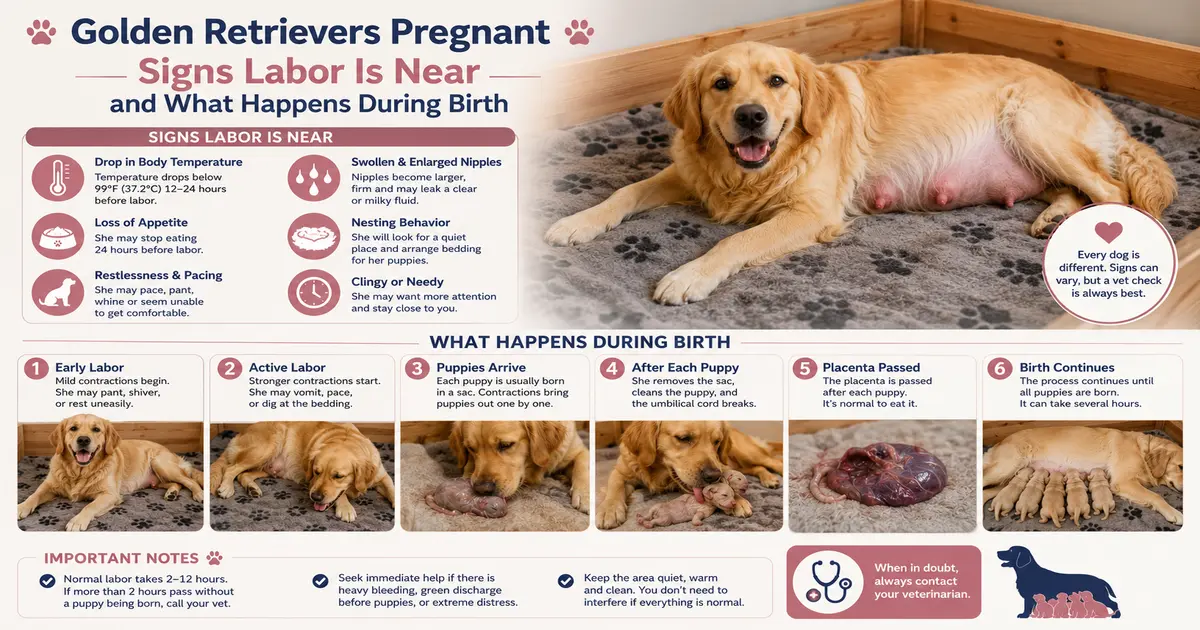
The most reliable sign that labor is close is a drop in body temperature, usually to around 99°F (37.2°C) or lower, roughly 24 hours before birth begins. A rectal thermometer is the most accurate way to track this in the final week.
Alongside the temperature drop, most Golden Retrievers show nesting behavior, restlessness, and sometimes a loss of appetite. Some pant or pace more than usual as contractions begin.
Labor itself generally happens in stages: mild contractions and restlessness first, followed by stronger contractions and the delivery of each puppy. Most healthy litters are delivered within a few hours, though it can stretch closer to 24 hours in some cases.
A short break between puppies is normal, but a gap of more than two to four hours with visible straining and no puppy delivered is a sign to call the vet right away. Prolonged, unproductive labor can point to a complication that needs quick attention.
How Many Puppies Do Golden Retrievers Usually Have?
Golden Retrievers typically have litters of around 6 to 8 puppies, though litter size can range smaller or larger depending on the individual dog, her age, and other factors. First-time mothers sometimes have slightly smaller litters than experienced mothers.
An ultrasound partway through pregnancy can give a rough puppy count, though it isn’t always exact since puppies can be hard to count precisely on imaging. A late-pregnancy X-ray tends to give a clearer count, since puppy skeletons show up well by that stage.
Knowing the expected litter size ahead of time helps with practical planning, like preparing enough whelping space and being ready to recognize if labor stops before every puppy has arrived.
Frequently Asked Questions
Does a longer pregnancy mean something is wrong?
Not necessarily, since the 58–68 day range is normal. But going noticeably past day 68 without labor starting is worth a vet call, since it can sometimes signal a problem.
How soon can a Golden Retriever get pregnant again after giving birth?
Physically, she can go into heat again a few months after whelping. Most breeders and vets recommend waiting for at least one full heat cycle, if not longer, before breeding again to let her body recover.
Does litter size affect how long the pregnancy lasts?
It can play a small role. Dogs carrying larger litters sometimes deliver slightly earlier, while smaller litters may run a little longer, though the difference is usually just a few days.
Can you tell how many puppies are coming before birth?
Yes, with reasonable accuracy. An ultrasound gives an early estimate, and a late-pregnancy X-ray usually gives the most reliable count once the puppies’ skeletons have developed.
Conclusion
A Golden Retriever’s pregnancy lasts about 63 days, with a normal range of roughly 58 to 68 days from ovulation to birth. Knowing this timeline, along with the early signs, development stages, and care needs along the way, helps take the guesswork out of a process that can otherwise feel unpredictable.
If you suspect your dog is pregnant or she’s showing symptoms you’re unsure about, the most reliable next step is a veterinary exam. A vet can confirm pregnancy, rule out a false pregnancy, and help you plan for a safe delivery.
For further reading on canine reproduction, Cornell University’s College of Veterinary Medicine offers a detailed, science-backed overview of the whelping process.

Hi, I’m Jack Austin, founder of Cool Goldens. I share practical, research-backed advice on training, nutrition, and daily care to help you give your Golden Retriever the happiest, healthiest life possible.