

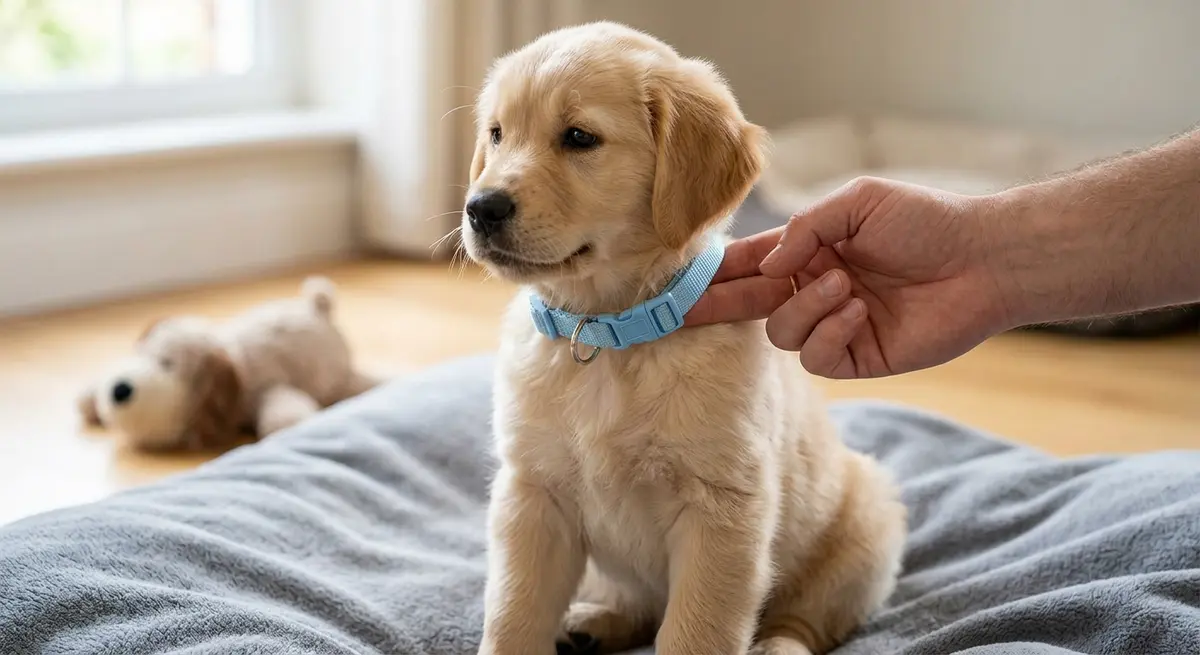
Most Golden Retriever puppies need a collar between 10 and 14 inches at 8 to 10 weeks old, though the right fit depends more on measurement than age. Golden Retrievers grow quickly during their first year, which means one collar rarely lasts long.
Getting the size wrong in either direction creates real problems, from slipping out of a loose collar to discomfort from one that’s too tight. This guide covers exact sizing by growth stage, how to measure correctly, and what to look for as your puppy’s neck size changes..
How to Measure Your Puppy’s Neck for a Proper Fitting Collar
Getting the right fit starts with a simple measurement, not guesswork. Use a soft fabric tape measure, the kind used for sewing, and wrap it around the base of your puppy’s neck where a collar would normally sit.
Keep the tape snug but not tight. Add about two inches to the number you get. That extra space accounts for the two-finger gap needed for comfort and growth room.
If you don’t have a soft tape measure, a piece of string works too. Wrap the string around the neck, mark where it overlaps, then measure the string against a ruler.
The Two-Finger Rule for a Safe Fit
Once the collar is on, slide two fingers flat between the collar and the puppy’s neck. If they fit snugly with a little pressure, the fit is right. If you can fit three or more fingers, the collar is too loose. If you can barely fit one finger, it’s too tight.
Check this fit weekly during the first few months. Golden Retriever puppies grow quickly, and a collar that fit two weeks ago may already be too small.
Golden Retriever Puppy Collar Sizes by Growth Stage
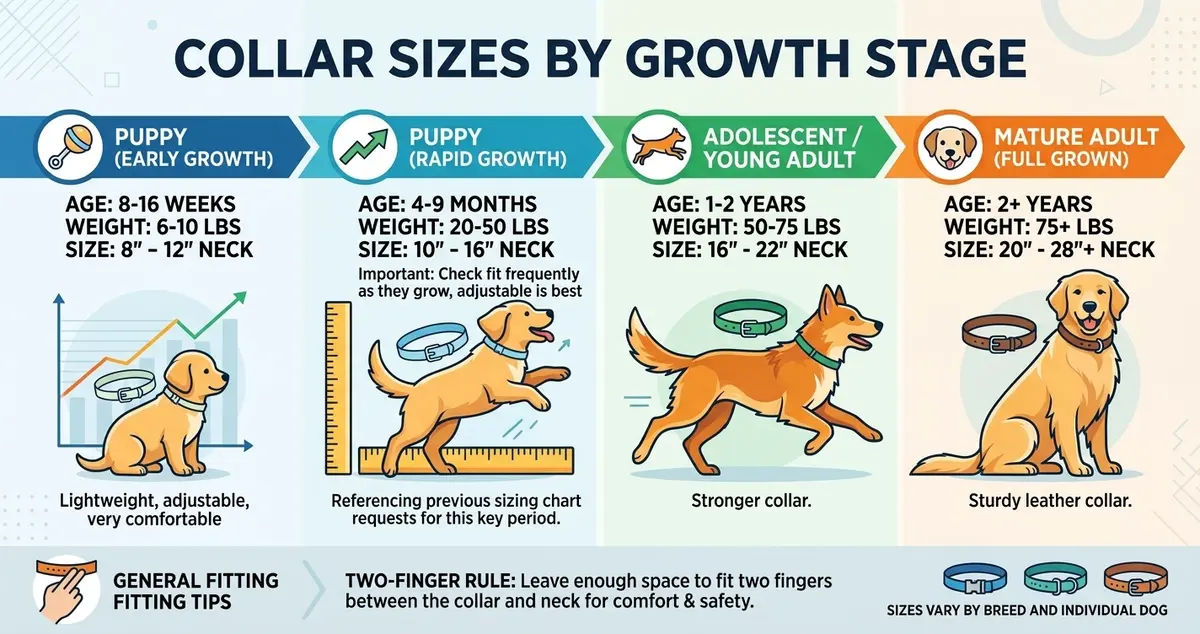
Collar size isn’t a one-time decision for a Golden Retriever. Because the breed grows steadily through its first year, most owners go through two or three collar sizes before their dog reaches full size.
The stages below give general size ranges. Always confirm the fit with the two-finger rule rather than relying on numbers alone, since individual puppies vary in size even within the same litter.
Knowing how a Golden Retriever’s neck size changes with age makes it a lot easier to know when a new collar is coming. Full-grown adults usually land somewhere in the 18 to 24 inch range, but puppies obviously start out way smaller.
Aslo Read When Golden Retrievers Stop Growing
| Age | Approximate Neck Size | Notes |
| 8 weeks | 10–12 inches | Very small and light; check fit often |
| 10 weeks | 12–14 inches | Growth speeds up noticeably here |
| 3 months | 14–16 inches | First resize is common around this age |
| 6 months | 16–20 inches | Rapid growth phase, muscle and bone development |
| 9 months | 18–22 inches | Nearing adult proportions |
What Size Collar for Golden Retriever Puppy 8 Weeks Old
At 8 weeks old, most Golden Retriever puppies need a collar in the 10 to 12 inch range — pretty similar to what size collar a Lab puppy needs at that age, since both large breeds grow at roughly the same early pace.
What Size Collar for a 10 Week Old Golden Retriever Puppy
By 10 weeks, many puppies need a slightly bigger collar, often in the 12 to 14 inch range. This is a good point to check the fit weekly, since growth starts picking up around this age.
Collar Sizing at 3, 6, and 9 Months
Between 3 and 9 months, Golden Retrievers go through their biggest growth spurt. Necks widen along with the chest and shoulders, so collars from earlier months often become too tight within just a few weeks. Expect at least one, and often two, resizes during this window.
Why a Golden Retriever Puppy’s Neck Size Changes So Fast
Golden Retrievers are a large breed, and large breed puppies grow at a different pace than smaller dogs. Their bones, muscles, and skin all develop quickly during the first year, especially between 3 and 8 months.
Research published in a peer-reviewed veterinary study found that large-breed dogs continue growing until around 15 months of age, compared to 9–10 months in smaller breeds — which explains why a Golden Retriever puppy’s collar size keeps changing well past the first few months. Source
This rapid growth means a collar bought at 8 weeks is rarely the same collar your dog wears at 6 months. Checking the fit regularly matters more than trying to predict the “right” size in advance.
Growth rates do vary by individual and by lineage, so some puppies size up sooner than others. If your puppy seems to be growing unusually fast or slow compared to typical benchmarks, a quick check with your veterinarian can rule out any concerns.
Also read Golden Retrievers Running Speed
Choosing the Right Collar Width and Material
Collar width matters as much as length, especially for a puppy with a thin neck. A collar that’s too wide can feel heavy and awkward on a small puppy, while one that’s too narrow may not distribute pressure evenly.
For puppies under 4 months, a width of around 5/8 inch to 3/4 inch usually works well. As your dog grows past 6 months, you can move up to a 1-inch width, which better matches an adult Golden Retriever’s size and strength.
Material also affects comfort and durability:
- Nylon: Lightweight, affordable, and available in adjustable sizes. Good for fast-growing puppies since it’s easy to replace.
- Leather: Durable and softens over time, but usually costs more and isn’t always adjustable enough for a growing puppy.
- Biothane: Water-resistant and easy to clean, a practical choice for puppies that spend time outdoors or get muddy often.
For most puppy owners, a soft nylon adjustable collar offers the best mix of comfort, cost, and flexibility during the growth phase.
Adjustable Collars vs. Fixed-Size Collars: Which Works Better for a Growing Puppy
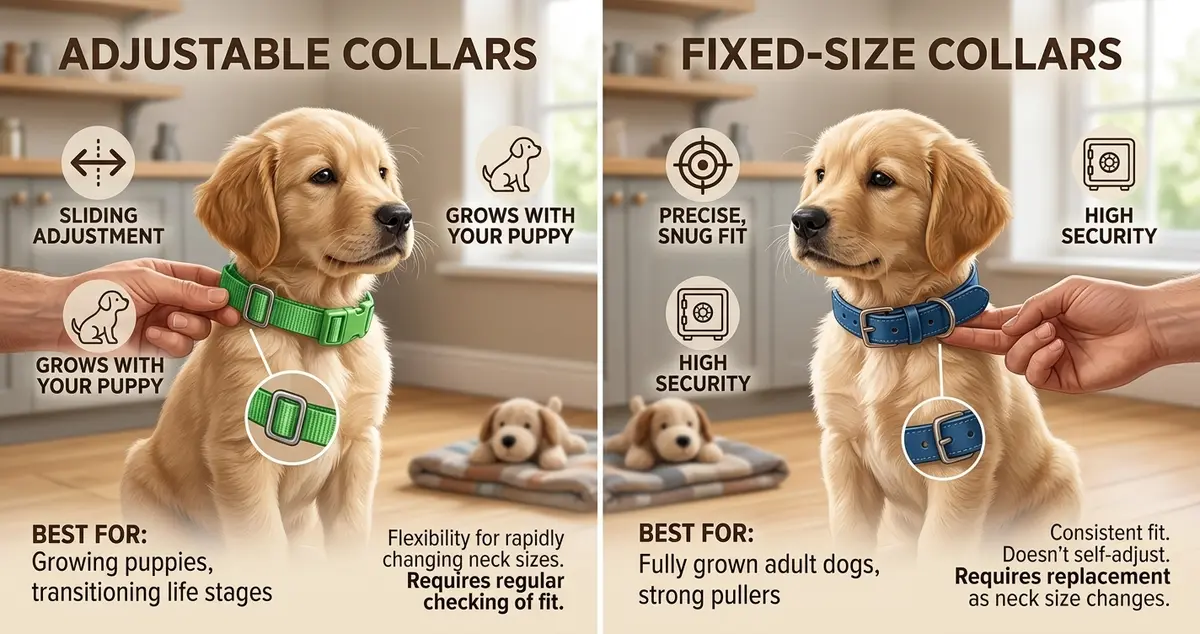
This is one of the most practical decisions a new puppy owner faces, and it’s often overlooked. An adjustable collar lets you loosen or tighten the fit as your puppy grows, which can delay the need for a full replacement.
A fixed-size collar, on the other hand, only works within a narrow range. Once your puppy outgrows it, you need a new one entirely.
| Factor | Adjustable Collar | Fixed-Size Collar |
| Cost over time | Lower, fewer replacements needed | Higher, multiple purchases likely |
| Growth flexibility | High, several inches of range | Low, fits a narrow size only |
| Fit precision | Good, but check buckle position | Often more precise if sized correctly |
| Best for | Puppies under 1 year | Adult dogs with stable size |
For a Golden Retriever puppy, an adjustable collar is generally the more practical choice. It won’t eliminate the need for resizing entirely, since puppies can grow beyond even a wide adjustable range, but it does reduce how often you need to buy a new one.
Collar Safety Features Every Puppy Owner Should Know
Beyond size, certain safety features matter for a growing puppy. A breakaway or safety-release collar is designed to open under strong pressure, which can prevent choking if the collar gets caught on something like a fence or crate bar.
ID tags should attach securely but not add unnecessary bulk to a small puppy’s collar. A separate, lightweight tag ring often works better than a bulky attachment.
There are also situations where a collar should come off entirely. The American Veterinary Medical Association and most veterinary behavior experts recommend removing collars during crate time and unsupervised play, since collars can catch on crate wires, toys, or another dog’s teeth during rough play.
If you’re setting up a crate routine for your puppy, our guide on crate training basics covers safe overnight setups in more detail.
Common Mistakes and Misconceptions About Puppy Collar Sizing
A few beliefs about puppy collars are common but don’t hold up well in practice.
“Bigger is always safer.” A loose collar actually increases the risk of your puppy backing out of it and running loose, especially outdoors or near roads. Safety depends on the right fit, not extra room.
“Leave the collar on all the time.” Constant wear increases the chance of it catching on something during play or crate time. It also means you’re less likely to notice when your puppy has outgrown it, since you’re not taking it off to check.
“One collar will last the whole puppy stage.” Given how fast Golden Retrievers grow, this is rarely true. Budgeting for at least one or two resizes in the first year is more realistic than expecting a single purchase to last.
“Collar size doesn’t matter much for a puppy.” An ill-fitting collar can cause skin irritation, hair loss around the neck, or in more serious cases, injury if the puppy pulls hard against it. Fit matters just as much for puppies as for adult dogs.
Signs Your Puppy’s Collar No Longer Fits
Watch for these signs that it’s time to size up:
- You can no longer fit two fingers between the collar and neck
- The collar leaves a visible mark or indentation on the skin
- Your puppy scratches at the collar more than usual
- The collar sits noticeably tighter than it did a few weeks earlier
- Fur around the neck looks flattened or thinner where the collar sits
If you notice any of these signs, resize or replace the collar right away rather than waiting for the next scheduled check. A quick weekly glance during regular grooming sessions is an easy way to stay ahead of these changes. Our grooming routine guide covers how to build this kind of check into your regular puppy care.
FAQs
Do Golden Retriever puppies need a harness instead of a collar?
Harnesses are great for walks since they spread the pulling force across the chest instead of the neck. If you go this route, you’ll need to measure both your Golden Retriever puppy’s chest (around the widest part of the ribcage) and neck to make sure you get a fit that’s actually safe.
How often should I check my puppy’s collar fit?
Weekly checks work well during the first 6 to 9 months, when growth is fastest. After that, monthly checks are usually enough once growth starts to slow down.
Is a martingale collar better than a buckle collar for Golden Retriever puppies?
Martingale collars tighten slightly under pressure, which can help prevent a puppy from backing out during walks. Buckle collars are simpler and fine for everyday wear at home. Many owners use a buckle collar daily and a martingale for walks.
Conclusion
Collar sizing for a Golden Retriever puppy isn’t a one-time decision. Measure your puppy’s neck directly, apply the two-finger rule, and expect to resize the collar at least once or twice during the first year of rapid growth.
Checking the fit weekly and choosing an adjustable nylon collar in the early months will keep your puppy comfortable and safe as they grow toward their adult size.

Hi, I’m Jack Austin, founder of Cool Goldens. I share practical, research-backed advice on training, nutrition, and daily care to help you give your Golden Retriever the happiest, healthiest life possible.