
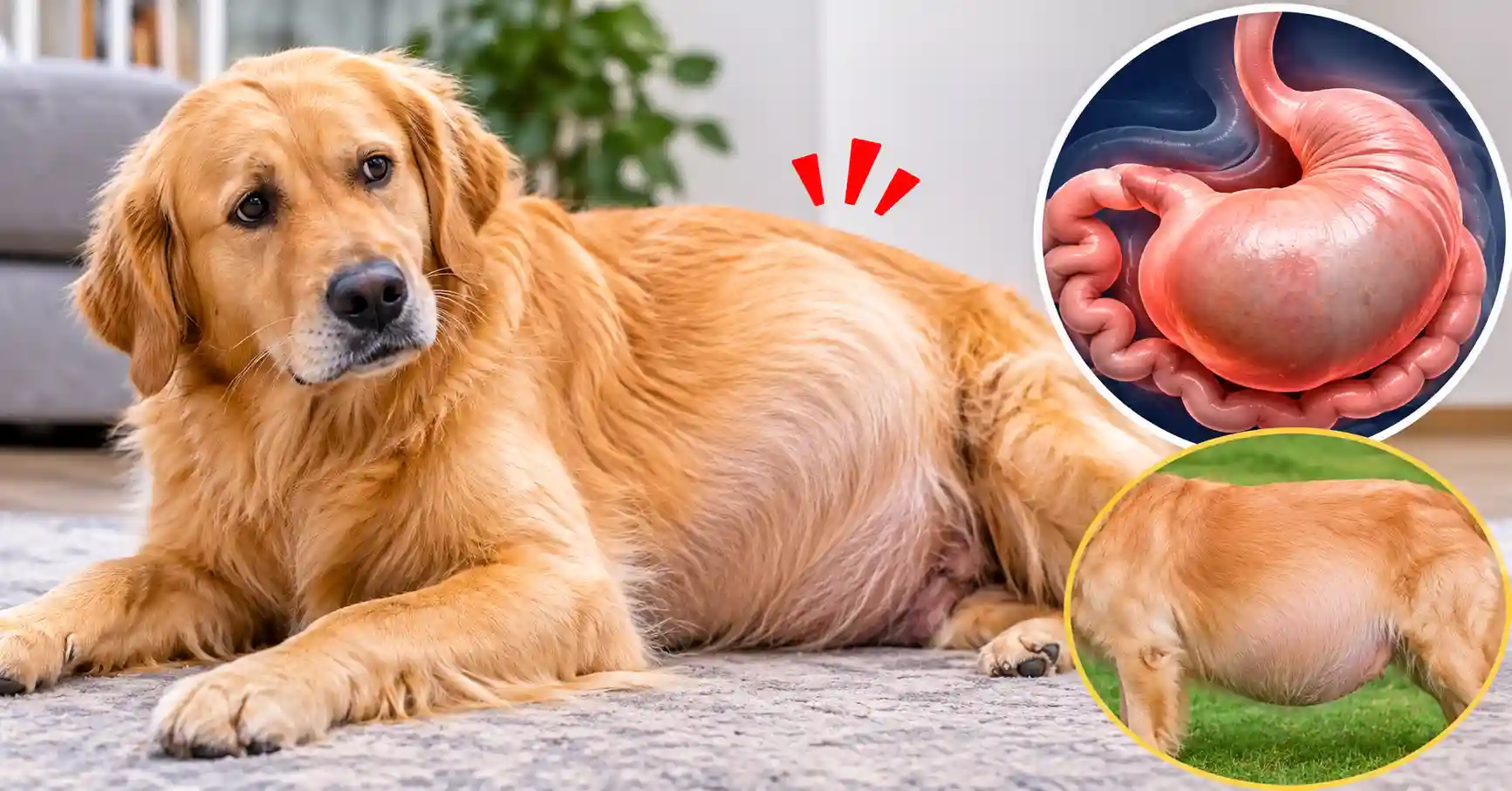
A Golden that looks fine at dinner can be in a life-threatening emergency by midnight. Bloat is a swelling of the stomach with gas, food, or fluid, and in some dogs the stomach also twists and cuts off its own blood supply. Either way, your dog needs an emergency vet right away.
This guide covers the warning signs, what to do in the first minutes, why bloat happens, how vets treat it, and the daily habits that lower your dog’s risk. If you think your Golden is bloating right now, stop reading and call a vet.
What Is Bloat in Golden Retrievers?
Bloat happens when a dog’s stomach fills with gas, food, or fluid and expands. In its most dangerous form, called gastric dilatation-volvulus (GDV), the swollen stomach also rotates, trapping the gas and blocking blood flow. Without emergency treatment, GDV can lead to shock and death within hours.
A healthy stomach lets gas escape upward and moves food along into the intestines. In a bloated dog, the stomach stretches and those normal exits stop working. The growing pressure pushes against the diaphragm, which makes breathing harder. It also squeezes large veins, so less blood returns to the heart.
If the stomach twists, the damage speeds up. The stomach wall can lose its blood supply and begin to die. Vets use the word “bloat” for the whole range, from simple swelling to a full twist. Because owners cannot tell the difference at home, every suspected case counts as an emergency.
Simple Bloat vs. Twisted Stomach: Understanding the Two Types
Vets describe two forms. The first is gastric dilatation, where the stomach swells but stays in its normal position. The second is gastric torsion, also called volvulus, where the swollen stomach rotates. When both happen together, the condition is called GDV.
| Feature | Simple bloat (gastric dilatation) | Twisted stomach (GDV) |
| What happens | Stomach swells with gas, food, or fluid | Stomach swells and rotates |
| Blood flow | May be reduced by pressure | Often blocked by the twist |
| Urgency | Emergency | Emergency, usually needing surgery |
| Typical treatment | Releasing the gas, IV fluids, monitoring | Releasing the gas, then surgery to untwist and secure the stomach |
The twisted form is the more dangerous one, but the simple form is not harmless. A large hospital-database study in the Journal of the American Veterinary Medical Association reported that 28.6% of dogs with dilatation alone and 33.3% of dogs with dilatation and volvulus died. The study was published in 1994, so treatment has likely changed since then. The message still holds: neither type is safe to watch at home. Vets usually confirm which type a dog has with an X-ray.
Warning Signs: What Bloat Looks Like in a Golden
Signs can start quietly and get worse fast. Learning the early pattern gives you the best chance to act before your dog collapses.
Early Signs
The first signs are often about behavior, not the belly. Your Golden may pace, whine, or seem unable to settle. Some dogs lie down, stand up, and lie down again within minutes. Others hunch or stretch as if trying to get comfortable.
Drooling and gagging are common. The sign vets stress most is unproductive retching: your dog heaves and tries to vomit, but little or nothing comes up apart from foam or saliva. A dog that suddenly refuses food or a favorite treat deserves the same attention. Any mix of these signs, especially after a meal or heavy drinking, justifies a call to a vet.
Late and Emergency Signs
As the stomach fills and pressure rises, the signs become hard to miss. The belly may look swollen or feel tight. Breathing turns fast and shallow. The gums and tongue can look pale, gray, or unusually dark. Your dog’s pulse may feel fast and weak, and the legs and ears may feel cold.
A dog at this stage may stumble, refuse to stand, or collapse. These are signs of shock. Go to the nearest emergency vet immediately and call on the way. Signs can worsen quickly, so do not wait for the full list to appear.
Why a Swollen Belly Is Easy to Miss on a Fluffy Golden
A Golden’s thick coat and feathering can hide swelling. From the side, the belly may look normal, and a gentle pat may not tell you much. Some dogs do show a round, tight abdomen, but many early cases look more like restless behavior than an obvious bulge.
That is why behavior matters more than appearance. Retching without producing vomit, drooling, pacing, and a sudden change in how your dog acts are all strong clues. If your dog seems distressed after eating, treat it as an emergency rather than a visual guessing game. If you feel the belly, do it lightly and stop if your dog reacts with pain.
Is It Bloat or Just Gas? How to Tell the Difference
Goldens get gassy, and a big dinner can leave them looking round. The comparison below can help you sort the common, harmless picture from the dangerous one. It is a guide, not a diagnosis.
| What you notice | Normal gas or a full belly | Possible bloat |
| Behavior | Relaxed, sleepy, or acting normal | Restless, pacing, whining, unable to settle |
| Belly | Soft, round, and comfortable | Tight, hard, or painful; may look swollen |
| Vomiting or retching | A burp, or a real vomit that brings relief | Heaving with little or nothing coming up |
| Drooling | Normal for your dog | Heavy or sudden |
| Breathing and gums | Normal | Fast, shallow breathing; pale gums |
| Over time | Eases on its own and your dog returns to normal | Does not ease, or gets worse |
Not every case matches the table. A single sign, such as retching with no vomit, can be enough reason to call. The rule is simple: when in doubt, call the vet. A phone call costs little, and waiting costs far more if it turns out to be bloat. Clinic staff can often help you decide over the phone whether to come in right away.
What to Do in the First 10 Minutes
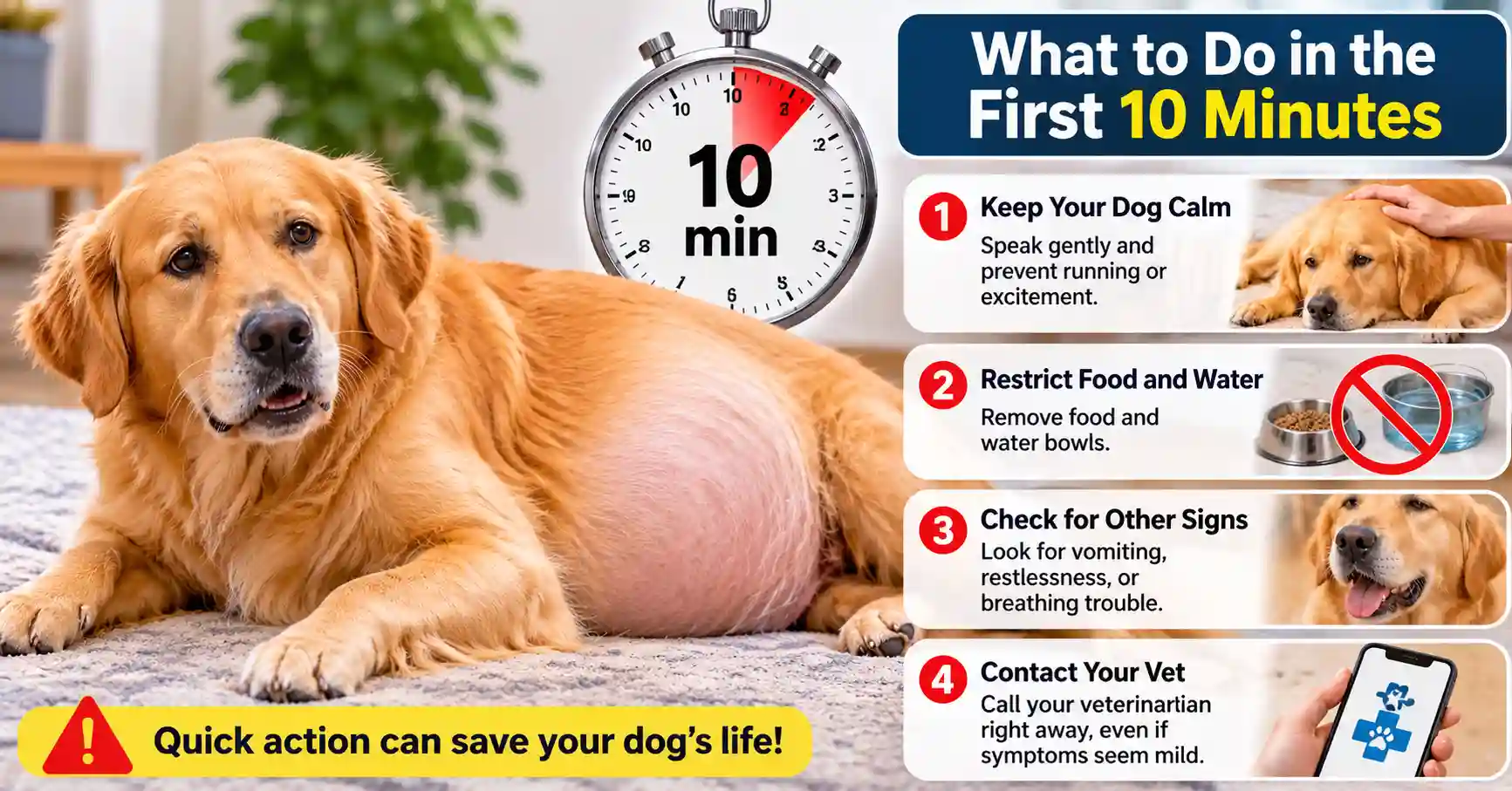
Fast, calm action matters more than anything else you can do at home. The steps below keep you focused when you are scared.
Steps to Take Now
- Call the nearest emergency vet and say “possible bloat or GDV.” This lets the team prepare while you travel.
- Leave right away. Do not wait to see whether the signs pass.
- If someone else can drive, have that person stay with your dog. Keep your Golden as calm and comfortable as possible.
- Offer no food or water.
- Have details ready: when your dog last ate and drank, what happened before the signs began, and any medications or past surgeries.
Every minute you save on the way to the clinic gives the vet more options.
What Not to Do
Do not try to make your dog vomit. Do not give anti-gas products, human medicines, or pain relievers. They cannot untwist a stomach, and they may delay or complicate treatment. Do not press on or massage the belly.
Do not wait overnight for the morning vet visit, even if your dog seems a little better. And do not try to treat shock at home. It needs IV fluids and close monitoring, which only a clinic can provide.
How Common Is It in Goldens? Breed Risk Explained
Golden Retrievers are large dogs, and bloat is mainly a large-breed problem. Goldens appear in lists of breeds that can develop it, but they usually sit below the highest-risk group. Great Danes, Standard Poodles, Irish Setters, and Weimaraners are among the breeds named most often in risk discussions. Exact rankings vary between studies, so treat any single number for Goldens with caution.
Two points matter for Golden owners. First, any dog can bloat. Mixed-breed dogs do too, although the 1994 study above found that purebred dogs had higher odds, about 2.5 times those of mixed-breed dogs. Second, breed is only one piece of the picture. Age, body shape, feeding habits, temperament, and family history all play a role, and a Golden with several of those factors may face more risk than the breed average suggests.
A lower risk than a Great Dane is not the same as a low risk. Because the condition is so dangerous, it is worth learning the signs and having a plan.
What Causes It? Known Risk Factors and Triggers
Nobody can point to one cause, but researchers have identified patterns. Some come with the dog, and others come from daily routines.
Risk Factors Your Dog Brings
Some risk is built in. A paper from a veterinary surgeon at a World Small Animal Veterinary Association congress notes that large and giant-breed dogs older than five face a greater risk than younger dogs. Cornell University lecture notes list a deep chest and a close relative with GDV as additional risk factors.
A 1997 case-control study also linked male sex, being underweight, and a fearful temperament with higher risk. Dogs described by owners as happy had lower risk. You cannot change your dog’s build or age, but knowing these factors helps you decide how closely to watch and whether to discuss preventive surgery.
Feeding and Lifestyle Triggers
Feeding habits seem to matter too. The 1997 study found higher risk in dogs fed once a day and in dogs that ate rapidly. The evidence on fast eating is mixed across studies, so it is a possible factor, not a proven one.
Large single meals, gulping a lot of water, hard exercise around mealtimes, and stressful events are often blamed as well. The research on these is limited or inconsistent. Their appeal is that they are easy to manage. You can split meals, slow down eating, and keep mealtimes calm without any downside for your dog.
What Researchers Still Don’t Know
Scientists have found links but no single cause. Many dogs with several risk factors never bloat, while some dogs with few risk factors do. Researchers also do not fully understand the exact chain of events: why the stomach stops releasing gas, and why it sometimes rotates.
You may hear confident claims about one trigger, such as a certain food or a certain bowl. Treat these with care. The honest summary is that risk comes from many factors acting together, which is why prevention advice focuses on lowering several of them at once instead of relying on one fix.
What the Research Says About Risk and Prevention
Several studies shape what vets know about bloat. A five-year Purdue University study followed seven large and four giant breeds. According to the abstract of the Journal of the American Veterinary Medical Association paper, GDV occurred at 23 cases per 1,000 dog-years in the large breeds and 26 in the giant breeds. Of the 105 dogs that developed GDV, 30 (28.6%) died, and the incidence rose with age.
The 1997 study in the Journal of the American Animal Hospital Association compared 101 dogs that had GDV with 101 that did not. Being male, underweight, fed once daily, a fast eater, or fearful raised risk. A happy temperament, and table foods added to a mostly dry diet, lowered it.
A 2012 internet survey of 2,551 dogs linked lower risk to playing with other dogs and running the fence after meals, fish and egg supplements, and spending equal time indoors and outdoors. Surveys show associations, not proof, and they depend on owner reports. This is one reason advice on exercise after meals stays unsettled.
Surgery has the strongest evidence. The introduction of a 2021 laparoscopic gastropexy study in Animals cites earlier research showing that effective gastropexy lowered the recurrence of stomach twisting from about 80% to under 5%. On raised bowls, the evidence conflicts. One large study tied them to higher risk, but reviewers found too few studies to settle the question.
Can Golden Retriever Puppies Get Bloat?
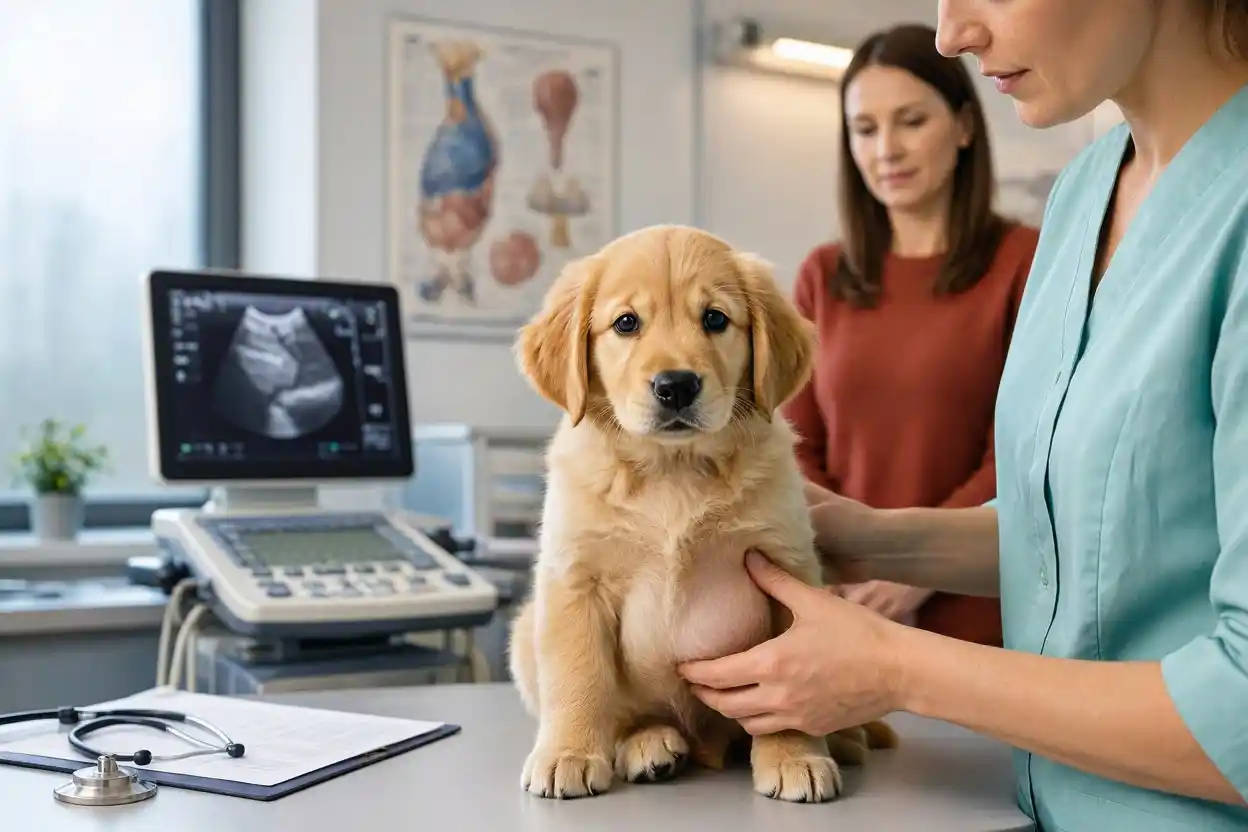
Risk climbs with age, so bloat is less likely in a young puppy. It can still happen, and the signs above apply to puppies too. A round belly alone is not proof of bloat. A big meal, worms, or swallowed air during play can all make a puppy look swollen.
Behavior tells you more. A puppy with a round belly who is playful, hungry, and comfortable is probably fine. A puppy that retches without vomiting, drools heavily, or seems tight and uncomfortable needs a call to the vet right away.
Puppyhood is a good time to build habits that carry into adulthood. Feed measured portions in the number of meals your vet recommends, use a slow-feeding bowl if your puppy gulps, and keep mealtimes calm. Ask your vet about the right schedule for your puppy’s age and growth, and bring up gastropexy early, since many owners plan it around spay or neuter surgery.
What Happens at the Emergency Vet: Diagnosis and Treatment
The team usually starts with a quick exam, checking gum color, heart rate, and pulse. X-rays show a gas-filled stomach and whether it has rotated. Bloodwork, including lactate, helps the team judge how much shock the dog is in. Heart rhythm monitoring is common because irregular beats can develop during and after bloat.
Treatment begins before surgery. Staff give IV fluids and pain relief, then release the gas, often with a tube passed into the stomach or a needle through the skin. If the stomach has twisted, surgery is needed to turn it back, check the stomach wall and spleen for damage, remove any dead tissue, and tack the stomach to the body wall to prevent a repeat.
Survival Rates and What Affects Outcomes
Published survival numbers vary. A Journal of the American Animal Hospital Association article cites reported mortality between 10% and 60%, and the 1994 study above found about 29% to 33%. Differences in dogs, studies, and available care explain the wide range.
Cornell lecture notes list reported factors linked to higher death rates, including high blood lactate, damaged stomach tissue, removal of the spleen, and a clotting disorder called DIC. Speed of treatment is also widely seen as important, which is why waiting is the riskiest choice. Ask your vet what outlook they see for your dog’s specific case.
Recovery and Post-Surgery Care
Most dogs stay in the hospital after surgery so the team can monitor heart rhythm, pain, nausea, and appetite. You can expect an incision, a cone or recovery suit, and take-home medications.
At home, plan for a quiet recovery. Your vet will set the exact rules, but they usually include leash-only potty breaks, no running, jumping, or rough play for several weeks, and small, frequent meals at first. Give only the pain medicine your vet prescribes. Vets often avoid certain anti-inflammatory drugs after GDV because of the risk of stomach ulcers, so never add human pain relievers.
Check the incision every day. Call your vet for redness, swelling, discharge, vomiting, a tight belly, weakness, or refusal to eat. Without a gastropexy, bloat can return, which is why surgeons usually tack the stomach during GDV surgery. Ask your vet to explain exactly what was done and how to spot a repeat.
How to Prevent Bloat: Daily Feeding and Routine Changes
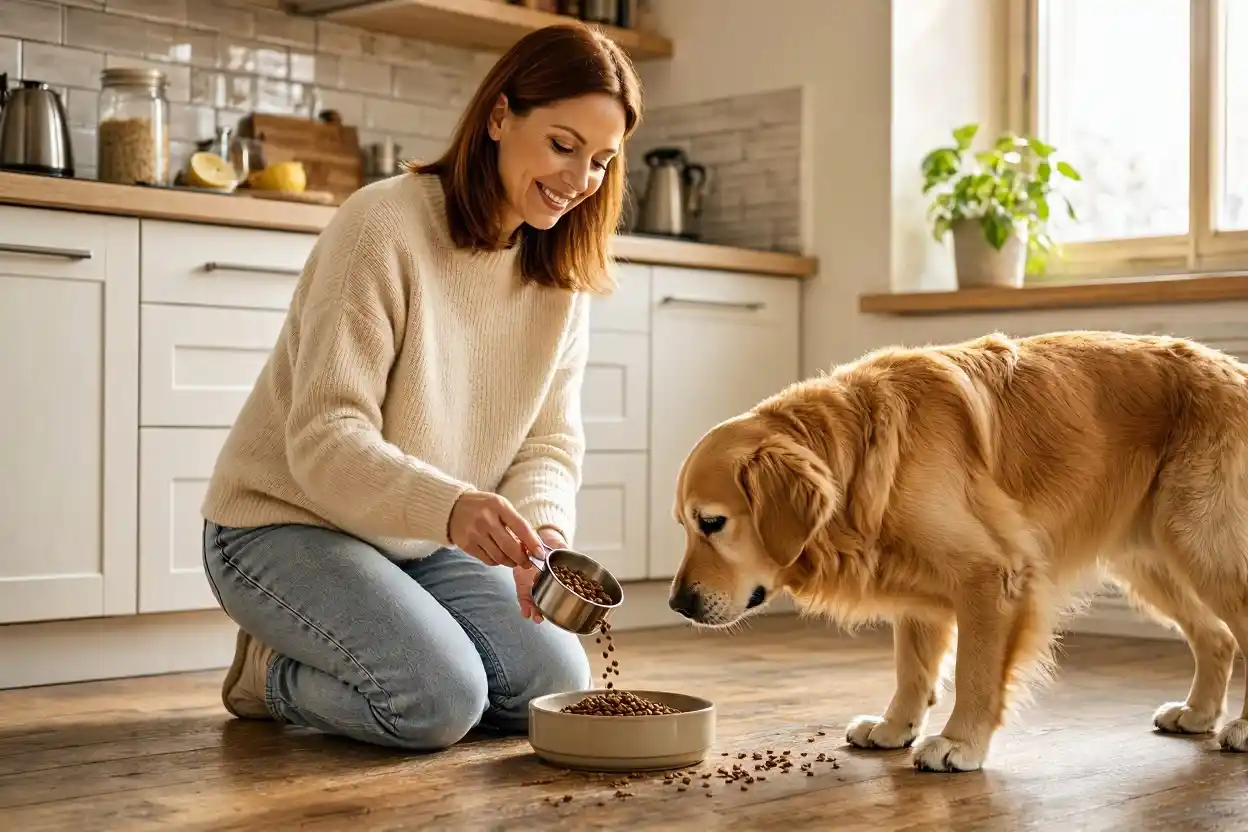
No routine guarantees safety. Still, small changes lower several risk factors at once, and they cost very little.
Meal Size, Frequency, and Slow Feeding
Feeding once a day was linked to higher risk in the 1997 study, so splitting the daily food into two meals is a sensible change. Smaller meals also put less stretch on the stomach. Slowing down a fast eater may cut the air your dog swallows, even though studies disagree on how much it matters.
A simple routine for an adult Golden:
- Feed two measured meals at consistent times, using the daily total your vet recommends.
- Use a slow-feeder bowl or puzzle mat if your dog gulps.
- Keep your dog calm before and after meals, with about an hour of rest or the time your vet suggests.
Rest Around Mealtimes and Water Habits
Many vets still advise a rest period around meals, and it costs nothing. Evidence on exercise after eating is mixed, so this is a low-effort precaution, not a proven rule. Skip hard play, long runs, and rolling around right after dinner.
For water, offer normal amounts and avoid letting your dog gulp a huge bowl right after a meal or a hard workout. Fresh water should stay available. If your dog drinks very fast, offer it in smaller refills instead of removing it.
Stress and Multi-Dog Households
A fearful temperament was linked to higher risk in the 1997 study, and a happy one to lower risk. You cannot change a dog’s personality overnight, but you can reduce stress around eating. Keep meals in a quiet spot and stay consistent with times.
In homes with more than one dog, feed them in separate areas. Competition can make a Golden eat faster and gulp more air. Plan ahead for events that upset your dog, such as boarding, travel, or visitors, and keep mealtimes calm and predictable during those periods.
Gastropexy: Preventive Surgery Explained
Gastropexy is a surgery that attaches the stomach to the body wall so it cannot rotate. It does not stop the stomach from filling with gas, but it targets the twist, which is the most dangerous part. Vets can do it as a preventive procedure in healthy dogs or during emergency surgery for GDV.
A BMC Research Notes study of 766 dogs of at-risk breeds found that none of the dogs with long-term follow-up developed gastric dilatation, GDV, or ongoing stomach and bowel problems after the procedure. Complications were rare and included bleeding into the abdomen and infection with partial opening of the wound. Short-term digestive upset can occur. The same paper notes an earlier report in which 11.1% of dogs developed gastric dilatation after gastropexy, so the stomach can still fill with gas.
Many vets offer the surgery at the same time as spay or neuter, though your vet can advise on timing. Techniques include open surgery and laparoscopic approaches. Questions to ask your vet:
- Is my dog a good candidate, given our family history and build?
- Which technique do you use, and why?
- What are the anesthesia risks for my dog?
- What does recovery involve?
- What is the full cost, in writing?
Common Bloat Myths vs. Facts
Some advice about bloat sounds sensible but does not hold up. Here are the ones owners hear most often.
| Myth | What the evidence says |
| Only giant breeds get bloat. | Large and giant deep-chested breeds face higher risk, but any dog, including mixed breeds, can bloat. |
| A raised bowl prevents bloat. | Studies conflict, and one large study linked raised bowls with higher risk. Ask your vet before buying one for this reason. |
| A bloated dog always has a visibly swollen belly. | Not always. A thick coat can hide swelling, and retching and restlessness may come first. |
| Anti-gas medicine fixes it. | It cannot untwist a stomach or release trapped gas, and trying it wastes time. |
| It is fine to wait an hour and see. | Bloat can worsen quickly. Call right away. |
| Gastropexy makes bloat impossible. | It aims to prevent twisting, but the stomach can still fill with gas. |
When a claim sounds too simple, check it with your vet. Bloat has many contributing factors, and no single trick covers all of them.
Build a Bloat Emergency Plan Before You Need One
Panic makes simple tasks hard. A plan on paper saves minutes when minutes matter. Set aside twenty minutes this week and work through this checklist:
- [ ] Save your regular vet’s number and the number of the nearest 24-hour emergency clinic in your phone.
- [ ] Learn the route to that clinic and the drive time at night.
- [ ] Decide who drives and who stays with your dog if two people are home.
- [ ] Keep a card with your dog’s weight, medications, vet history, and insurance details.
- [ ] Post the early and late signs on the fridge for everyone in the house.
- [ ] Review your pet insurance for emergency surgery coverage, waiting periods, annual limits, and exclusions.
- [ ] Ask your regular vet about gastropexy, even if your dog is young and healthy.
Share the plan with family members, pet sitters, and boarding staff so everyone knows to call a vet at the first sign.
Frequently Asked Questions
Can a dog with bloat still eat, drink, or poop?
Some dogs can. Early on, a dog may drink, pass stool, or even try to eat, so normal behavior does not rule out bloat. Retching with nothing coming up, restlessness, and a tight belly matter more. If the signs fit, do not wait for your dog’s appetite to disappear. Call the vet.
Can bloat go away on its own?
A twisted stomach will not untwist by itself, and you cannot tell at home which kind your dog has. Waiting risks tissue damage and shock. Treat every suspected case as an emergency, even if the signs seem to ease for a while, and let a vet decide what is happening.
Can bloat happen again after gastropexy?
The stomach can still fill with gas after gastropexy, but the attachment to the body wall is meant to stop it from twisting. In the 766-dog study, no dogs with long-term follow-up had dilatation or GDV, though another report found dilatation in 11.1% of dogs. Call a vet for any suspected episode.
Does dry kibble cause bloat?
Dry food has not been proven to cause bloat. Research links certain feeding practices, such as one large daily meal, to higher risk, but findings on specific food types vary. Talk with your vet about a diet and meal schedule that suits your dog instead of switching foods out of fear.
Does pet insurance usually cover bloat surgery?
Some accident-and-illness plans cover emergency surgery, but terms differ widely. Check waiting periods, annual limits, deductibles, breed-related exclusions, and whether preventive gastropexy counts as covered. Ask the insurer for written answers before you need the coverage, since emergency costs can arrive fast.
Key Takeaways
Bloat is a medical emergency, and a twisted stomach can become fatal within hours. Watch for restlessness, drooling, retching with nothing coming up, a tight belly, pale gums, and weakness. A thick Golden coat can hide swelling, so rely on behavior as much as on how the belly looks.
If you see these signs, call an emergency vet and go. Skip home remedies. For prevention, split meals, slow down fast eaters, keep mealtimes calm, and give your dog a rest period after eating. Ask your vet whether gastropexy makes sense for your Golden, especially if a close relative has had GDV.
This guide is general information and does not replace care from your own vet. Your next step this week: save the number of the nearest 24-hour emergency clinic in your phone and talk with your regular vet about your dog’s risk.

Hi, I’m Jack Austin, founder of Cool Goldens. I share practical, research-backed advice on training, nutrition, and daily care to help you give your Golden Retriever the happiest, healthiest life possible.